Robert Goldstein and
Robert Goldstein and "the Spirit of '76"
REVOLUTIONARY WAR ANTHOLOGY

Robert Goldstein's film Spirit of 1776 galloped from Paul Revere's ride straight through to Yorktown. Following seizure of the film by the government in 1917, Goldstein was jailed as an anti-British agitator until the Democrats were trounced from power in the 1920 General Elections. A copy might be somewhere in US government archives.

The essential plot was borrowed in 1924 by DW Griffiths for the film America which failed at the box office. Spirit may have also inspired The Howards of Virginia (available on DVD at Barnes & Noble.com).
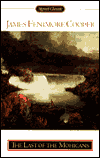
Last of the Mohicans

On DVD 1992 movie starring Daniel Day Lewis, Michael Mann and Madeline Stowe is impressive for the excellent score of colonial music:
Last of the Mohicans

. Goldstein's Spitit of 1776 was probably itself inspired by James Fennimore Cooper's Lionel Lincoln. Cooper's classic work on the Revolution The Spy was never made into a movie. Cinema goers of all ages have seen one of the many versions of The Last of the Mohegans about the French and Indian War (1754-1763) which has been made into more movies than exist in the entire Revolutionary War genre.

Although the Spy works on multiuple levels of irony in a cloudy layer of moral ambiguity, the penetrating story never was filmed. Likewise, many of the other great authors on the American Revolution would never see their works performed on the silver screen: Kenneth Roberts, Cornell Lengell, F Van Wyck Brooks, and Noel B Gearson.

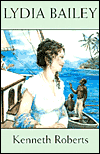
Lydia Bailey
Lydia Bailey

Kenneth Roberts's Lydia Bailey makes a tour de force over the problems of the young republic in dealing with foreign affairs in the uncertain Napoleanonic era.

Northwest Passage
Northwest Passage

The movie version starring Robert Young and Spencer Tracy (B&N) glides over the onset of Revolutionary agitation.

Kenneth Roberts the chronicler of Arundell in Maine from the French and Indian War through the War of 1812 did see Northwest Passage about the French and Indian War starring Spencer Tracy and Robert Young go to the screen. However none of Roberts writings on the Revolution: Arundell, A Rabble in Arms and the Battle of Cowpens never made it onto film. Curiously Lydia Bailey set against the sweep of the Haitian Revolution and the War with Tripoli made it to the pictures in two separate films: Lydia Bailey and Tripoli.

The movie version Lydia Bailey approaches race relations against the backdrop of the violence accompanying the rebellion in Haiti caused by the attack of the French Empire on the Haitian people who would have been quite willing to join the French in liberty equality and fraternity voluntarily. The Haitian War for Independence concerns racial issues Americans find difficulty confronting.

The movie Tripoli is poorly done and makes more of a mockery of that war than it already was.

The Young Republic scrounges for film titles with the Revolution. The greatest film on the young republic is the Buccaneer starring Charleton Heston. Buccaneer has an excellent battle scene which lasts on film slightly longer than the Great Turkey Shoot at New Orleans.

The Young Republic comes to the fore in Edward Evert Hale's classic short story The Man Without a Country about an officer sentenced to receive his wish: never to hear of The United States. The Man Without a Country has been twice converted into movies. Neither version is available on DVD.

HOWARD FAST ON THE REVOLUTION
Bunker Hill: The Prequel to the Crossing

Unvanquished
Unvanquished

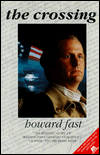
Crossing
Crossing

Howard Fast is one of the most prolific writers on the American Revolution, but his past as an American radical in the communist cause makes him one few super-Patriots would invite home to dinner. Fast claims to have been once proscribed on the infamous black list. Only The Clossing (available at Barnes & Noble.com) is sold on DVD.
The most prolific writer on the revolution was unquestionably Howard Fast who may not have wound up in the slammer but boasts of having been blacklisted in the McCarthy era. There certainly are underrcurrents of Fast's leftist ideology in The Unvanquished and Citizen Tom Paine, but there is a bitter irony: without writers like Fast, there would never have been a John Wayne.

Two of Fast's works on the Revolution made it to the small screen: April Morning starring Tommy Lee Jones and The Crossing. The Crossing is often used as a teaching tool on the Revolution.

Kent Family Chronicles
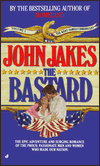
Bastard (The Kent Family Chronicles #1)

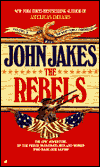
The Rebels (The Kent Family Chronicles #2)

John Jakes founded a new genre the multi-generation family sage when he put Philip Kent on his adventure from the Ancien Regime in France through hidebound England and into the upheavals on the New World. Only Bastard (Barnes & Noble.com) is available on DVD.
In the 1970s with the bicentemial year approaching John Jakes stormed onto the scene with his memorable Kent Family Chronicles, a family saga. All the volumes in the series were best sellers. The two earliest books in the series, The Bastard and The Rebels, deal with the Revolution and Revolutionary agitation leading to Independence. Both the Bastard and The Rebels made the small screen in a TV mini-series which enjoyed a wide audience in the bicentenial year. Regretfully they have not been replayed often.

Johnny Tremain
Johnny Tremain

Johnny Tremaine on DVD at B & N.
Despite the popularity of the Kent Family Chronicles in the bicentential era, Jakes is probably better known for North and South his Civil War tales.

Jakes Kent Family Chronicles became a best seller, but there are many parallels between the Disney classic Johnny Tremaine written by Esther Forbes and the character of Philip Kent, the grand patriarch of a line he founded. Esther Forbes may have invented a new genre by giving her character a physical disability he must overcome. Yet he stands in the firing line with the best of them.

Johnny Tremaine is notable for its excellent rendition of period music. The Liberty Song sung throughout is a version of the period song Heart of Oak.

The bicentenial year did bring out the cute musical 1776, often used as a teaching tool on the Revolution. 1776 is now on DVD at Barnes & Noble.com.

Devil's Disciple
Devil's Disciple

George Bernard Shaw took up the quill against the Crown in his marvelous comedy Devil's Disciple which went to film with a cast of Sir Laurence Olivier, Kirk Douglas and Bert Lancaster. Shaw's principal accomplishment in Devil's Disciple was a penetrating study of the personalities of those whose world views collided. In more recent years BBC made a new version starring Patrick Stewart of Star Trek New Generation fame. Regrettably the newer film with Patrick Stewart has never been re-released in America.

The Patriot
The Patriot

Mel Gibson is THE PATRIOT on Barnes & Noble.com.

Mel Gibson's bravura performance in the Patriot renewed interest in the Great Saga. Though the filn is criticized for graphic depiction of the violence in the War in the South, Ben Martin (Mel Gibson) as a member of the Assembly in his arguments against war and independence augured the destruction war would bring.

The violence in the Patriot has disuaded school districts from utilizing the film as a teaching tool.

Where Mel Gibson succeded as the Patriot Al Pacino flopped in Revolution. Revolution is highly recommended for much attention to detail in period music, clothing, flags and uniforms. Maybe the World didn't turn upside down when the British surrendered to the tune of Minstral Boy.

Drums along the Mohawk

Drums Along the Mohawk

John Ford directed Drums Along the Mohawk based on a Walter Edmonds novel about settlers in the Mohawk Valley. Downplaying British involvement in the war and attributing all British atrocities to Tories, Ford avoided direct conflict at least with the enemy's sensativities.

The enemy is advancing into the valley and the settlers huddle in the fort. There is plenty of fighting. The piece is well filmed and thought through although trickery and stealth rather than a great final battle won the day at Fort Stanwix.

Despite the many patriotic themes in John Ford's works, Ford seems to have overlooked that the US flag was first unfurled in combat at Fort Stanwix. Ford does recount the hardships borne by colonial women who cut their hair off to defend the ramparts at Fort Stanwix.

Dark Eagle: A Novel of Benedict Arnold and the American Revolution

Aidan Quinn Kelsey Grammar in Matter of Honor at Barnes & Noble.com.

Kelsey Grammar is more than a good listener when he took up the role of George Washington in Matter of Honor. Aidan Quinn plays Benedict Arnold with a fatalism worthy of a Shakespearian tragedean.

"Oh, what have I done!" moans Arnold.

The made for TV film compares favorably to Scarlet Coat the 1955 film dealing with the Andre affair.

John Light played Major Andre with the same gentility as Michael Wilding in the older film.

Matter of Honor has a few minor historical errors including failure to record Andre's promotion to major.

Anthology © 2003 by HA Andrews ALL RIGHTS RESERVED

HA Andrews is RPPS Commandant and maintains the RPPS Cultural Service.


Arthurian Legend * FULLOSIA PRESS * * FULLOSIA * * * RPPS CULTURAL SERVICES