
Wed. March 19.2003 1:16 PM EST
by Gil Kaufman
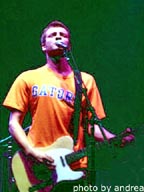
Joe Sumner - don't call him Sting's son - carves his own piece of the music puzzle.
Call it the Osbourne dilemma. Do you pull a Kelly - meaning use your father's stardom to launch a music career - or an Aimee - lay low, bide your time, and do it on your own?
For Joe Sumner, there was only one answer. Ditch the name, try to
fly under the radar, and forbid your label's publicity team from ever mentioning your superstar dad. It's hard to believe the Fiction Plane singer will remain incognito after people hear the band's addictive debut, Everything Will Never Be OK. From there forward it's pretty clear the bandleader could only be the son of Gordon Sumner, a.k.a. Sting.
"Sometimes I hear it," said the soft-spoken 26-year-old of the resemblance to dear old dad. "There used to be even more [similarities], but my voice has changed." Sumner's vocals on such anthems of ennui as "Cigarette" (featuring the pull-no-punches lines "Touch me cause my daddy's rich/ Marry into bigger fish") are eerily reminiscent of his father's work on early Police records. But Joe has definitely succeeded in blazing his own trail. Schooled both in the U.S. and London, his jaded worldview probes where dad's music soothes.
The band - featuring bassist Dan Brown, guitarist Seton Daunt and new recruit Peter Wilhoit on drums - came together over Sumner and Brown's love of Nirvana. Their more tangible inspiration, though, can be found in the impassioned, big-idea rock of U2.
So forgive Joe if he's a bit reluctant to discuss the pleasures of growing up with a father who's one of the world's biggest pop stars. As VH1 found out, he'd rather talk about how everyone tried to convince him he was a crap singer and how "Smells Like Teen Spirit" turned him into a "greasy freak."
VH1: When did you realize you wanted to be in a band?
Joe Sumner: Me and Dan got into Nirvana when we were 14; that's when we formed a band. He played piano and I played guitar. I wanted to be the singer, but I couldn't sing.
VH1: Did someone tell you that?
Sumner: Yeah. And Dan said we should get a different singer. Eight years later someone said, "Okay, fine, you can sing."
VH1: Why did you want to be the singer?
Sumner: I felt like I could do it. The words in the songs seemed very important to me. To be able to express them is my favorite thing.
VH1: I read that you almost gave up music before you discovered Nirvana. How did they turn you around?
Sumner: I had no interest in music before that. I was more into video games and drawing. I heard "Smells Like Teen Spirit" and I got turned into an insane, greasy, unwashed freak overnight. It was the energy that captured me, because the words are indecipherable unless you have them written down. I'd never heard anything like it. Plus, it wasn't just pop music, which I hated.
Dan Brown: It wasn't about what you looked like or fitting into this fashionable scene. It made music seem more accessible. It was like [Nirvana decided,] 'we could try to make music as well.'
VH1: Several Fiction Plane songs have a pessimistic tone to the lyrics, but a buoyant sound to the music.
Sumner: The lyrics are not exactly negative, but they're qualified with a bit of ... something. It's a Trojan horse. You have a happy song which people like, and then you have lyrics that really make you think. [It's a bit different than] having both elements completely down and depressing.
VH1: The old "tricking people into thinking" scam.
Sumner: I hope so.
Brown: We're not miserable people. The lyrics are about finding a way to enjoy life. That's what we're seeking. "Everything Will Never Be OK" is about realizing that life is not perfect and that things always go wrong, but that it's okay. The music can be quite jolly and the lyrics quite dark ... we don't want to be a miserable band. We want to make music that's fun to sing along with and dance along to and get off on.
VH1: "Soldier Machismo" seems like a perfect song for these edge-of-war times.
Sumner: I wrote it in December of 2001, when we were going to war in Afghanistan. I was thinking, "What are they doing, actually?" It's a question about who are they protecting us from?
VH1: It's a kind of aggressive pacifism.
Sumner: That's what we really need right now. The [peace movement] is very aggressive right now. [Dissension] works ... people are questioning what's going on.
Brown: We all felt outraged by some of the things that happened in Afghanistan. The idea of "collateral damage" is not acceptable to us. Hopefully the lyrics will make people question the use of military action, especially in the current climate. We're so far removed from everything that we think of people in Iraq as cattle who can be slaughtered. But they're real people with lives.
VH1: Okay, be honest. What's easier, pretending your dad isn't Sting, or just saying, "Whatever," and letting people know and accepting that they'll treat you differently?
Sumner: We just do what we do and whatever happens ... If people decide to hate us for that reason, we'll just keep on playing. I can't dwell on it for too long.
VH1: How has Joe's background affected the band?
Brown: I think he's now totally aware that it's inescapable. People will know who he is and certainly it gets mentioned a lot in the press. What we try to achieve as a band is to not sell ourselves on that fact of who he is, like some famous sons have done in the past. We are a real band with something we're really proud of. The hard thing is to win people over on our own terms.
VH1: You have it in your contract that no promotional materials can mention the Sting connection. Did you have a conscious decision that you were going to make it on your own, no matter what?
Sumner: Yeah. If I had done it the other way, I would have been very unhappy. It would make me go insane, like, "Oh, everyone likes these songs." And it wouldn't be true. I like to feel like I'm qualified to do this job.
VH1: The title "Hate" pretty much sums it up. But, again, you mix that dark lyric with some seriously soaring rock.
Sumner: It's about going into a place where you only look at other people and don't really think about yourself. That happens if you watch a lot of TV. You think, "People in the world are so f*cked up, and I hate all the music on TV and all these people are so stupid." The reason the song is so anthemic is because I think millions of people are doing that, criticizing society from afar. It's so easy to switch off and not actually do anything about the way you act. I'm definitely not excluded from that bracket.
VH1: You never studied music, and people said you couldn't sing, so, did you have a back-up plan? Did you study a trade?
Sumner: Not really. I've always thought this is the only thing I can do. I did a degree in environmental studies in London at Richmond College, which helped me with lyrics.
VH1: What's your earliest memory of music?
Sumner: We had a piano at the bottom of the stairs and I'd go down and play and put the echo pedal on and play three notes for two hours. That was when I was six or seven, before I thought music was really interesting. I'd get lost in the resonating noises.
Brown: I remember writing my first song when I was seven, an instrumental piano piece. I remember thinking, "Wow!"
VH1: Did you realize at the time that what your dad did was make music?
Sumner: Not really. There were a lot of instruments in his house, but I grew up with my mom in London.
VH1: What was the first album you owned?
Brown: Probably a Duran Duran album.
Sumner: The Specials. I bought it with my allowance just before Nirvana broke, when I was 13.
VH1: Why that one?
Sumner: I heard a few of the songs and I thought it was really cool the way they had issue songs. "Concrete Jungle" I thought was cool because they swore in it.
VH1: What was dad's advice about getting into the business?
Sumner: He told me to study scales and chords and f*ck the rest of it. Let the rest of it happen.
VH1: Ever think about just changing your name to avoid the questions?
Sumner: I did that for a while and it started coming up worse. I went as Mendez, a completely fictional name.
VH1: Can you think of a concert you've seen where afterwards you thought, "This is what it's all about."
Sumner: I saw Coldplay at the Glastonbury festival last year and they did their new album without anyone having heard it. It was an audience full of expectations, but totally listening to the music and experiencing it for the first time. That was a magical show.
VH1: Name a song you wish you'd written.
Sumner: A lot of songs by Pavement. "Paranoid Android" by Radiohead, and I wish I'd produced or played drums on the new Roots album.
VH1: Sting or the Police? Which do you prefer?
Sumner: No comment.
Brown: Oh, God. I don't know how I can answer that question. You git! Um, I don't listen to either.
