
Ah, perspective. This is an area that many people struggle with, when, in its simplest
form, it is probably among the easiest of the concepts you have yet to learn.
You already know that objects appear smaller than they really are when seen at a
distance. Were you to look around you, you would see that in evidence. Perspective actually
follows lines, which simplifies things considerably. Objects that have When only one vanishing point is in use, we are utilizing the principle of One Point
Perspective [Study "A"]
For this study, I followed my mother's suggestion and scanned photographs with the
lines of perspective and the vanishing points drawn on them. Its easier this way, trust me. For
the record, perspective is a boring, albeit necessary lesson.
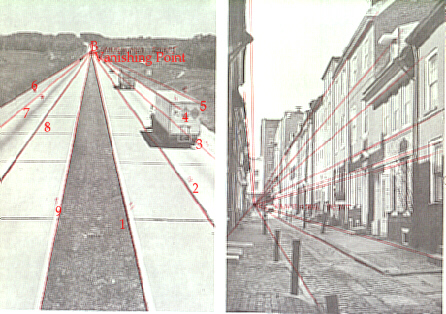
Now. In Study "A", (which I forgot to label, and which shall heretofore be known as "the truck picture")
we're looking at a picture of a freeway with trucks and the like on
it. I've assigned a numerical value to each pair of perspective lines so that you will better be able
to follow me here. All those lines get a bit confusing.
Study "A" is, as we said, a one point perspective, meaning, it has a single vanishing point
(B). The function of lines one and nine is fairly straightforward. They outline the meridian in the
centre of the freeway. Two and eight, likewise, are obviously the division between the first and
second traffic lanes. Three and seven are the same. The presence of the truck in that view does
not interrupt the line of perspective. It remains the same. This may seem obvious, but I've
encountered a number of people who believe the presence of an object somehow nullifies the
existence of a perspective line. Crazy, eh? Anyway, lines four and five are present to designate
the tops of the two trucks. In essence, the lines trace the pattern of the dominant subject(s), in
this case, the highway and the two trucks.
Easy, right?
Study "B" is another one point perspective, this time, a little more complex because of
the nature of the picture. Again, the lines of perspective follow the angles of the dominant
subjects.
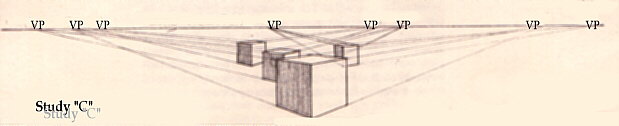
Study "C" is an example of multiple vanishing points, and is an model of how horrific
perspective can be. Thank god for old Practice following various paths of perspective. This is an area where it will do you justice to be
creative, and to equip yourself for every contingency. Possibilities for perspective are limitless.
Remember that, having either physically or mentally staked your lines of perspective, it
is now required that your work follow them. All that means is that all your parallel lines find a
vanishing point. Here again, logic comes into play. Really, the only rules you have to adhere to
are to remember that the closer you get to the vanishing point of your drawing, the smaller your
subjects are going to appear, and the less detail they are going to have. Be mindful of the
proportion, however, as people often tend to over exaggerate the difference in scale from
foreground to background. How your subjects relate to one and other is as important as
following the lines of perspective themselves.
This seems like a primitive exercise in drawing, until you take into account that every
drawing has a perspective, and that proportionality in perspective can be difficult to master.
Stick to your imaginary lines of perspective while instigating your masterpiece and you'll be fine.
A few good rules are:
Determine how many vanishing points your subject had. That is; how many parallel lines must be
utilized
For the first while, lightly pencil in perspective lines until you are well enough acquainted with
the process to merely visualize them
Remember that all pictures have perspective, and that proportion is easier to assess if you
use lines
Subjects in the foreground will be larger and more detailed than subjects in the background.
All featured subjects in a given work should relate
If all else fails, go with what you think you know. If its wrong, some talentless critic will point
it out, I'm sure.
 parallel sides follow
perspective lines that converge at a point in the background called "the vanishing point" when
viewed in perspective. In other words, lines that are equidistant in reality appear to angle
together in the background.
parallel sides follow
perspective lines that converge at a point in the background called "the vanishing point" when
viewed in perspective. In other words, lines that are equidistant in reality appear to angle
together in the background.
 High School art classes, or the only examples of
perspective you would have would be one point. There is no way in hell I ever intend on
repeating that particular assignment.
Over all, aside from doing a few practice runs with different perspectives, there's not a
lot you can do for this tutorial. The main point of it is that you begin to relate the perspectives
you see in every day life to this lesson. Just as you are to remember to reorganize your
surroundings into geometric arrangements, you must also remind yourself to analyze different
perspectives as well. Perspective can adopt many vanishing points and every point of view.
High School art classes, or the only examples of
perspective you would have would be one point. There is no way in hell I ever intend on
repeating that particular assignment.
Over all, aside from doing a few practice runs with different perspectives, there's not a
lot you can do for this tutorial. The main point of it is that you begin to relate the perspectives
you see in every day life to this lesson. Just as you are to remember to reorganize your
surroundings into geometric arrangements, you must also remind yourself to analyze different
perspectives as well. Perspective can adopt many vanishing points and every point of view.
