
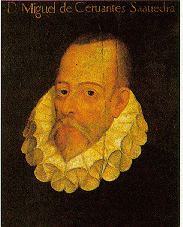
What we know of Cervantes's life is the result of a long series
of
inquiries begun during the first three decades of the seventeenth
century. But the most significant contributions have been those of
scholars in the early part of this century, especially Cristóbal
Pérez Pastor. The documents that have been published through their
efforts come from public, parochial, and notarial archives, and they
generally refer to Cervantes's captivity, the posts that he occupied
in Andalusia, and certain other important events in his life. Few of
these documents, however, cast any light on his life as a writer,
much less on his personality. We need a methodical commentary on
these documents to bring up to date the sketch which James
Fitzmaurice Kelly published in Oxford in 1917: Miguel de Cervantes
Saavedra; reseña documentada de su vida. We also need a critical
biography worthy of the name. Luis Astrana Marín's big book Vida
ejemplar y heroica de Miguel de Cervantes Saavedra (Madrid,
1948-1958, 7 vols.) suffers from a less-than-solid methodology as
well as a number of personal biases. Still it contains a
considerable
amount of information and so remains an essential work
of reference.
Rosa Rossi's essay Escuchar a Cervantes (Valladolid,
1988) attempts
to do away with the idealized portrait of Cervantes
by interpreting
his life as the confluence of his supposed Jewish
origins and his
latent homosexual tendencies. Certain recent
biographers--such as
Andrés Trapiello (Las vidas de Cervantes,
Barcelona, 1993) and, not
without a hint of scandal, Fernando
Arrabal (Un esclavo llamado Cervantes,
Paris and Madrid, 1996)--have
revived the tradition of romanticized
biographies in which the
biographer's personality obliterates that
of the writer whose life
is the supposed subject.
