Master Thespian
Master Thespian

(Looks Best Using MS Explorer 5.0 Using 'Smaller' or 'Smallest' Text)
Auditions
Last Updated
January 8th, 2001
|
| |
Cold Readings
 Audition Tip Number One:
- Cold Reads: If you're like me you probably thought that at a 'cold read' audition, everyone auditioning would be reading from the script for the very first time. Har! A 'cold read' audition is simply an audition where in addition to, or in place of, performing two contrasting monologs, you also read from the script. But it is anything but 'cold' for most of the actors auditioning. You should get the play (see below) or request 'sides' (pages from the play with your character speaking usually available from the casting people) at the very least three or four days before your audition.
- Personally, to obtain the play I am contemplating auditioning for, I travel to the main City of Phoenix Burton Barr Library.
 By not looking at the bums out front of the library, I ignore their facile pleas and bravely enter the lobby. I've visited the toilet before I leave my place, so I don't have to worry about being assaulted in any of the library's public rest rooms which are also usually the living rooms of the afore mentioned vagrants. (Some former actors, no doubt.)The main library in your city will usually have a copy of most all plays, unless you are in San Francisco and then all you will find is 1500 copies of Angels in America (That's a joke). By not looking at the bums out front of the library, I ignore their facile pleas and bravely enter the lobby. I've visited the toilet before I leave my place, so I don't have to worry about being assaulted in any of the library's public rest rooms which are also usually the living rooms of the afore mentioned vagrants. (Some former actors, no doubt.)The main library in your city will usually have a copy of most all plays, unless you are in San Francisco and then all you will find is 1500 copies of Angels in America (That's a joke).
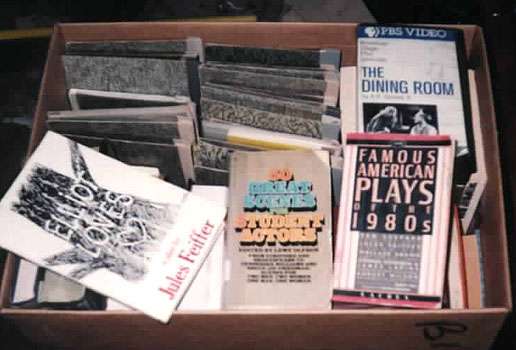
- The play you are searching for also could be in a volume that contains a collection of plays, often titled something similar to, "Best Plays of the Sixties". Note that these are usually abbreviated versions of the play so use them as a last resort. Sometimes, because the plays inside these "Best Plays" books are never entered into the library's computer data base, the only way to locate plays hidden in these large volumes is to read the 'Contents Page' in every volume.
- Go now and check out the play as soon as possible, do not wait until one week before auditions. If you wait, other actors more dedicated than you will have already checked 'your' play out.
- If you are really serious about this acting 'thing', and you don't have money to burn, you should be aware of all the used-books sales going on in your community. For when these sales arrive, you must attend them and scarf up all the interesting (to you) books about acting and all the play titles that look familiar to you. Recently, at such a sale, I picked up the plays, I Never Sang for My Father, by Robert Anderson and William Inge's Picnic for less than the price of a pack of Juicy Fruit gum. Hell, for $20 you can easily walk away with titles that you would have paid $300 for at Border's Books !
-
If there is a list of characters, usually at the front of the play, (Dramatis Personae), read the list. Do any of those characters 'fit' you? 'Fit' your type? For instance, if you are 49, male, five foot ten inches and weigh 270 pounds and the character called for is a sixteen year old Olympic gymnast, that is not your 'type.' Just starting out, you can ask your acting teacher or honest friends to help you narrow down your type. For your acting teacher you can simply ask, "What's my type?" For your honest friends, you can approach them with, "What kind of person do I look like? A married person? A judge? A waitress. A sophisticate?" The types suggested are not iron-clad, the are just to give you an idea. After you've been cast in four or five productions you'll have pretty much figured out your type. Sometimes, you can phone the casting people and honestly describe yourself to them and they will gladly inform you if your 'type' is included in the play. Once you read the play, you will usually be aware if your type will fit into the play. I only mention this 'type' stuff so you won't be embarrassed by showing up at an audition, where everyone (but you) knows there is no way in hell you can be cast. They know because your type just doesn't mesh into this particular play.

-
If the character list does not rule you out, read the play, keeping an eye out for the character(s) that you, Number 1: would enjoy playing and Number 2: could play. Know your current limitations, for the character you would enjoy portraying may be beyond your present abilities, or not. You decide. After you've read the play, you now know the circumstances involved and the relationships churning through the chapters. You can now make informed character choices. For instance, rather than guessing if Gene Garrison gets along with his father Tom, in I Never Sang for my Father, after reading the play you realize that they basically hate each other.
 How to read a play to determine if you would actually, in your heart of hearts, want to put in the twenty to thirty hours per week to be seen in it. How to read a play to determine if you would actually, in your heart of hearts, want to put in the twenty to thirty hours per week to be seen in it.
- The first thing I do, is to read the back of the play book in order to become aware of what the play is about. I'm checking to see if it is about a subject that might promote anything I am in great objection to. For instance, I believe abortion is murder, so if the playwrite appears to promote abortion as a legitimate, moral means of birth control, I would probably not audition for that play. Naturally, you need to make your own decisions on these matters.
- Then I open the play book and I thumb through the pages pencil-marking and reading only the scenes my character is in. I do this to see if I can get a quick understanding of the play, a grasp of what my character and the other characters are about, and to count lines.
 Oh no! Master Thespian, a line counter? Yup, I count da lines because, unless I am desperate to break into a certain production company or media or work under a gifted director or with a brilliant actor or close friend or just to do a favor, I am not willing to devote well over one hundred hours of my life just to utter twenty two lines. Also, consider what your character is saying, don't just skim through the words. If your character is saying something that grosses you out or assaults your image of morality or propriety, maybe you don't want to play that character. In example, the play Pterodactyl's that I am currently preparing a cold reading for, I see where one of the characters says something to my character that is really sick. It's something I have no desire to say on stage ... ever. But since the words are directed at my character, rather than spoken by my character, I don't have a problem with it. Oh no! Master Thespian, a line counter? Yup, I count da lines because, unless I am desperate to break into a certain production company or media or work under a gifted director or with a brilliant actor or close friend or just to do a favor, I am not willing to devote well over one hundred hours of my life just to utter twenty two lines. Also, consider what your character is saying, don't just skim through the words. If your character is saying something that grosses you out or assaults your image of morality or propriety, maybe you don't want to play that character. In example, the play Pterodactyl's that I am currently preparing a cold reading for, I see where one of the characters says something to my character that is really sick. It's something I have no desire to say on stage ... ever. But since the words are directed at my character, rather than spoken by my character, I don't have a problem with it.
- Be sure to read the playwrite's notes. (These are the italicized words in parenthesis littered throughout the play. If you've ever read a Tennessee William's play you are quite familiar with these.) While these notes are often ignored by both actors and directors, they are just as often carried out. Watch especially for blocking notes. The play I'm in now has a wrestling match that had I read about it and realized that it was a wrestling match, I would have gone back into the gym prior to rehearsals. (Yeah, I know, actors are always supposed to be in good physical condition. But when one is on the cusp of three hundred pounds fitness has long passed.)
- Do not memorize the lines and do not use a monologue from the play for any of your audition pieces. It is fine to be very familiar with the lines, just short of memorization. Why? Because if you walk in with the lines already memorized the auditors may come to the conclusion that the performance you give today is the best you can do.
- Do, at home, at acting class, or in the line at the grocery store, try out blocking (movement) and different voices, projection, etc. for the characters you think
you might be asked to read for. Unless the audition notice requests a specific accent, just use your normal voice.
- Now, when you show up at the audition, you'll be calmer and better prepared and more relaxed and more able to strut your stuff. Yes!
|
 Audition Tip Number One: