
|
Home
Newsletter Index
ARTICLES:

This year I decided to weave a strip for each card, using as inspiration a long tablet-woven belt from Tunisia on display in the ethnographic wing of the Israel Museum. I've admired it since we first arrived in Jerusalem.
I figured out how to achieve its textures and patterns and I made up two narrow sample warps, each one yard long. One warp had eleven tablets for the border and the other had twenty tablets to try out the letters. They went very well, and so I went the whole nine yards (figuratively as well as literally), planning to weave a 6" piece for each card. I calculated that it would take about an hour for each one and that seemed reasonable to me; I would be thinking of each recipient as I wove their strip.
Well, there was a great difference between the samples and the nine-yard 60-tablet (240 threads) warp, so that it took me not minutes or hours, but days to weave the first one. All kinds of technical difficulties arose, all related to variations in tension between the threads. I realized that I'd never get 51 cards woven in time for the holidays, so I decided to weave one longer strip, 16" long, including border bands and the year, as well as the greeting. Yosef, my husband, took a picture of it and I mounted it on card stock, with a tassel so that one can see the actual colors and feel the texture of the yarns.
When Yosef and I went back to the museum, I stopped to look at the belt in which Ellie Hadad had woven his name and the date, decades ago. I found to my delight that while his belt was the source of my weaving, I had internalized his design and made it my own. He used wide borders so that his proportions of triangle-stripes to the center are 2:3:2, while mine are much narrower. The colors he chose were pastels, pale dusty pink, light slate blue, soft rose, cream, and black in the edge patterns, cream and pale sage green in the checkerboard and lettering. I rather enjoy my selection of these offshoots of the three basic primaries--the touch of earth brown and the soft celadon grey of the background. He used much finer threads than I did, and his letters thus have more detail.
Throughout the solving of all the tension problems, I remained calm, knowing that somehow I'd come through all this with a sample for my greeting cards. Believe me, I now understand tablet-weaving more thoroughly than I ever did before. I'd be interested to learn from the museum ethnographers whether Jewish Tunisian weavers had special narrow looms to control the warp tension on their tablet-woven belts or whether they worked from a free-hanging chain as I did. I now have eight more yards of this warp, still threaded up in their cards for additional projects throughout 5760 (soon to coincide with 2000).
[L.C. asked that his name not be used because male knitters are very unusual in Belgium. A scan of two of his doilies will appear in the Web newsletter.]
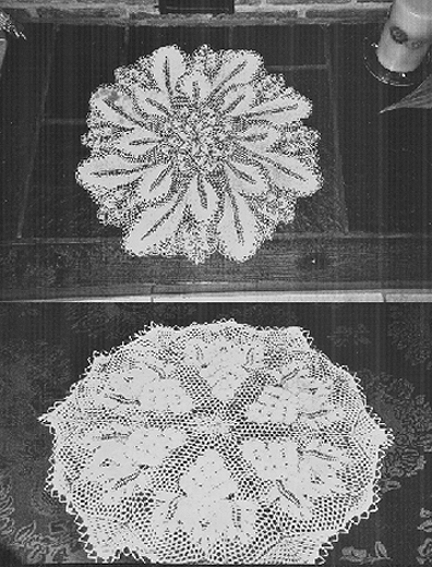 I am 23 years old and live in Aalst, some 30 km from Brussels, Belgium. I have a degree in management support and started training as a Russian-German translator in September. As a full-time student I have little time left for hobbies, but I try to make the most of every free moment. My two biggest passions are music (I take lessons in classical singing) and--strangely--lace knitting. It's unusual enough for someone to be as passionate about knitting as I am in Belgium, and it's even more remarkable for a man to knit, but I find it most relaxing. It keeps your mind off the little everyday worries, and finishing a project is enormously rewarding. Looking at my creations fills me with a feeling of tremendous pride, because I know that few people are capable of, or find the courage, to make such pieces of unbelievable beauty and elegance.
When people hear of Belgium, they usually think of chocolate and waffles, but anyone interested in lace will undoubtedly be familiar with our rich lace tradition. Flemish laces, especially Bruges bobbin lace, have the reputation of being the finest and most exquisite of all. Cities like Bruges and Brussels inevitably evoke the image of idyllic lace shops and lace workers in traditional outfits. The craft has been passed on from generation to generation and still quite a few lace makers carry on the tradition. Even now the lace industry is an important part of our economy and tourism. But unlike bobbin and needle lace, knitted lace never achieved the same popularity. If knitting ever was a beloved pastime, it was so for articles of fashion, rather than decorative knitting such as lace. However, in recent years a revival of old crafts is noticeable, among them lace-knitting. People are escaping reality, if only for a few moments, by turning to needlecrafts, and the Internet has made information about crafts and the required materials so much more accessible.
In general, craft supplies are easy to obtain where I live, as long as it's nothing special. I don't really have a favourite yarn shop. I use DMC crochet cotton for my tablecloths. My first projects were made from cheap cotton imported from Turkey. It is sold in Brussels, where a lot of immigrants live. The price of these yarns is very tempting, but experience has taught me there's no point in saving a few dollars (actually Belgian francs) for materials that may be poor quality. You want your tablecloths to last for a lifetime and perhaps pass them on to your children. Besides, if you take into account the amount of time that goes into making a large tablecloth, the extra cost is worth it.
I have been knitting for as long as I can remember. My mother, who passed away three years ago, was an avid knitter, and it was she who taught me the technique. She liked sitting outside on a chair in front of our house, always with a piece of knitting in her hands. She knitted sweaters for me and my two brothers. I was fascinated by the way her hands formed stitches with needles and yarn and thus creating beautiful sweaters. One day I said to her, "Teach me how to do that!" And so she did. I was hooked from the very first moment. I must have been seven- or eight-years-old then. From then on there was no end to my knitting ambitions. It started with toys and dolls, then sweaters and socks, and soon I entered the exciting world of knitted lace.
My mother bought me a Burda lace magazine with a gorgeous tablecloth on the front page. She told me about her childhood and how she learned to knit lace from the nuns at boarding school. "I made tablecloths of more than 200 rounds!," she was always saying. When I asked her where these tablecloths were now, she answered they got lost somehow over the years. It would have been wonderful to see her work. Maybe the tablecloths will show up again some day.
Meanwhile, I knitted the beautiful tablecloth from the magazine. It is called "Goldregen" and was designed by Herbert Niebling, also a man and my favourite designer. I've done a few of his smaller cloths as well, and I plan to make the "Steinrose" and "Adelaide," both over 300 rounds! My latest piece was the Daffodil tea cloth by Marianne Kinzel--if you ask me, she is the only designer whose work can compete with Niebling's masterpieces.
During my childhood I had a habit of starting a project, knitting a few rows, and then quitting. I always wanted to try new stitches, new yarns, new patterns. This explains why only a few things I started got finished, but at the same time I learned a lot. Besides knitting, I taught myself to crochet from my mother's books and magazines. Knitting has few secrets left for me. People are always asking me, "Isn't it frightfully difficult to knit lace?" Not at all. The knitting itself is child's play, until you drop a stitch and have to pick it up some 10 rounds down under. You are lucky to restore the damaged piece, if you can find the fallen stitch at all! I always make a lot of mistakes and I spend hours ripping out and reknitting rows.
What makes lace-knitting difficult are the fine materials that are used and, above all, the time and patience required for a large tablecloth. Like most lace knitters, I started with regular bedspread cotton and large needles. Gradually I began to use finer threads and thinner needles. In fact I have stopped using anything larger than 2 mm needles and size 80 crochet cotton. I even regret that the very fine crochet yarns that were available in the past are no longer being produced today.
The lack of genuinely fine materials has forced me to turn to other needlecrafts, where truly fine threads are still being used. Bobbin lace seemed the obvious choice, the threads to make it being readily available locally. I purchased a few cones of extremely fine cotton and linen and, while knitting a few samples from them, I got interested in the manufacturing process of lace threads and eventually spinning. I started reading about historic laces and the threads that made them, and became intrigued by the splendid Flemish laces of the 17th and 18th century. Until recently I knew very little about bobbin lace, although I did try it once as a child, among other things. Now I wish I could go back a few centuries to see how these wonderful achievements were created. That's how my obsession with finer and finer threads was born.
Through the Internet I learnt about the gossamer-like shawls from Shetland and Orenburg, fine enough to be pulled through a wedding ring. There's something mysterious and fairytale-like about these shawls. The yarn for them is so exceptionally fine that it cannot be spun by commercial machines. It could only be spun by hand. I realized that if I ever wanted to knit such a shawl, I would have to find someone who would be willing to spin the yarn for me or to spin it myself. I decided to have a try.
I saved for a spinning wheel and started practicing. I'm definitely planning to knit a ring shawl in the near future, perhaps next summer or so, if my spinning advances and if I succeed in spinning a sufficient quantity of yarn by then. Spinning is becoming as important to me as knitting is, and I would like to explore all possibilities of the craft. I'm optimistic. It's a real challenge, but so many knitters have achieved this before me, so why shouldn't I succeed?

The girls of the guild! L to R: Avital, Haya, Jennifer, Althea, Donna

Althea and Avital
Our first guild meeting of the year was held at Donna's house in Ein Kerem, and attended by Althea (welcomed after a long absence because the current Intifada is keeping her housebound in Bracha), Jennifer, Haya, Ethel, and me. Donna fed us all very well. Those of you who didn't come to the meeting missed the Greek salad, Moroccan pastries, sunflower bread, cheeses, coffee and tea, and witty conversation! We knitted, chatted, and passed around books and magazines. Jennifer brought her digital camera and I will post a couple scans in the Web newsletter.
