|
The ABC's of Art Styles, Movements, Schools and Periods
After information has been compiled in/out of class, results shall be posted for student's reference. Individual's will be required to do his/her own research and share results with the rest of the class. Compiled information will be the students responsiblity for quiz/test material.
ABSTRACT EXPRESSIONISM
Vocabulary Terms
Abstract Expressionism: A school of Painting, originating in New York in the 1940's that combined abstract forms with spontaneity of artistic expression.
Gesture Painting: Action paining. In abstract art, a form of abstract expressionism that emphasized importance of the physical act of painting. The term was coined by US art Critic Harold Rosenberg, 1952.
Color Field: Paintings with solid areas of color covering entire canvas. Artists were interested in the lyrical or atmospheric effects of vast expanses of color. Filling the canvas and by suggestion, beyond it to infinity. Very large paintings, meant to be seen up so close that the viewer is immersed in a color environment.
Non-Representational: Of, or relating to, or being a style of art in which natural objects are not represented realistically, nonobjective.
Artists
Jackson Pollock, Robert Motherwell and Franz Kline; Clyfford Still and Mark Rothko
Influences and Time Period
Societal Comments, Events, Influences
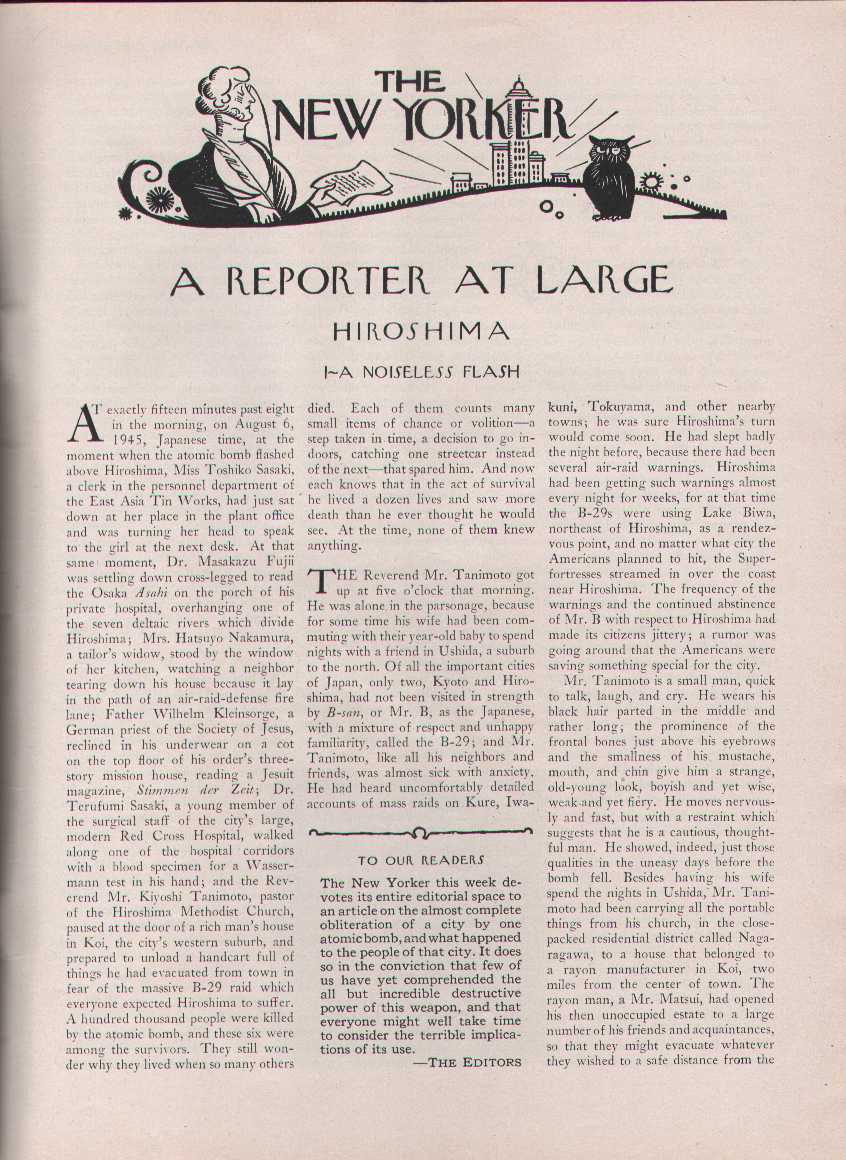
....In 1945, the US drops the atom bombs on Japan. In 1946John Hersey, author of HIROSHIMA, wrote an excellent account of survivors. Click here to see/read the original NEW YORKERS first page tribute to this write and his book.
....In 1944, the first digital computer was completed.
....All Abstract Expressionist were influenced by existentialist ideas, which emphasized the importance of the act of creating, not the finished product.
....In 1939, WWII begins. In 1941, Japan attacks US at Pearl Harbor. In 1941-45, 6 million Jews were murdered by German Nazi's.
....In 1949, George Orwell publishes Nineteen Eighty-Four.
....Abstract Expressionist sought to express their subconscious through art. They also shared in interest in Jung's ideas on myth, ritual and memory. They saw painting as a way of life, and themselves as disillusioned commentators on contemporary society after the depression and WWII.
ART NOUVEAU
Vocabulary Terms
Art Nouveau: French for "New Art". A style of art, architecture, and decoration popular in the 1890's that used stylized natural forms/flowing lines. Figures were elongated and in some cases distorted and its practitioners relied oheavily on plant forms; tulips, lily pads and thistle heas being particularly favord. A style distinguished by its sinuous curves, swirling lines and ethereal quality.
ethereal: very delicate or highly refine; very light, airy or insubstantial; belonging to the heavens or celestrial sphere.
aesthetic: sensitive to or appreciative of art or beauty; leasing in appearance.
Artists
Drawings-Lous Anquetin, Aubrey Beardsley, Edward Burne-Jones, Alphonse Much and Jan Toorop. Architeture - Gaudi and Horta. Furniture - Mackintosh. Glass - Wisteria of Tiffany.
Influences and Time Period
Symbolism, Pre-Raphaelites, Arts and Crafts movement and Aesthetic Movement; 1858-1914
Societal Comments, Events, Influences
....In 1880, Tchaikovsky writes the 1812 Overature. Click here to listen to a sample clip of this composition.
....In 1893, New Zealand becomes the first country to allow women to vote.
....In 1885, the Statue of Liberty arrives in New York from France.
....In 1898, the Spanish American War, fought over Cuba. The war was a victim of yellow journalism - sensationalization/distortion of events to the point of untruth.
....In 1897, Rudulph Diesel produces the heavy oil engine and Bram Stoker's Dracula was written.
....Art Nouveau was an attempt to create an International style based on decoration. It was to many a response to the Industrial Revolution. Some artists welcomed and embraced technolgical progress (like cast iron) while others deplored mass production. As a result, those artists aimed to elevate the decorative arts to the level of fine art by applying the highest standards of craftsmanship and design to everyday objects.
....
|
HOME
|