|
Selecting and
preparing the slippers
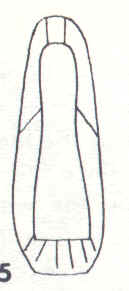 The
satin of the toe slipper must be gathered into pleats on the underside of the
slipper just as it is in soft ballet slippers. These pleats are absolutely
essential, for they provide for the expansion and movement of the toes.
Incidentally, the presence of The
satin of the toe slipper must be gathered into pleats on the underside of the
slipper just as it is in soft ballet slippers. These pleats are absolutely
essential, for they provide for the expansion and movement of the toes.
Incidentally, the presence of
these pleats is your proof that the slipper is hand-constructed.
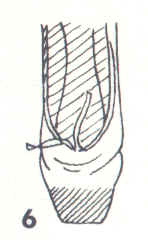 The
boxing should be light. The
boxing should be light.
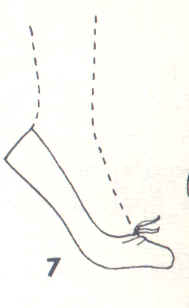 The
sole of the slipper must be flexible to permit the use of the demi-pointe. If
the sole is very thick at the toe end and too stiff to permit the shoe to bend
in this fashion, it is not the proper kind of slipper, for it will not permit
the correct use of the feet. The
sole of the slipper must be flexible to permit the use of the demi-pointe. If
the sole is very thick at the toe end and too stiff to permit the shoe to bend
in this fashion, it is not the proper kind of slipper, for it will not permit
the correct use of the feet.
In
preparing the slippers for use note these suggestions:
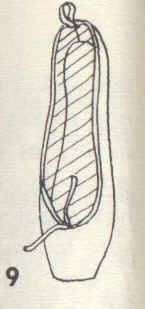
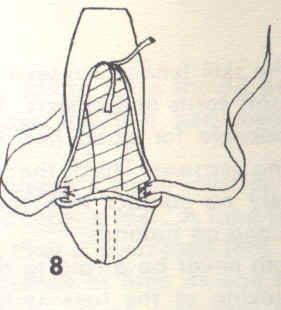 To
find the correct place on which to sew the ribbons, bend the back of the slipper
down until it touches the inner sole. Sew the end of the ribbon at the fold,
attaching it to the canvas inner lining about midway between the binding and the
sole. Do not stitch through the satin and do not sew to the binding, for the
drawstring must remain free. The ribbon should be about three quarters of an
inch in width and made of heavy satin. To prevent the knot from slipping and
untying, and the ribbon from rolling up To
find the correct place on which to sew the ribbons, bend the back of the slipper
down until it touches the inner sole. Sew the end of the ribbon at the fold,
attaching it to the canvas inner lining about midway between the binding and the
sole. Do not stitch through the satin and do not sew to the binding, for the
drawstring must remain free. The ribbon should be about three quarters of an
inch in width and made of heavy satin. To prevent the knot from slipping and
untying, and the ribbon from rolling up
like a string, line the inside of the ribbon with cotton tape, sewing it to the
ribbon with tiny stitches. About one inch of the end of the ribbon should be
folded under before it is sewn to the shoe in order to make the attachment
strong and eliminate any raveling. Sew the ribbon on with heavy thread, using
cross-stitches. Clip the ends of the ribbon on the bias to prevent fraying.
 An
elastic loop sewn to the inside back of the heel will help to keep the slippers
on at the heels if one has trouble with this. An
elastic loop sewn to the inside back of the heel will help to keep the slippers
on at the heels if one has trouble with this.
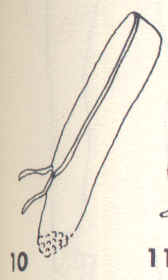 Darning
helps to preserve the slipper for longer use because it prevents the satin from
fraying. Use an embroidery needle and embroidery cotton of the same color as the
slipper. You will also need a thimble and a little pair of pliers as it is
difficult to pull Darning
helps to preserve the slipper for longer use because it prevents the satin from
fraying. Use an embroidery needle and embroidery cotton of the same color as the
slipper. You will also need a thimble and a little pair of pliers as it is
difficult to pull
the needle through the stiff material of the boxed toe. The darning covers the
entire toe of the slipper at the bottom and the tip of the end. It should not
extend over the top of the toe. After the darning is completed, cover it with a
thin layer of colorless shellac and hang the slipper's up to dry, allowing
several days for the shellac to dry thoroughly.
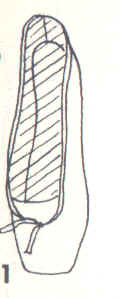 If
you find that the vamp is too short and that you break across the toes as you
stand on pointe, sew a piece of strong heavy ribbon (not elastic) across the top
of the vamp at the inside. If
you find that the vamp is too short and that you break across the toes as you
stand on pointe, sew a piece of strong heavy ribbon (not elastic) across the top
of the vamp at the inside.
 A
properly tied shoe. The ribbons must always be straight (and clean!), not rolled
up into strings. Tie a secure knot and tuck the ends of the ribbons out of
sight. Draw the drawstrings, tie them securely (a bow is best so that they can
be readjusted easily), and tuck them inside under the vamp. A
properly tied shoe. The ribbons must always be straight (and clean!), not rolled
up into strings. Tie a secure knot and tuck the ends of the ribbons out of
sight. Draw the drawstrings, tie them securely (a bow is best so that they can
be readjusted easily), and tuck them inside under the vamp.
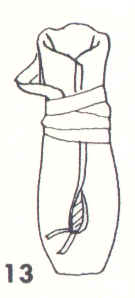 Put
your shoes away carefully if you want them to last. Fold the back in to the
inner sole, fold both sides over, wrap the ribbons around and tuck the ends in. Put
your shoes away carefully if you want them to last. Fold the back in to the
inner sole, fold both sides over, wrap the ribbons around and tuck the ends in.
Don't
do this!!!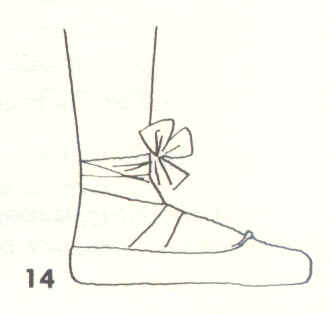
| 
