|
Foreword Position
on pointe
The
Foot

The ideal
foot for dancing sur les pointes is the square foot--one that gives the
impression that the toes are sawed off straight across--with a low arch and a
solid, strong ankle. Such a foot will "wear well" and will be a great
comfort to the dancer because in standing on pointe the weight of the body will
be borne evenly by all of the toes.
 This foot, while
more beautiful in appearance because of its high arch (beginning almost in the
ankle) and its slim, well-turned ankle, is much more difficult to work with
because of its great flexibility and softness. Even with excellent training and
care it will never be so strong as the foot illustrated in Figure 1.Dancers with
this type of foot must be especially careful in their training and must go
through a longer preparatory period before attempting to dance on pointes.
This foot, while
more beautiful in appearance because of its high arch (beginning almost in the
ankle) and its slim, well-turned ankle, is much more difficult to work with
because of its great flexibility and softness. Even with excellent training and
care it will never be so strong as the foot illustrated in Figure 1.Dancers with
this type of foot must be especially careful in their training and must go
through a longer preparatory period before attempting to dance on pointes.
 Another
type of high arch; this one, however, is stronger than the foot illustrated in
Figure 2 because the arch does not involve the ankle joint. Another
type of high arch; this one, however, is stronger than the foot illustrated in
Figure 2 because the arch does not involve the ankle joint.
The
grouping of the toes is very important to the would-be ballet dancer:
 short
toes, all even in length, are the best for pointe work because all of the toes
will share the burden of the dancer's weight; short
toes, all even in length, are the best for pointe work because all of the toes
will share the burden of the dancer's weight;
 at
least three toes should be "carriers"; at
least three toes should be "carriers";
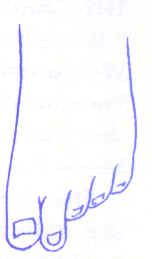 when one toe is
longer than the rest, the dancer finds toe work difficult and painful. when one toe is
longer than the rest, the dancer finds toe work difficult and painful.
| 
