
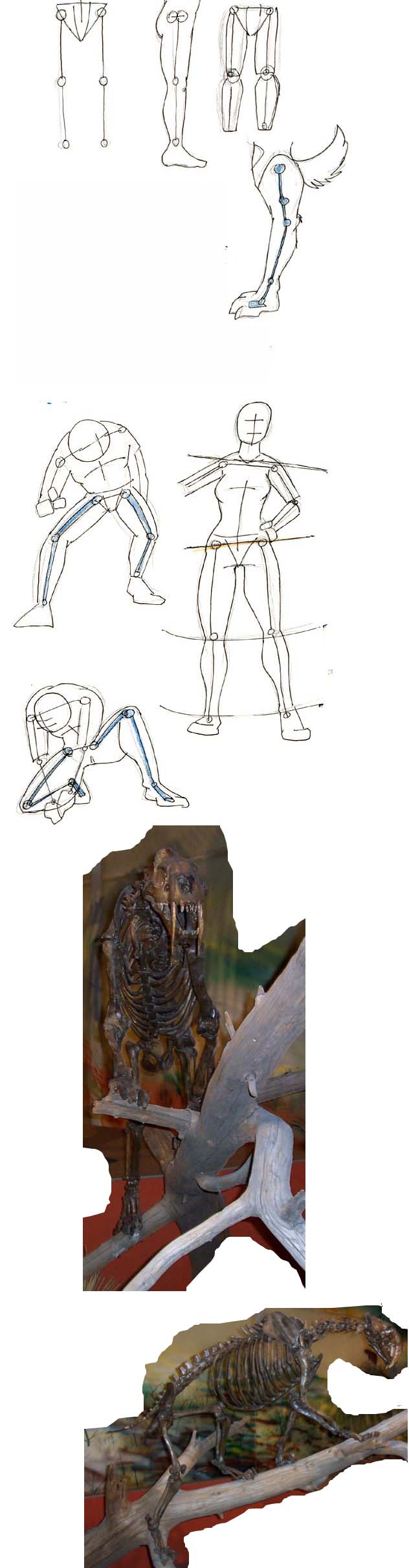
Talbot says, "hmmm, slight mod on a human leg form..."
You say, "And thank DonQuixote for the pictures of the sabretooth skeleton he was kind enough to photograph and send to me. They help immensely, especially since I flubbed the example I had drawn, and messed up the legs on it. *blush*"
Piccillo ahems and continues, "Now the legs of a body are very important. Before you begin drawing them however, you have to consider *what* kind of fur you will be drawing. Will you be drawing a fur that walks on human legs, or animal looking ones? Or will it move about on all fours, and just stand up to do things like use tools (like a gorilla would)?"
You say, "Now as I've said before, there is no wrong way to draw a fur. You have to decide what you like, and what style you'll choose to draw in. The legs are no exception."
You say, "There are some basic points to keep in mind while you make you decide on which to put on your figure though."
You say, "The first is - that the more animalistic a leg is, the more 'specialized' it will be."
You say, "For example, cheetahs have long legs made for running, while a chimpanzee has legs made to grasp trees. If you keep your figure along the lines of an 'animal', there'd be a great difference in the type of leg you draw."
You say, "A cheetah would probably have a short body when compared to it's long limbs. A chimp would probably have very short legs for it's size."
You say, "Also the way they stand might be different too. A chimp could stand bow-legged, as a point."
Wallaroo_Blacke churr, "So, if they were morphic, the cheetah would be leggy and digitigrade."
Wallaroo_Blacke churr, "And the chimp would be flat-footed."
You say, "Yes, the chimp would walk flat in this case, while the cheetah would be on the balls of their feet with animal-like legs."
You say, "Now if the creature walks around on two legs all the time, realisticly it would develop along more humanish lines - with the rear legs growing stronger and thicker to support the weight and the shock of walking and running, while the arms shortened a bit and slendered down some on average."
You say, "Fourtunately, as artists, we don't have to be *too* concerned with natural evolution if we don't want to be. ;)"
Wallaroo_Blacke churr, "That's a relief."
You say, "The important thing, as always, is to find what *you* like. With time, you'll develop to where you want to go."
Piccillo continues. "Now, the buildup of the leg is not as hard as it appears on the surface. On a human model (and if you choose a more animal morph, your milage may vary) the distance from the hip to the knee is the same as the distance from the knee to the ankle."
You say, "The upper parts of legs look a bit shorter, due to the fact that the weight on the hips tends to mask where the legs start."
You say, "The legs, overall, are roughly the same length as the length from the top of the head to the bottom of the hips as well."
You say, "It makes for some easy math when designing a figure."
You say, "Of course, as mentioned, doing animal mixes promptly chucks that figure right out the window. Some animals have long bodies but short legs (like minks and weasels). Would you draw them with short compact limbs and long torsos? Or make them more human-like? The choice is yours to make of course, and as long as you are aware there is a choice you'll be able to fool around with different designs and make the one that's right for you."
Piccillo nods to Alex. "They are difficult to get right. I still struggle, but do a fairly good job. :) The best way to do it, I've found, is to make a rough triangle like I've done up top - then attach the legs to the sides of said triangle."
You say, "After that, building up the shape is kind of like adding putty to a wire model. Build up the figure until it looks the way you want."
You say, "Yes Sherri?"
Sherri says quietly, "Dunno if anyone would stil have them, but Graytail's brother used to have little posable figures with elastic bands holding their torso and legs together, their waist comes out if the band snaps... they're a good guide"
Sherri says quietly, "well, the figures are a decent guide in themselves"
Piccillo nods to Yasha, "I remember the type. Since Christmas is coming up, there should be something suitable in the stores."
You say, "Something that may help with your design is a basic understanding of how the leg works. While it's not going to help you pass your medical exams, this is the basis of how it goes."
You say, "Legs (and all muscles) work along the lines of contraction. Basicly, it's like tying a rope to something and pulling on it. A muscle used for movement is anchored to the bones of your body, on either side of a joint (those would be the circles in the drawings)."
You say, "When a muscle contracts, it 'pulls' on it's anchor points as it shortens - causing the bones to be pulled twoard each other due to the tension. They pivot around the joint in a way the joint will let them flex. That is the basics of it."
You say, "If you want to design a leg that looks realistic, you have to keep this in mind. One can certainly draw anything you want, but if you want it to strike a viewer as something that 'might be possible' you would have to follow this rule."
AlexRaccoon says, "Athletic mags are good for this too"
You say, "We could go more in-depth, with tendons and such...but as I said, none of us are using this lesson as a medical exam. This will be enough for us to make a good drawing out of. :)"
Piccillo continues. "Now another thing to keep in mind is what is called the 'center of gravity.' "
You say, "The center of gravity is the balance point...the point at which something exerts the least amount of force to keep it's balance. If you take a pencil and put it on your finger and balance it, the point where it keeps it's balance is it's 'center of gravity'."
You say, "Now for a figure, the center of gravity is the natural position, standing up, where you'd have to exert the least amount of muscle force to keep from falling over and hitting the rug with your face."
You say, "Yes, there are oddities in this rule - which we can discuss after the generals. :)"
Talbot says, "I was going to ask how the wings could effect center of gravity"
You say, "In this case, Talbot, wings help *keep* a birds balance, but dont' effect it's center of gravity much. The best way to think of the center is to divide the weight equally on either side of the figure..."
You say, "...however, birds are an odd exception to a standard rule. Usually the legs of a animal try to balance the weight evenly over the legs."
You say, "Birds that don't fly much follow this rule, like chickens and Emus."
You say, "Flying birds however, seen to defy this rule a bit - having their legs placed a bit further back along their body."
Talbot says, "what about bats and such?"
You say, "Their secret, however, is in their tails and not their wings. A birds long tail allows it to counter-balance itself on a perch. Much like a lever or fulcrum, it can use the very light weight of it's tail (which sticks out behind it) to keep it's balance in a normal way."
You say, "Bats are pretty much the same as all animals - excetp the tend to 'hang' rather than 'stand'. But their back legs tend to be positioned the same - along the lines of their center of gravity."
Piccillo continues. "If you watch a bird at perch, you notice it moves it's tail a lot to keep balance. Usually just small twitches, but it's enough."
You say, "Now a normal body has a center of balance (excluding birds and other critters that exist solely to mock my lesson, I'm sure. ;D ) drawn in a straight line from the head to the hips from the front, and basicly cutting the body in 'half' from the side."
You say, "The body will do it's best to balance it's weight over the legs by leaning back and forth, to use the least amount of effort."
You say, "Now this assumes straight human legs, but animals have an advantage as they have four to balance on."
You say, "Kind of like having a chair with two legs and four, the four is much easier to balance - and therefore needs less strength devoted to keeping the wight up."
Piccillo continues, "That means that the legs can be much thinner and more specialized. Just about any animal's legs don't have large lower legs - they aren't very neccesary. Large upper legs for forward propulsion are the norm.
You say, "For these models, you can find the center along the animals back, and about halfway down. It's not as important as a two legged critter though to keep - which is why some animals are infamous for 'landing on their feet' - it's easier for them to orient their bodies the way they want them."
Yasha-Myr replies softly, "Ok... for your propultion example, for larger legs... if that the case... why are cheetahs faster, but lions are larger legged.. wouldnt the opposite be true?"
You say, "It depends on where and what the muscles are used for. Let me explain with your examples..."
You say, "Cheetahs are built for speed. Their muscles lie along their upper body and upper legs. They exist mostly to move the creature, so they develop there. "
You say, "Now a Lion is built for power - it brings down larger prey than a cheetah. While it's limbs are bigger, they are not built for running but for holding on to things larger than itself in some cases."
You say, "Compare it to a runner versus a wrestler. A good runner is usually wiry and thin - while a wrestler is developed more."
You say, "The big problem with center of gravity comes with those who don't have standard bodies. A figure with animal legs, for example, would realisticly not be able to move well at all. While a dog or cat stand on their hind legs at times - they won't move around on them for very long, and aquardly at best."
You say, "While art isn't bound by messy things like realism at all times, just be aware if you *want* your art to look realistic these legs won't be the perfect ones for something that spends most of it's time on two feet rather than four."
You say, "The other factor is weight. Like those who are hefty, or as has been mentioned 'winger style' pics...where certain portions are excessively...um, weighty."
You say, "Now to realisticly depict something with large weight in the front standing, we have to think about it's center of gravity. By drawing a line in the middle, we see that frontal weight means we have to move the line forward some - in some cases, this means the line might even extend beyond the legs themselves."
You say, "To realistcily correct that, the body will balance itself out as best it can. It will lean back a bit, or bend the legs. You can simulate this by holding a medium bulky object in front of you (like a sleeping bag, or a few heavier cushions) and observing how your body leans back slightly to compensate for the frontal weight."
You say, "Of course, it is art. You can always say *it's magic!* and just draw them how you like. ;)"
*end of lesson*
