
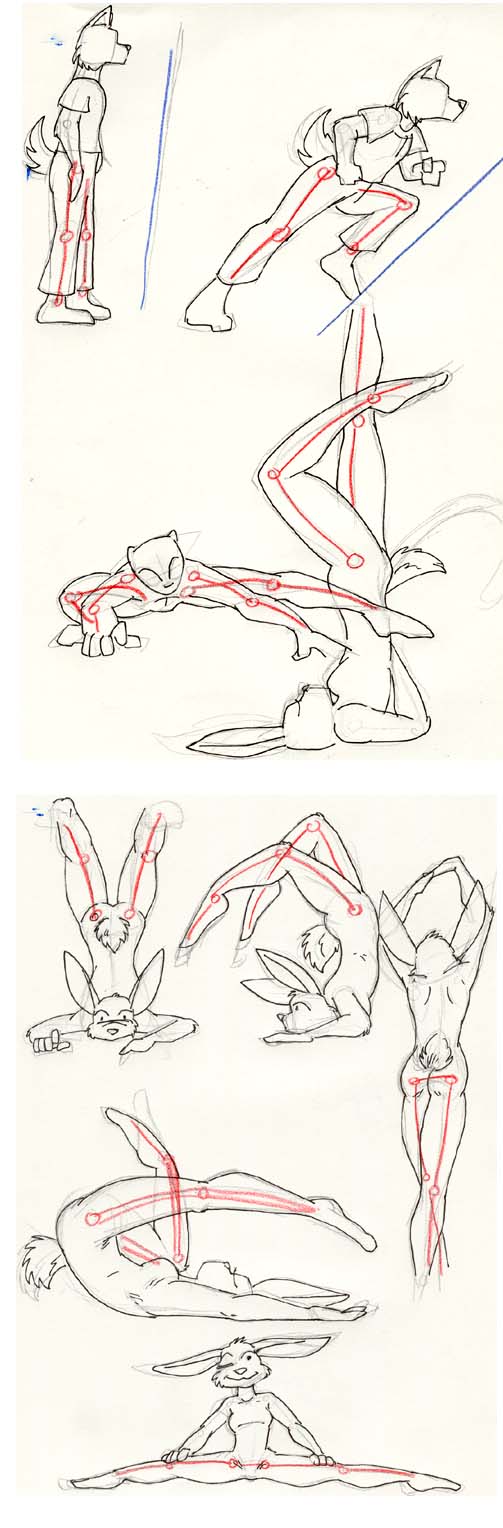
You say,"Tonight's class is a study of the legs and how they move.
You say, "Now the leg in motion isn't something I can teach about too much - because it's a topic that covers such a wide variety of poses and moves. So while I can cover some general tips for how to handle them, a lot depends on you and how you are trying to show action in your picture."
You say, "Now a good basic rule is shown at the top of the page. "
You say, "There are two figures there, on the left side you see someone moving at a slow walk - on the right, one in full sprint. Notice the blue line I've drawn next to each of the two figures."
You say, "A good rule for bipeds is this : the faster a figure is *trying* to move the more it leans forward in the direction of it's movement...in this case, running."
You say, "This rule does get broken a bit though, as there are different types of moving. Jogging, for example, is an exercise meant to move you along but keep you straight - so you tend not to lean."
You say, "As you can see with what I've drawn, the red lines are there to help show the curve and length of the legs. As some of you may know, the basic standard for a leg build is that the upper leg (from hip to knee) is the same length as the leg from knee to ankle, and the legs are basicly as long as the body - measured from the top of the head to the groin area."
Brongaar nickers, "Does this apply to ones that walk digitrade?"
You say, "You mean animal legs, I assume. That all depends on how you plan on your digigrade to move. If it travels on it's hind legs all the time, then I'd *hesitantly* say yes. Note I am hesitant becuase there isn't any real way I can tell you that 'this is how it goes'. It's up to each artist, eventually, to decide on how their picture will move."
You say, "Well, like a lot of my 'answers' I really leave the final answer up to you. ;) While it's a bit rougher that way, I'd rather you learn your own style than I just teach you mine. You'll be happier with the results in the long run, I beleive - and may even start your own trend which I will be learning within a year. "
Piccillo continues, "Of course, leg length has a lot of variety even in humans - we've all seen people who have longer or shorter legs and arms that average I'm sure. But with animal/human crosses, there is a lot more to consider. If we want the picture to look more like the animal, how will we change the length? Will an elephant have much shorter stockier legs? Will a gazelle have long but thin ones? This is where it truly depends on you, the creator of the picture, to make some descisions.
You say, "Note that their isn't a *wrong* descision in this case (although some would like you to think there is, according to their tastes). You might want to try various types of legs to see which types you like drawing."
You say, "That being said, I've chosen for this set of examples to draw a rather human-like bunny for the most part, although she does have larger than normal feet."
You say, "Now notice something I've done though - although this borders on me teaching you my *style* rather than art fact. The bones in your legs are straight...but notice I've drawn the guide lines at a bit of a curve...and the front of the leg isn't perfectly straight even in the finished ink."
You say, "I do this to help show muscles in the leg. Especially in well formed ones. But it's not just that. Having the leg curve ever-so-slightly helps suggest grace and motion for me, so I tend to do it that way."
Piccillo puts a finger on his cheekruff andcontemplatively and says, "Art is *not* life...it is nearly impossible to capture on paper the perfect image a photograph can catch. But at the same time, we are given the chance to suggest things that a photo cannot...allowing us to 'bend' natural rules to our whim to help us create something that is more than a static reproduction.
You say, "While it is straying a bit from the point, it's something that many art books seem to forget to remind you of. There are plenty out there that can teach you how to draw a leg and body - better than I can here even. But at the same time, they can be restricting if you don't keep an open mind."
You say, "Now that the preaching is done, I can address what is probably the biggest problem with legs. And that is foreshortening - when a limb (in this case a leg) is pointing at you, or away, or at an odd angle."
You say, "For example, if you look in the mirror and point straight at it - your arm is given the illusion of looking very short. Short of surrounding yourself with mirrors, it really is hard to get a good look at how a leg moves and curves."
You say, "The best way to find how something looks in this case is to have a model on hand you can move and turn in any direction to get a good look at. And as usual, I go the cheap route - I use my friendly neighborhood bendy-straw. "
You say, "These are straws that have a small place where ribbing has been built into them so you can bend them. To make a model leg, just trim the straw so equal length lies on both sides of the bend...if you want a longer leg to study (or if you are making an odd leg), just add some straw by pinching the end of a section and sliding it inside the other."
You say, "The straws cost only a buck or two for a package, but are very versatile when you are trying to make the proper pose. If you tape two together to a light object (like a triange of styrofoam) you can even make working models of legs you can move about."
You say, "That's about it for this week, the class was very short by the usual standards...but a lot, as I said, depends on you. "
*end of class*
