
Other famous ladies
Lady Godiva of Coventry:
 Lady
Godiva (or Godgifu in the spelling of her time) was an Anglo-Saxon gentlewoman
who lived from about 1020 to 1080 A.D. In 1057 she did the historical ride that
made her to the most famous horsewoman in the middle ages.
Lady
Godiva (or Godgifu in the spelling of her time) was an Anglo-Saxon gentlewoman
who lived from about 1020 to 1080 A.D. In 1057 she did the historical ride that
made her to the most famous horsewoman in the middle ages.
(On the photo: Maureen O’Hara played her role in the Universal movie of 1955 “Lady Godiva of Coventry”)
 She was the wife of Leofric, Earl of Mercia. Both
were quite religious and founded an abbey in the small town of Coventry,
Warwickshire. But besides that, the Earl felt responsible for many public
affairs of the growing town.
She was the wife of Leofric, Earl of Mercia. Both
were quite religious and founded an abbey in the small town of Coventry,
Warwickshire. But besides that, the Earl felt responsible for many public
affairs of the growing town.
(On the photo: Maureen O’Hara again and George Nader as Leofric in the 1955 Universal movie)
 Lady
Godiva was a good horsewoman but a patron of the arts too. She had noble
aspirations, and one of them was art for everyone. She wanted to have the
masses interested in artistic concerns. To promote her idea, she offered nude
pictures of herself as an example of the perfectly glorious beauty.
Lady
Godiva was a good horsewoman but a patron of the arts too. She had noble
aspirations, and one of them was art for everyone. She wanted to have the
masses interested in artistic concerns. To promote her idea, she offered nude
pictures of herself as an example of the perfectly glorious beauty.
(On the photo: Maureen O’Hara)
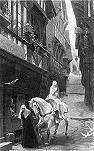 Leofric
proclaimed that “if Lady Godiva would ride her horse through the marketplace of
the town, in the full light of mid-day, clothed in only that which God had
given her, than he would reduce taxes”. She agreed, he was surprised by his
wife’s courage and decided not just to reduce the taxes but to remove them all
(except tolls on horses). So she began her historical ride on a day in late
August.
Leofric
proclaimed that “if Lady Godiva would ride her horse through the marketplace of
the town, in the full light of mid-day, clothed in only that which God had
given her, than he would reduce taxes”. She agreed, he was surprised by his
wife’s courage and decided not just to reduce the taxes but to remove them all
(except tolls on horses). So she began her historical ride on a day in late
August.
(Painting by Le Febvre, about 1900)
 She sat straight and properly in the saddle. In
reality her hair was done in two large braids which were curled at the back of
her head, one on each side. The tale that she was covered totally, except for
her legs, by an enormous quantity of hair, was added in the 17th
century by prudish Chuchmen. The earliest written description is the “Chronica”
by Roger of Wendover who lived about 150 years after Godiva.
She sat straight and properly in the saddle. In
reality her hair was done in two large braids which were curled at the back of
her head, one on each side. The tale that she was covered totally, except for
her legs, by an enormous quantity of hair, was added in the 17th
century by prudish Chuchmen. The earliest written description is the “Chronica”
by Roger of Wendover who lived about 150 years after Godiva.
(On the photo Maureen O’Hara)
 Much later, King
Edward I, wished to discover the truth of Godiva’s story. The ancient records
showed that in 1057 there were no taxes except those on horses. This seems to
be the proof that the core of the Godiva tale is true.
Much later, King
Edward I, wished to discover the truth of Godiva’s story. The ancient records
showed that in 1057 there were no taxes except those on horses. This seems to
be the proof that the core of the Godiva tale is true.
(On the photo: a beautiful model, obviously with a wig, poses for an advertisement in 1976)
 Lady
Godiva and her ideas live on in her myth. Only a few people know something from
her life nowadays, but the detail of her long hair (even if it is fiction) made
her to a symbol of beauty for all times.
Lady
Godiva and her ideas live on in her myth. Only a few people know something from
her life nowadays, but the detail of her long hair (even if it is fiction) made
her to a symbol of beauty for all times.
(On the photo: a model named “La Milo” at a celebration in Coventry in the Twenties)
