By the Author of the Scrapboard : | |
|---|---|
 | Attack, Avoid, Survive: Essential Principles of Self Defence Available in Handy A5 and US Trade Formats. |
 | |
 | Crash Combat Fourth Edition Epub edition Fourth Edition. |
 | |
 | |
There can be little argument that the Avenger GAU-8 cannon of the A-10 Warthog has proved to be an effective anti-armour system.
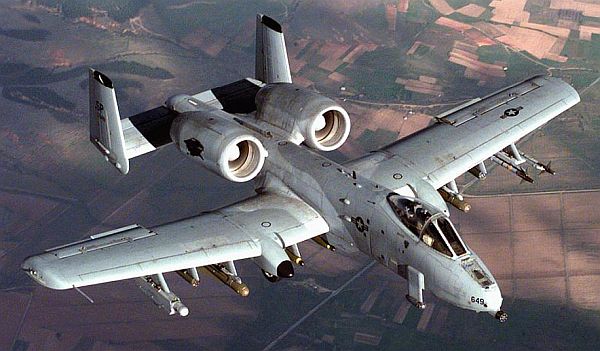
Less certain is how effective it is against light infantry. Certainly a direct hit from a 30mm round will take a soldier out of a fight, but how effective are the near misses?
Such high velocity rounds probably bury them selves several feet underground before exploding, which can be less than ideal.
In another article, I've suggested new types of ammo that might address this problem.
This page has an alternate approach that has other potential benefits.
Suppose we build a variant of A-10 that does not have the Avenger cannon and instead has a lesser weapon such as a .50, 20mm or 25mm gatling.
Such a move saves a lot of space and weight.
Instead we fit this variant, which we will call the “Groundhog”&, with a turret mounting a laser designator and thermal imager.
The aircraft can therefore “paint” a target at any bearing. Ideally the turret would also hold the new gun armament, allowing an all around field of fire.
To exploit this new system to its maximum potential, we will use some of the weight that has been saved to add a second crewman to operate the turret.
The Groundhog can still carry a full range of hardpoint mounted weapons and yet can carry a greater quantity of ammo for its smaller calibre gun.
The Groundhog has several potential roles:
The Groundhog therefore has a complimentary role to its Avenger‑armed sister.
Not only can it designate targets more effectively, but it also helps defend Warthogs from air defenses. Groundhogs would operate in mixed squadrons with Warthogs.
If the tactical situation should change, the Groundhog can still mount the podded 30mm GAU-13 cannon system and would use this weapon more accurately than high speed F-16s.
The end product has poor thrust to drag ratio ergo POOR Acceleration, that will assure you get hit a lot.
However, not bad for our FIRST attempt to design an airplane for this badly needed kind of war work. Next time, we should do better.
The legacy of the program:
Challenge is to get them into a smaller, more agile ASP and let they go to work with the grunts (full time).
Desired characteristics include:
Hard to beat turbo‑prop and the best configuration for that is pusher or unducted‑fan pusher."
Chuck E. Myers, Jr.For the standard single seat A-10, the main changes are procedural rather than structural:
Missiles and rocket pods are probably more use for MAS than free‑fall ordinance, and only a few pounds of these will go a long way.
One common suggestion of the MAS Working Group is the need for an aircraft like the OA-37, both for Forward Air Control and as a attack plane to supplement the A-10s.
A two-seater Groundhog version of the A-10 may be the answer. Primary Systems would be the laser designator and FFAR pods, particularly when loaded with laser guided rounds. Starstreak may be another option.
This aircraft may have a fixed or turreted 25mm GAU-12, or it may carry such weapons in pods. For harder targets, the Groundhog can carry 30mm ADEN cannon pods or larger missiles such as Maverick.
It is debatable as to how practical and prudent strafing as a tactic is in the modern battlespace.
Guided missiles and rockets permit an attack aircraft to remain out of cannon range.
By the Author of the Scrapboard : | |
|---|---|
| | Attack, Avoid, Survive: Essential Principles of Self Defence Available in Handy A5 and US Trade Formats. |
| | |
| | Crash Combat Fourth Edition Epub edition Fourth Edition. |
| | |
| | |