Added 1-2-2025
Carlton Meyer proposes this interesting idea (slightly edited):
“The FAA spends millions of dollars each year to evaluate expensive safety ideas but ignores simple improvements. Many airplanes are unintentionally camouflaged making it difficult to see them in the air or ground. Those flown by United Airlines are some of the worst. Add some fog or light rain and their aircraft disappear from view. Note the barely visible white airplane flying above, which would be invisible against clouds. Keep in mind that "runway incursions" on the ground are a serious problem as well.
“The FAA should require that 80% of an airplane's skin be painted with high visibility "luminous" colors, which are already used by fire departments and highway workers. (In 2015 the FAA approved use of safety orange, fire engine yellow, and bright red). Fire departments moved from red to luminous yellow decades ago to reduce traffic accidents, but airlines failed to adopt this simple idea. This would greatly improve aviation safety as most small aircraft rely only on visual identification. If phased in over a ten-year period, this would cost little since aircraft are repainted every few years. The other 20% of the skin is available for unique lettering, logos, or stripes, like the brightly colored Hertz airplane.
“This idea could be improved by assigning specific colors to different types of aircraft. This allows pilots easier identification because a small dot in the distance may be a huge, fast 747 or a slow, tiny Piper Cub. Perhaps slow single-engine props could be painted bright orange; slow helicopters - pink; faster multi-engine props - bright "lime" green; and very fast jet aircraft - bright yellow. This idea is simple to grasp, costs nothing to implement, yet would prevent several accidents a year.”
It may be simpler to divide fixed wing light aircraft into “fast‑movers” and “slow‑movers”, irrespective of type and number of engines.
Red or orange is already a relatively common colour for helicopters, particularly those that operate over snow. An additional advantage is the colour stands out against most types of terrain, making a helicopter downed for any reason easier to locate.
Fixed‑wing aircraft that operate in polar regions often use red too.
During the interwar years, US Navy aircraft had their wing uppers painted yellow to make spotting ditched aircraft easier.
Police helicopters in the UK use a scheme of a yellow upper and dark blue underside. The yellow shows up against the ground to an aircraft flying above while the dark blue contrasts against the sky to an aircraft alongside or below. to make them more visible from both above and below.
My irreverent side likes the idea of following Carlton’s suggestion and replacing the yellow with pink to create a flying pig!
Recently I started reading the novel “Ecotopia” by Ernest Callenbach, which has led me off to various divergent threads of research.
While reading about “kei‑trucks”, I noticed the bright colours many seemed to be painted in.
Remembering Carlton’s idea, it occurred to me that there was some merit in encouraging civilian vehicles to be more visible. More people are killed by automobiles than by guns or in air collisions, after all.
Ecotopia offers an interesting, if alarming suggestion that driving offers an outlet for the need to be competitive and aggressive, including the risk of smashing into each other.
Vehicle collisions are at least a magnitude more likely that air-to-air collisions. Why not encourage bright colours for automobiles? Hard to see colours such as white, black, greys and dark shades not to be used unless combined with very visible colours.
In overcast conditions, or at dusk or dawn, many vehicles in pale, neutral or very dark colours are nearly invisible.
It is common for railway locomotives to have large sections of their front painted yellow. Red and orange are also used in some countries. The whole locomotive may be painted in bright, eye‑catching colours.
In the UK, emergency vehicles use a high‑visibility pattern often called “Battenberg”. This is a checkerboard pattern with large squares of yellow and either blue (police), green (ambulance) or red (fire service).
It is widely recognized as logical to have emergency vehicles highly visible, so why not other road users too?
The introduction of hi‑viz clothing on building sites has significantly reduced the number of worker deaths. Think what might be achieve on our roads!
At the very least, council vehicles such as dustcarts and other municipal vehicles should use bright colours and patterns.
Perhaps tax breaks could be offered to companies that ensure their commercial vehicles are hi‑viz.
Such colour schemes could also function as a means of brand promotion. High visibility markings are already a legal requirement for some heavy good vehicles, but it is obvious that more can be done than a few strips of reflective tape.
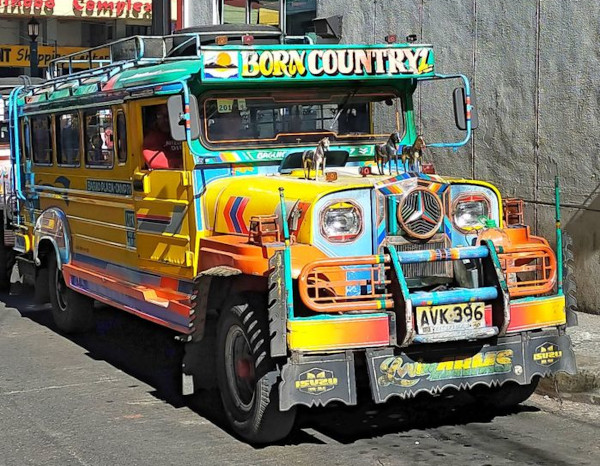
Hi-viz could also be encouraged for public transport road vehicles. In many parts of the world decorated public transport is already common.
For decades, American school buses have been painted yellow so they may be more easily seen.
For vehicles such as taxis, being more visible would help attract the attention of potential customers.
For privately owned vehicles, perhaps owners could be encouraged by reduced insurance premiums for vehicles considered to be hi‑viz.
The visibility of a vehicle should be a consideration in legal cases concerning road traffic incidents.
If you want to camouflage paint your pickup truck, or just prefer a drabber, more natural colour, there is the option of added hi‑viz adhesive markings that may be removed if no longer required.
Such adhesive markings could also be used on military vehicles during peacetime operations.
These ideas, unfortunately, assume drivers are actually paying attention to not killing someone rather than texting or updating their facebook!
By the Author of the Scrapboard : | |
|---|---|
 | Attack, Avoid, Survive: Essential Principles of Self Defence Available in Handy A5 and US Trade Formats. |
 | |
 | Crash Combat Fourth Edition Epub edition Fourth Edition. |
 | |
 | |