
 |
CICHLIDS By: Gatekeeper |
|
|
Any lake as large as Lake
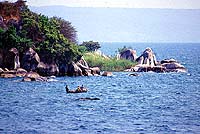
Tanganyika will provide a variety of habitats. There are shallow swampy
bays and steep rocky shores. The rocky shoreline dominates many areas of
the lake, with many different structures. We find rubble composed of
fist-size or football-size rocks or square stone, and boulders or large
rocks with eroded round shapes. Each habitat may have its own fish
community or many species may be found in both, the rocky The sandy bays are often
at a steep decline, and the diver may find them dull and boring, since
there is little to see. Occasionally, we find large shoals or small
groups of silver, bottom-oriented cichlids. Empty snail shells are
buried into the sand providing shelter for shell-dwelling cichlid
species. Deeper down the substrate is more sandy and In the open-water zone solitary fish or predators living in groups can be seen hunting for Clupeids represented by two species in Lake Tanganyika. These are the main prey items for most fishes of the lake. Most species stay close to the substrate and only a few are found in the open areas. The rock-dwelling cichlids stay close to or between the rocks and in crevices and the sand dwellers are mostly found above the sediment. There are few large areas with vegetation. Dense but small clusters of plants are found in the transition zones between sandy and rocky areas. The plants only grow in shallow areas with enough light to satisfy their needs. Few cichlids of Lake Tanganyika are adapted to this kind of habitat although we occasionally find Simochromis diagramma and Ctenochromis horii and their juveniles and Petrochromis fasciolatus in these areas.
Site designed by Gatekeeper. Best viewed under Internet Explorer 5.0 or above. All
text files provided here are copyrighted by their respective author. |

 areas
and the transition zones. The rocky shoreline is often interrupted by
deposits of sand and gravel. At the base of tall rock formations there
are often large sandy islands on terraces covered with sand or fine
gravel. The best known species found in these areas are the grazers or
aufwuchs-feeders of the genera Tropheus and Petrochromis. There are also
many cave breeders like the Lamprologids and species of the genus
Ophthalmotilapia. We find large shoals of Cyprichromis and Haplotaxodon
species hovering in a distance from the rocks while carrying their
offspring in their mouth.
areas
and the transition zones. The rocky shoreline is often interrupted by
deposits of sand and gravel. At the base of tall rock formations there
are often large sandy islands on terraces covered with sand or fine
gravel. The best known species found in these areas are the grazers or
aufwuchs-feeders of the genera Tropheus and Petrochromis. There are also
many cave breeders like the Lamprologids and species of the genus
Ophthalmotilapia. We find large shoals of Cyprichromis and Haplotaxodon
species hovering in a distance from the rocks while carrying their
offspring in their mouth.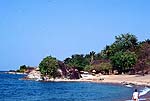 muddy
but still firm. Here, some species dig long tunnels to serve as hiding
places and spawning sites. The number of species is generally lower in
the open areas where there are fewer hiding places than in the rocky
rubble zones. Still, the density of fish may be high in the open-water
areas. Here we often find large shoals of Xenotilapia species, which are
often called "sand cichlids" amongst aquarists, despite the
fact that some species are only found above the rocks.
muddy
but still firm. Here, some species dig long tunnels to serve as hiding
places and spawning sites. The number of species is generally lower in
the open areas where there are fewer hiding places than in the rocky
rubble zones. Still, the density of fish may be high in the open-water
areas. Here we often find large shoals of Xenotilapia species, which are
often called "sand cichlids" amongst aquarists, despite the
fact that some species are only found above the rocks. Besides
the classification of different shore areas, we find a vertical
distribution of habitat zones. This is, however, of little interest to
the aquarist, as the substrate hardly changes. Only the algae cover
becomes thinner with increasing depth while thicker layers of sediments
are being deposited. The shores at a depth of up to 10 m make up the
littoral zone. Further down, we find the sublittoral benthic zone. In
the bathic or deep zone with no light and the bathypelagic deep open
water areas we find fish species with large eyes or other special
sensing organs. This should be accounted for when these species are kept
in the aquarium. The tank should be covered to keep out bright light,
that can damage the eyes of these fishes, and sufficient shelter needs
to be supplied.
Besides
the classification of different shore areas, we find a vertical
distribution of habitat zones. This is, however, of little interest to
the aquarist, as the substrate hardly changes. Only the algae cover
becomes thinner with increasing depth while thicker layers of sediments
are being deposited. The shores at a depth of up to 10 m make up the
littoral zone. Further down, we find the sublittoral benthic zone. In
the bathic or deep zone with no light and the bathypelagic deep open
water areas we find fish species with large eyes or other special
sensing organs. This should be accounted for when these species are kept
in the aquarium. The tank should be covered to keep out bright light,
that can damage the eyes of these fishes, and sufficient shelter needs
to be supplied.