
 |
CICHLIDS By: Gatekeeper |
|
|
Their different nutritional requirements alone indicate that Mbunas and Non-Mbunas should not be maintained together in the same tank. Despite this, the keeping of members of these two groups together is often practised. One can help the situation by feeding the larger Non-Mbunas individually with large chunks of meat while the Mbunas are made to live on the vegetarian flaked feed. Independent of the group
and species-specific differences, it must be emphasised that the Lake
Malawi cichlids have a high metabolism. A strong filtration system and
more importantly a regular water change of 30-40% of the tankís total
volume every 2-3 weeks is a necessary prerequisite. A major factor in the husbandry of these fish is the size of the tank. The bigger the tank the fewer the problems associated with the cohabitation of various species. Whoever keeps a stock of various species in a 200-L-tank must be prepared to be often involved in regulating the fish population. This means that subdominant fish or an aggressive male must be removed from the tank in order to maintain the ”peace”. With tanks of about 600 L is this type of regulation reduced to a minimum. In tanks of 1000 L, aggression rarely develops or if it does, it fizzles out without any adverse effects as the attacking and subdominant individuals can easily evade each other. Naturally, this situation depends largely on the size and aggression potential of the species being kept. A 30-cm-long Dimidiochromis kiwinge male is quite capable of keeping the whole stock of a 1000-L aquarium in check. The aforementioned suggestions are in respect of the species usually kept in a standard aquarium and that have a total body length of 12 to 15 cm; in individual cases up to 20 cm. Otherwise the rules for the cohabitation of Lake Malawi cichlids are as normal. It is obvious that one should not keep the very aggressive species with the less assertive cichlids. Predators and the large Lake Malawi cichlids should also be maintained alone. This is also true for the sand-dwelling Nyassachromis spp., if one wishes to enjoy their typical behaviour patterns. In addition, with the cohabitation of various species, the rule is: the more diverse the species the larger the size of the tank required.Often the question arises about the number of fish which can be sensibly maintained together. Here it is important to note that the lower the number of fish present in the aquarium the greater the effects of aggression. This is because the aggression can only be directed at a few individuals who are then attacked by the aggressor. This is rarely the case in a overpopulated aquarium. Additionally, at a certain population density the territorial behaviour of the males is totally diminished, simply because it is no longer possible to defend a territory. In this way aggression is totally undermined, but in such tanks the individual fish are subjected to a very high degree of stress which may lead to disease and temporary infertility. The golden mean is, as so often, to be recommended. With Mbunas, a population of 30 to 40 fish with a length of 7-10 cm in a 2-metre-tank has proved to be a good compromise. Finally, the skill of the keeper is required in deciding which population density is suitable for his conditions. There is no magic formula. In conjunction with the
total number of fish that can be held in a specific aquarium, the
question All Lake Malawi cichlids, as mentioned previously, are maternal mouthbrooders. The formation of breeding pairs between the sexes does not actually occur as they remain together only during spawning (so-called agamic mouthbrooders). Spawning occurs in the majority of the species (as known so far) during circling. Immediately after the female has laid her eggs she turns round and takes them into her mouth. The yellow egg-spot-like blotches in the anal fin of the majority of the males may have the function of animating the females to snap at them so that they will take up the maleís spermatozoa into their mouths (Wicklerís Egg Dummy Theory). Subsequently, the eggs are fertilised in the mouth of the mother fish. In the majority of the aquaristically known species the brooding period, depending on water temperature, takes about 3 weeks. Small variations are possible according to species differences. The fry are usually ca. 10 mm long when released and are fully developed. As the young fish are immediately capable of ingesting Artemia nauplii and finely crumbled flaked feed, rearing usually does not present any problems. In the Non-Mbunas, during the next few days after their release, the fry are taken back into the motherís mouth in the advent of possible danger and in the evening. In the Mbunas the brooding behaviour after the release of the fry is distinctly weaker. According to observations in captivity many of these species release their fry and take no further notice of them. All in all, the breeding of Lake Malawi cichlids is very easy. Under suitable conditions it is almost unadvoidable that the breeding instinct will take its own course. Whoever wishes to raise the young fish should place the females into a separate tank 1 to 2 weeks after spawning. Site designed by Gatekeeper. Best viewed under Internet Explorer 5.0 or above. All
text files provided here are copyrighted by their respective author. |

 arises about the suitable number of cichlids from a specific species.
Normally it is recommended to keep one male with a number of females.
However, in those species where the females are aggressive to each other
it may be impossible to keep two or more females together. Basically it
has been ascertained that it is sometimes very difficult to keep two
females from the same species together. Only a very few or very many
appears to be the best principle for especially aggressive species. What
is applicable to the females also holds true for the males, whereby it
must be taken into consideration that the keeping of a number of males
together is only sensible in a large tank (depending on the size of the
species: +/-500 L). One thing is of great advantage in the maintenance
of a number of males together ñ as there are always rivals present, the
males remain permanently in their most colourful îdress” so that they
are constantly ready to display and to defend their
arises about the suitable number of cichlids from a specific species.
Normally it is recommended to keep one male with a number of females.
However, in those species where the females are aggressive to each other
it may be impossible to keep two or more females together. Basically it
has been ascertained that it is sometimes very difficult to keep two
females from the same species together. Only a very few or very many
appears to be the best principle for especially aggressive species. What
is applicable to the females also holds true for the males, whereby it
must be taken into consideration that the keeping of a number of males
together is only sensible in a large tank (depending on the size of the
species: +/-500 L). One thing is of great advantage in the maintenance
of a number of males together ñ as there are always rivals present, the
males remain permanently in their most colourful îdress” so that they
are constantly ready to display and to defend their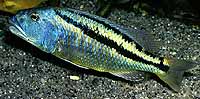 territory.