
(The above advertising is
provided by Angelfire and may not represent the views of this website)
***************************************
 |
Beauty By Nature Galaxy
Effect |
The following information was provided by club member Robert
Taylor
(Information and photos are copyright material of the author/photographer).

Unlike fixed focal length lenses, a telephoto zoom
allows the photographer to vary the focal length. By turning the focal ring the
image of your subject will then become larger or smaller.
Zoom lenses are available in several focal
lengths, with the 75 to 210mm or 80 to 200mm being the most common second lens
in a camera bag.
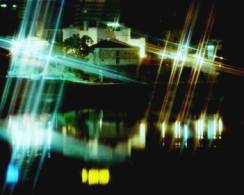 The illustrated images within this article
have been made using an 80 to 200mm or 75 to 300mm lens. However this doesn’t
mean you can’t use your smaller focal length zoom lens. Most 35 mm cameras
today will come equipped with a 28 to 80mm or 35 to 105mm lens. There is no
reason why this technique shouldn’t work using these lenses also.
The illustrated images within this article
have been made using an 80 to 200mm or 75 to 300mm lens. However this doesn’t
mean you can’t use your smaller focal length zoom lens. Most 35 mm cameras
today will come equipped with a 28 to 80mm or 35 to 105mm lens. There is no
reason why this technique shouldn’t work using these lenses also.
Night image
Minolta SRT 200 W/80 to 200mm lens
Fuji 100 Film 2 ½ minute exposure @ F/16
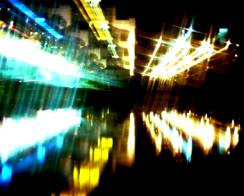 By zooming the lens during a long exposure,
results in strong lines radiating from the centre focus point of the subject.
It’s generally best to centre your main subject, because the image will show
less of the zoom affect and therefore appear sharper.
By zooming the lens during a long exposure,
results in strong lines radiating from the centre focus point of the subject.
It’s generally best to centre your main subject, because the image will show
less of the zoom affect and therefore appear sharper.
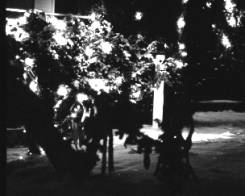
Night image
Same image as above but zoomed from 200mm to 80mm over the same 2 ½ minute
exposure, in four segments pausing at 80mm.
 You must use a slow shutter speed of 1/30
second or preferably longer. Exposures of 1/30 or 1/15 second can he hand held,
if the focal length of the lens is controlled by sliding the lens barrel in and
out, opposed to rotating it. For those of us who need to rotate the lens barrel,
a tripod would be needed to avoid camera shake with any exposure greater than
1/60 second. With a tripod-mounted camera, exposures can be increased from
fractions of a second into minutes.
You must use a slow shutter speed of 1/30
second or preferably longer. Exposures of 1/30 or 1/15 second can he hand held,
if the focal length of the lens is controlled by sliding the lens barrel in and
out, opposed to rotating it. For those of us who need to rotate the lens barrel,
a tripod would be needed to avoid camera shake with any exposure greater than
1/60 second. With a tripod-mounted camera, exposures can be increased from
fractions of a second into minutes.
Night image Canon Elan IIE W/75 to 300mm lens
Kodak T400CN film, 1 sec. @ F/22 exposure
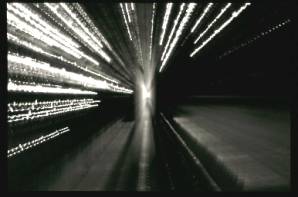 A strong zoom streak will be produced if your
background consists of a mixture of bright and dull colours or highlights and
shadows. To obtain maximum results zoom through the full range of the lens focal
length. The speed in which you zoom during exposure will also have a great
affect on the image outcome. Likewise zooming from 200 to 80mm will produce a
different affect than zooming from 80 to 200. You can also pause during the
exposure to sharpen the image. Once the image has been focused at the 80 or the
200mm focal length it remains in focus during the zoom procedure.
A strong zoom streak will be produced if your
background consists of a mixture of bright and dull colours or highlights and
shadows. To obtain maximum results zoom through the full range of the lens focal
length. The speed in which you zoom during exposure will also have a great
affect on the image outcome. Likewise zooming from 200 to 80mm will produce a
different affect than zooming from 80 to 200. You can also pause during the
exposure to sharpen the image. Once the image has been focused at the 80 or the
200mm focal length it remains in focus during the zoom procedure.
An
ISO 100 rated colour film and small apertures is most often used to produce zoom
images, even for night photography.
The image named Galaxies was made at night using
Kodak T400CN film. A mini chest pod was mounted to the camera aiding to camera
stability in the 1 second F/22 exposure.
Most cameras will allow you to cock and fire the
shutter without film in the camera. This provides an excellent way to practice
zooming the lens during an exposure. When you are confident in your ability to
zoom from 80 to 200mm during an exposure, load it with your favourite flavour of
film and go have some creative fun.
Written by Robert Taylor London Ontario Canada
for Beauty by Nature club members
All images and text carry the author’s copyright.
