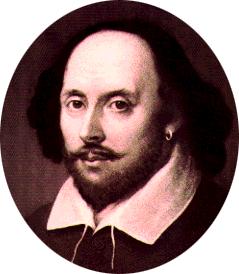
 HAMLET's advice to the players (HAMLET, Scene 2, Act 3) is one of the finest lessons in dramatic art ever presented in concrete form by the world's greatest actor-director-dramatists, William Shakespeare. The universal rules of acting were set by his standard long ago. Hamlet's fundamental principals and advice to the players can even be applied today. Below is the original text followed by a modernization of the original language.
HAMLET: Speak the speech, I pray you, as I pronunc'd it to you, trippingly on the tongue; but if you mouth it, as many of you players do, I had a lief the town-crier spoke my lines. Nor do not saw the air too much with your hand, then, but use all gently; for in the very torrent, tempest, and, as I may say, whirlwind of your passion, you must acquire and beget a temperance that may give it smoothness. O, it offends me to the soul to hear a robustious periwig-pated fellow tear a passion to tatters, to very rags, to split the ears of the gorundlings, who, for the most part, are capable of nothing but inexplicable dumb shows and noise. I would have such a fellow whipp'd for o'erdoing Termagant; it out-herods Herod. Pray you avoid it.............Be not too tame neither, but let your own discretion be your tutor. Suit the action to the word, the word to the action; with this special observance, that you o'er-step not the modesty of nature; for any-thing so o'erdone is from the purpose of playing, whose end, both at the first and now, was and is to hold, as 'twere, the mirror up to nature; to show virtue her own feature, scorn her own image, and the very age and body of the time his form and pressure. Now, this overdone or come tardy off, though it makes the unskillful laugh, cannot but make the judicious grieve; the cnesure of the which one must, in our allowance o'erweigh a whole theatre of others. O, there be players that I have seen play - and heard other praise, and that highly - not to speak it profanely, that, neither having the' accent of Christinas, nor the gait of Christian, pagan, nor man, have so strutted and bellowed that I have thought some of Nature's journeymen had made men, and not made them well, they imitated humanity so abominably..................O, reform it altogether. And let those that play your clowns speak no more than is set down for them; for there be of them that will themselves laugh, to set on some quantity of barren spectators to laugh too, though in the meantime some necessary question of the play be then to be considered. That's villainous, and shows a most pitiful amibition in the fool that uses it. Go, make you ready.


|
 MODERNIZATION:
- Say the lines exactly as written by the playwright. Have an understanding of the meaning and say them fluently and clearly.
- Do not use large gestures, physical indications or artifical hand and arm movements but rather retain energy and control in order to build smoothly and effectively to an emotional climax.
- Do not merely use ridicilious action and/or ham it up mugging and creating noise just to please unintelligent and unappreciative audiences.
- Do not be boring or uncommitted, either, let your movements be guided by your inner understanding of the role. Be natural and suit the action to the word and the word to the action. A natural quality should be stressed.
- Overdoing it or overacting is not an honest interpertation or deptiction.
- An honest depiction presents the true character and brings about the characters integrity and deamons in a truthful, natural manner. The purpose of acting is to present life as it is in accordance with the custom and time of the play.
- Overacting or underacting to get a laugh from an audience is wrong. Anything that is done in an artificial manner or is not true to life will spoil the play for the intelligent few whose criticism outweighs that of all the rest of the audience.
- There are actors, sometimes highly praised, who show no resemblance to the people they are portraying, or even to humanity, when they strut and bellow in their bad imitations of the stage.
- Never put in ad libbed or extemporaneous lines, especially in hujmorous roles, even when these lines are clever enough to make some stupid people int he auidence laugh or when the actors themselves laugh at their antics. Such methods draw the attention away from the center of interest and ensure the loss of important lines. Such action is enexcusable and hsows a most pitiful amittion in the fools who use it.
- Modern directors usually say the same sort of thing to beginers in the first few rehearsals: Get your lines; speak clearly; keep your hands still; do not overact; be natural and easy; do not play to the least discerning in the audience; hold back; be yourself at your best; stick to the script; use your head; act like a human being; do not steal the scene from the main business.


|






