
RHEUMATOID ARTHRITIS
|
 Signs and symptoms
The signs and symptoms of rheumatoid arthritis may come and go over time. They include:
* Pain and swelling in your joints, especially in the smaller joints of your hands and feet
* Generalized aching or stiffness of the joints and muscles, especially after sleep or after periods of rest
* Loss of motion of the affected joints
* Loss of strength in muscles attached to the affected joints
* Fatigue, which can be severe during a flare-up
* Low-grade fever
* Deformity of your joints over time
* General sense of not feeling well (malaise)
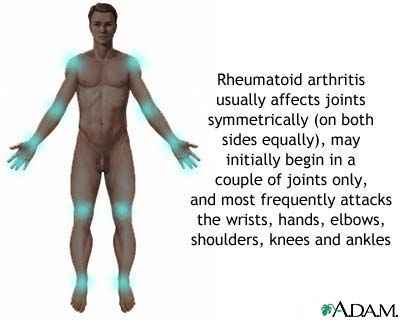
Rheumatoid arthritis usually causes problems in several joints at the same time. Early in rheumatoid arthritis, joints in your wrists, hands, feet and knees are the ones most often affected. As the disease progresses, your shoulders, elbows, hips, jaw and neck can become involved. It generally affects both sides of your body at the same time. The knuckles of both hands might be one example.
Small lumps, called rheumatoid nodules, may form under your skin at pressure points, and can occur at your elbows, hands, feet and Achilles tendons. Rheumatoid nodules may also occur elsewhere, including the back of your scalp, over your knee or even in your lungs. These nodules can range in size — from as small as a pea to as large as a walnut. Usually these lumps aren't painful.
In contrast to osteoarthritis, which affects only your bones and joints, rheumatoid arthritis can cause inflammation of tear glands, salivary glands, the linings of your heart and lungs, your lungs themselves and, in rare cases, your blood vessels.
Although rheumatoid arthritis is often a chronic disease, it tends to vary in severity and may even come and go. Periods of increased disease activity — called flare-ups or flares — alternate with periods of relative remission, during which the swelling, pain, difficulty sleeping and weakness fade or disappear.
Swelling or deformity may limit the flexibility of your joints. But even if you have a severe form of rheumatoid arthritis, you'll probably retain flexibility in many joints.
|
 Causes
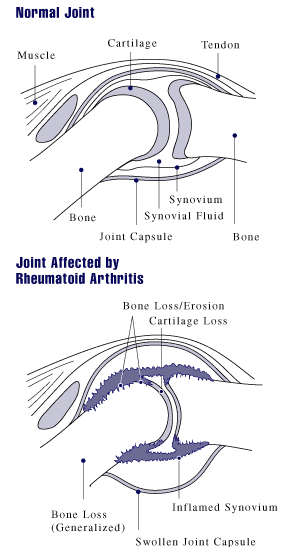
As with other forms of arthritis, rheumatoid arthritis involves inflammation of the joints. A membrane called the synovium lines each of your movable joints. When you have rheumatoid arthritis, white blood cells — whose normal job is to attack unwanted invaders such as bacteria and viruses — move from your bloodstream into your synovium. There, these blood cells appear to play an important role in causing the synovial membrane to become inflamed (synovitis).
This inflammation results in the release of proteins that, over months or years, cause thickening of the synovium. These proteins can also damage cartilage, bone, tendons and ligaments. Gradually, the joint loses its shape and alignment. Eventually, it may be destroyed.
Some researchers suspect that rheumatoid arthritis is triggered by an infection — possibly a virus or bacterium — in people with an inherited susceptibility. Although the disease itself is not inherited, certain genes that create an increased susceptibility are. People who have inherited these genes won't necessarily develop rheumatoid arthritis. But they may have more of a tendency to do so than others. The severity of their disease may also depend on the genes inherited. Some researchers also believe that hormones may be involved in the development of rheumatoid arthritis.
|
Risk Factors The exact causes of rheumatoid arthritis are unclear, but these factors may increase your risk:
* Getting older, because incidence of rheumatoid arthritis increases with age. However, incidence begins to decline when people reach their mid-70s.
* Being female.
* Being exposed to an infection, possibly a virus or bacterium, that may trigger rheumatoid arthritis in those with an inherited susceptibility.
* Inheriting specific genes that may make you more susceptible to rheumatoid arthritis.
* Smoking cigarettes over a long period of time.
Rheumatoid arthritis causes stiffness and pain and may also cause fatigue. It can lead to difficulty with everyday tasks such as turning a doorknob or holding a pen. Dealing with the pain and the unpredictability of rheumatoid arthritis can also cause symptoms of depression.
Rheumatoid arthritis may also increase your risk of developing osteoporosis, especially if you take corticosteroids. Some researchers believe that rheumatoid arthritis can increase your risk of heart disease. This may be because the inflammation that rheumatoid arthritis causes can also affect your arteries and heart muscle tissue.
In the past, people with rheumatoid arthritis may have ended up confined to a wheelchair because damage to joints made it difficult or impossible to walk. That's not as likely today because of better treatments and self-care methods.
Treating rheumatoid arthritis typically involves using a combination of medical treatments and self-care strategies. The following self-care procedures are important elements for managing the disease:
*EXERCISE REGULARLY
*CONTROL YOUR WEIGHT
*EAT A HEALTHY DIET
*APPLY HEAT
*APPLY COLD FOR OCCASIONAL FLARE-UPS
*PRACTICE RELAXATION TECHNIQUES
*TAKE YOUR MEDICATIONS AS RECOMMENDED
The degree to which rheumatoid arthritis affects your daily activities depends in part on how well you cope with the disease. Physical and occupational therapists can help you devise strategies to cope with specific limitations you may experience as the result of weakness or pain. Here are some general suggestions to help you cope:
*KEEP A POSITIVE ATTITUDE
*USE ASSISTIVE DEVICES
*KNOW YOUR LIMITS
*AVOID GRASPING ACTIONS THAT STRAIN YOUR FINGER JOINTS
*SPREAD THE WEIGHT ON AN OBJECT OVER SEVERAL JOINTS
*TAKE A BREAK
*MAINTAIN GOOD POSTURE
*USE YOUR STRONGEST MUSCLES AND FAVOR LARGE JOINTS
www.arthritis.org
|




 Complications
 Self-care

