
Session #1: (Introduction) "3, 2, 1... Let's Jam!"
-When did you first realize it, the moment you witnessed a great piece of film making. For many, films and television series attempt to open one's mind to fantastical feats of endless imagination, emotion that we couldn't often find in merely reading about a plot, listening to a story or simply visualizing a series of aspects which we could not even dream to see in the real world. This is product of the human imagination, we attempt to share with others things we cannot see in the real world. These visions of the imagination serve to entertain, left for the individual interpretation and view on the aspects of motion picture. It is both a medium, a commercial form of enterprise as well as a popular art form which has been among us for a century now. First and foremost, films and television are meant to entertain; but many talents and multiple efforts are waged to bring forth these fantastic pieces of art. They are what often shape the very way we all behave and construct our existing society. Often films are highly moving, controversial; often television shows regain a self-made following which stays with it for many years. They begin to mold the very existance of popular television of today. But with the aspects of simply imitating a great work of cinema in history, there always arises the possibiilty of faulting the mere entertainment value, and we then have something which drifts into the cliche. The worn premise, the day-old piece of film which no networks or viewers want, something which the society soon forgets. Of course, not only have motion picture and television been means of artisitic beauty and huge popularity, but always and foremost the goal has been to make money as a medium. Without this fact however, a film or television show cannot attain it's popularity. Often despite the fact of gaining cultural momentous and significance durring it's popular runs on the world's most viewed piece of plastic and electronic waves. We often forget how far we've come in this industry since we gave up radio as our means of sitting down durring dinner time with our family. But let us change the on-going subject for a moment, mainly for those of you who were able to read this far without realizing that you were not reading something about the theme of this website in general. This site of course is about Japanese animation, and all the great aspects which make this film medium not only a critical and commercial hit; but something which I myself feel is uniquely a difinitive genre all by itself. Anime excels in ways you least expect it. Unlike typical Hollywood fare often forcing the premise down the viewers' throats, anime entices fans with it's unique visual extravagance, it's peculiar motives and disitinctive methods, it's stunning presentation of character depth and familiarity of style which makes it a wonder with fans. Something extremely unique and often mesmerizing lies amidst it's impeccably noticable, yet diminutive reputation as something of an almost occult nature. This false speculation had almost acquired amounts of near unacceptance as a popular film medium in the United States durring the late 80s. Perhaps this was for the best considering it's what I felt to be temporary image in soceity. Anime was indeed, NOT something which contained just violent, erotic or perhaps mere adult oriented entertainment (These aspects appeared all too present in the controversial "Urotsukidoji"). Perhaps the film medium needed a more direct commercialization as something more becoming. That it was in Japan, genres ranged anywhere to the obscene, to the insanely cute; something which distinguishes this animation medium among all else.
But perhaps this general ideal was too sophisticated for the majority of those willing to buy into the anime craze. Though many series has come along, few gave into the mere characteristic of anime being a highly versatile film medium that it is. Because of this fact, I feel it to be a genre in itself; something which fans can relate to. The famed "Carl Macek" has been solely responsible for some of this mere speculation of the film medium. His great effort through distribution of the famed "Robotech", among others brought to the U.S., often gave rise to this unique yet small-scale word about this distinctive film industry from Japan. With this came other anime films which were merely sci-fi/horror, this paved the image of anime as merely violent content, none would be anything but amazed when the groundbreaker "Akira" showed us that there was more to anime than meets the eye. Masterful directors like the famed "Miyazaki's" films appealed to a wide variety of fans willing to accept anime as a potential successful medium. Though it had gained certain fame in it's small scale video distribution, also pioneered by Macek among others. But anime is indeed not a fad or pop-culture fan following vehicle; like any other medium it itself contains a respective film history many don't realize exists. The medium in Japan started off as comic book madness which in turn contained it's share of great contemporary and legendary figures such as "Tezuka Osamu"; which soon gave rise as a popular television and film medium. Containing it's share of visionaries, producers and among all else directors and animators. Spread throughout a nearly 40 years of commercial triumph in Japan, making it's own way into world records and various awards and respect for what it is; a film medium. Session #2: (Something Big) "They Will Create A New Genre Itself, It Will Be Called Cowboy Bebop"
-Many anime films and shows defined the times, gave rise to more popular and contemporary series, often some push the envelope of conventional animation film making. While others often leave viewers and fans in amazement and admiration. Indeed, this is not like anything else, totally unique yet familiar in it's own little way of imbedding itself in it's origins; yet still respecting the cutural aspects of the things around it. This is what I love about anime, and why I feel it's so entertaining. But sometimes an anime film or series can be so original, so entertaining and so spellbinding; it nearly leaves you the point of ardent thought. Anime is not idiomatic, neither is it something which copies other mediums. It rather utilizes this fact to transform into something totally fresh. The animators are often brilliant in creating something which will stay in the viewers minds, which does not cease to entertain even the most sceptical critic. One anime series which succeeds masterfully in creating this imaginative vision in anime is "Cowboy Bebop". A science fiction epic created by two of the most famed and brilliant animation artists, "Shinichiro Watanabe" and "Shoji Kawamori". Despite a first impression by many as an aberrational title, and something which could painstakingly fall victim to the cliche; "Cowboy Bebop" is a masterpiece of animation where you'd least expect it. First and foremost, the series is a science fiction released around 1998, making it one of the more contemporary series of the decade. It's director "Shinchiro Watanabe" had actually has second-thoughts about producing a series of his own with this theme, at first many didn't feel it would reach a wide enough audience. Watanabe had co-directed the scifi epic "Macross Plus" with famed "Shoji Kawamori", who is respected for his work on Robotech and many other popular series. Watanabe was given the task as long as the series contained "Space Ships", something which always seems to please audiences after all. But a series like Bebop takes a turn on something which you least expect coming from a sci-fi epic. Watanabe had from the start wanted to create something different, something fans had never seen before. Though the mere production of the series which layed the groundwork for it's plot, was something familiar to countless genres we see in both American and Japanese cinema; Watanabe had surprised the anime world by creating something totally unconventional, yet entertainingly fresh. The series covered everything from the "Star-Trekish" space opera, the ancient shogun, the retro 70s buddy-cop flick, the western, the redemption and revenge story, conceptual jazz, contemporary pop-culture, villians with gimmicks, the James Bond/Bruce Lee/Idealistic hero figure and of course everything of the anime style. This of course made an unlikely hit like "Cowboy Bebop" something of critical speculation. Something with so many familiar genres and premises couldn't possible work, something which producers as well as Watanabe himself feared from the beginning.
A series like this one is usually product of flop, cliche as well as campy styles. Most Hollywood films attempt to avoid the cliche by creating the odd. But film makers often find that when they attempt to created the different, it lands back in their face as something which the movie goers and television viewers don't easily accept or appreciate. Often film makers try so hard to create something unorthadox, they often forget that sometimes the most brilliant and profound of storytelling comes from something completely familiar; something which makes us human. Shinchiro Watanabe is a brilliant director for idealizing these aspects found in "Cowboy Bebop". Although he utilizes the familiarity of popular film making, Watanabe brilliantly yet artistically attempts to form these aspects into something wonderfully engaging. A story of course is never complete without it's characters. Something which the anime medium is famous for, creating such icons in cartoon film making, trademarks of anime in Japan. The central hero in the series is something which is a cross between classic "Eastwood" films and "Kurosawa's" masterful anti-heros. A character who's personality is engulfed into anime's popular cultural styles. Bebop's central hero "Spike Spiegel" is one both unlikely yet appealing in his own way. Character designer "Toshihiro" Kawamoto" greatly utilizes a unique sense of color as a palat for creating an environment containing these character. You often get a sense that you cannot visualize these characters any other way, and they mold perfectly into their surroundings. Spike is both suave and cunning, yet he contains a painful past subject to the typical anti-hero; a life containing love and loss. This sort of character is often faulted in Hollywood by showing too much of the characters' personality in the beginning. This aspect does not welcome the opportunity of character depth and development; alas viewers get that sense of cliche and boring nature. Animation makes it possible for the directors to use a palat to create the world they envision, giving them total control; rather than relying on multiple talents to form a good outcome. In animation, the talents are utilized to perfect the result; and viewers get that sense that they are being drawn into the world, instead of having it being forced to them like something they have to enjoy (Ex: Over-commercialism with Hollywood movies). Animation is gentle in it's approach, yet it forcefully creates a brilliant execution with it's stories. Session #3: (Bell Peppers & Beef) "It's All Those Lids, I'm Gonna Crush Em All Away!"
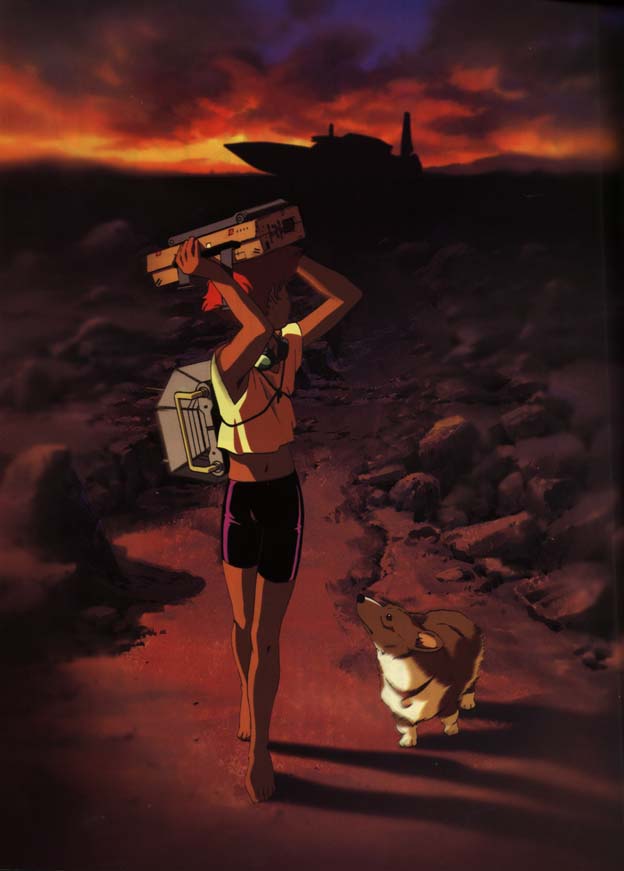
-In "Cowboy Bebop", "Watanabe" does not need to make us like the characters by forcing upon the viewers a structured storyline; rather the characters themselves we already feel we know. Their appeal and depth in turn begin to shape the storyline, one which never falls victim to cliche, despite the show's stylistic approach. An approach which creates depth, rather than creating hype. Cowboy Bebop uses magic to make us part of the story, it never relys on the image of it all to make us like it; because we already know it's something special. There are many ways the director achieves this faultlessly. Every single inch of architecture, building design and structure appears totally unique in the world of Bebop. Though they are derived from many cultural influences, (Much like the characters themselves) Cowboy Bebop creates the image of the story as if these worlds themselves were created with vision. Each world and culture in the animation is unique and we get a sense they were built from scratch, with all the lives and people which inhabit them. The characters in Bebop in turn affect the lives of these different cultures and civilizations. One aspect to take keen note in the series is it's dialouge, screenplay writer "Keiko Nobumoto" creates the illusion of real-life, with not complicated pieces of dialouge made to be like duets, rather it consists of extremely prolific pieces of screenplay which give further growth to character development in later scenes; some of the greatest "call-backs" and "one-liners" can be found in "Cowboy Bebop". Something which never falls victim to being dullness or impetuous blunder, mainly because of it's impeccably brilliant character presentation and storyline structure. As for the storyline structure, "Cowboy Bebop" cannot be looked at as entirely an on-going plotline; rather it's a sequence of events. Each episode contains it's seperate predicaments, and they never drift over to a next episode segment; at least not very often. Each part is played with grace and sheer technical beauty. The characters themselves develop and change throughout, and we feel just as much part of the story as "Spike" and his crew on "Bebop"; the stylish spaceship which the crew lives on. Another thing about the series to notice fully is "Shoji Kawamori's" mechanical designs, which are indeed brilliant. The various cultures portrayed are reflective in the architecture, and mechanical mechanisms are made to look like they all work like a clock; considering what designs may really develop to be like. While at the same time they seem to reflect "Kawamori's" brilliance as an animator, the ability to create something unique, which serves as something accurate. Spike's crew is a most unlikely one, containing his one-armed partner and ex-cop "Jet Black", a female bounty hunter named "Faye Valentine" as well as a trusty canine named "Ein" and a hacker named "Edward", whom is actually a girl. Many characters in Bebop seem to jump out at the viewers as the unconventionally unique, often containg long names and unusual past relations. These aspects fit well in an environment so diverse as space. The visual and technical brilliance is as great as going back to Lucas' "Star Wars". Character relations and confrontations play like classic vintage westerns, while they themselves seem rather complcated and peculiar. This depth is greatly utilized in Cowboy Bebop to create that sense of tragety and loss in the main characters. Something which is not overshadowed, but praised in a way with the shows cunning dialouge and outrageous comedy. Which is a mix between blaxploitation, pop-culture refrences and anime satirical themes. Often the dialouge is so well executed and timed within the storyline, it seems often hilarious for a moment; that these characters themeselves are in a way laughing at the story and their own lives. In that this is the only way they know how to live, reflecting all the criminals and evil-masterminds in the stories; whom are often tragedies in themselves. One of the criminals in the first episode meets a terrible fate, despite her appearance being a rather decent person at heart; "Spike" has to halt her ways because of an evil accomplice. But just because they are criminals, does not mean they are indeed humans with the ability to love. The accomplice of the outlaw in the first episode only wishes to have a happy life on the planet Mars, (Where Spike was born) but she cannot get there with the love she holds for her accomplice; a relationship which cannot exist in a world full of hate and corruption. Watanabe is brilliant in presenting the audience with a unique view on the series' villians. Like "Spike", the greatest tragedy of the outlaw in the first episode (Her name is never said) is that her beauty and visions cannot be accepted in an world which is already too blinded by this sad fact that she is undeniably a crimminal. Spike early on could not have the joy and trust of his most sought out love, because of mere circumstances in her life. In a disinct sense, villiantry is indeed a tragedy. Something which is as moving as anything in Shakespeare's greatest works, and can be complicated as the most somber drama. Though "Cowboy Bebop" never presents itself as a tragedy, but as an entertaining action/science fiction. With it's mold of popular genre stylization and character development, arises a most unlikely turn on moving human drama; something which is least expected from a show which presents itself as just fun; but ends up being more rewarding than it's made out to be. Cowboy Bebop is truly nothing short of a masterpiece. One of the most important aspects of the show however, is it's unique sense of stylization. While already presented as nearly every genre, Bebop at times seems almost like a 20s silent film. Often sequences of music and motion are used highly effectively. Instances of silence are often the most effective, and are as mesmerizing and brilliant as any great segment containing music. This is often used to create realism and depth, though stilled shots, close-ups and duets of musical score. But "Cowboy Bebop" realizes that it's not trying to be overly abstract in an artistic sense, it intices the audience with visual brilliance; something which is never overshadowed by worn cinematic technicques or "stock-footage". In addition to it's stellar animation (Which is an achievement in itself), Cowboy Bebop also utilizes CG effectively; not to overshadow it's cel but instead to serve as both camera and background usage. This makes the show highly versatile for unique camera techinques and faultless editing; scenes are both carefully placed and structured for effect. This of course makes the action sequences all the more effective. Sequences which are not hyped by visual effects, but scenes which are solely about the characters themselves; which is of course what this show is all about. Music is also wonderful, composed by "Yoko Kanno" one of the most respected in anime for her excellent score. While taking a different turn on her usual music style, Kanno has produced music highly suitable for Bebop's environment and themes. She greatly mixes conceptual jazz with vintage contemporary tracks, in addition to Bebop is also the presence of very slow and hauting lyrics; as well as fantastic intrumental classical music. The result is something greatly moving. All quality aspects of an excellent "space-opera" molded around a coceptual jazz soundtrack. Stunning, mesmersizing and highly enjoyable. Often the show takes time to simply display scenery, while background songs are being played. A tribute and technique to directors like "Miyazaki". But what makes the music in Bebop even more fantastic is it's presentation, often some of the show's most memorable themes are presented through some characters; whom play the tunes themselves on instruments. It can be said in a distinct sense that "Cowboy Bebop" is it's music. Session #4: (Adios Cowboy) "Someday It'll All Make Sense"-The series of Bebop exists without pre-destinated origin or lack of originality. Yet the show specifies it's aspects through both comical instances and self-made celebral vignettes. Cowboy Bebop" does not fault into cliche, misdirection or over-seriousness because it already realizes that it's not attempting to do so. Rather it celebrates it's aspects through instances of satrical conventionality. In other words, it's as if the character themselves are living through the plot just as the audience is. A great example is the show's minor text displays, comical parody and character-oriented "Coming-Episode" segments. Which are both brilliant, hilarious and the best presentation of series previews I've ever seen. Of course, these are only a few of the little things which make a show like this shine. In a medium of animation film making which pushes the conventional means of social acceptance and entertainment by letting the viewers know that there are other things out there. And that it's o.k. to drift into the familiar if done to the extent of great entertainment. You often forget how great anime shows can be when you watch something like "Cowboy Bebop", a series which reminds us that anime is truly a great film medium. All these aspects are of course what makes story structure work in animation and movie making, but it never hurts to drift away from the mainstream by transforming familiarity into something magical. Something which I feel animation in the United States have not yet accomplished to certain extents. The Japanese have been at it for 40 years now with "anime", and I hope great directors like "Watanabe" continue to create such great pieces of artistic brilliance. Most of all what I truly love about this show is the depth in both technical style and visual presentation. It is a product of fantastic talent rarely found in film making and in directors like "Watanabe". The ability to create stories which do not form these characters into something great, but it is what these great characters can do for the story. Try finding anything like that in "Looney Toon Land".... -Do You Have A Comrad?Back To Main Page |
