You are here: Home > Electronics > Vacuum Tubes > Tetrode and Pentode
Generic Tube typesTETRODES AND PENTODES
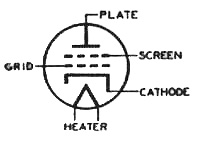
The effect of grid-plate capacitance in causing excess regeneration can be eliminated in a number of ways. One scheme requires the use of special circuit arrangements which set up counteracting effects to balance out the action of the grid-plate coupling. This method is known as neutralization. A second and preferable method is to reduce the grid-plate capacitance in the tube itself to a negligible value. This is accomplished by employing a fourth electrode in the tube which is known as the screen. The screen is placed between the plate and the grid and thus makes a four-electrode tube -hence the name tetrode. With this type of tube, intricate circuits and balancing difficulties can be eliminated. The screen is constructed so that the flow of electrons to the plate is not materially obstructed, yet it serves to establish an electrostatic shield between the plate and the grid. The screen is usually operated at some positive voltage lower than that of the plate and is by-passed to the cathode through a condenser having low impedance at the operating frequency. This by-pass condenser effectively grounds the screen for high-frequency currents and assists in reducing the effective grid-plate capacitance to a minimum value. This reduction permits tetrodes to provide a high order of stable amplification with relatively simple circuits. The 865 and 860 are representative tetrodes.
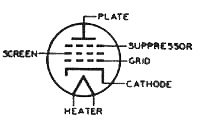
In all radio tubes. electrons striking a positive electrode may. if moving at sufficient speed. dislodge or "splash out" other or secondary electrons. In diodes and triodes, such secondary electrons produced at the plate usually do not cause any trouble because no positive electrode other than the plate itself is present to attract them. These electrons. therefore, are eventually drawn back to the plate. In tetrodes, the screen (operating at a positive potential) offers a strong attraction to secondary electrons when the plate voltage swings lower than the screen voltage. This effect limits the permissible plate swing for tetrodes because the major portion of the space current then goes to the screen rather than to the plate. The plate swing ]imitation can be substantially removed when a fifth electrode, known as the suppressor, is placed in the tube between the screen and the plate. Such five-electrode types are called pentodes.
|