You are here: Home > Electronics > Vacuum Tubes > Introduction
Vacuum Tube
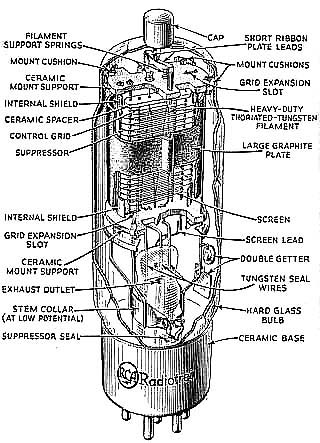
VACUUM TUBES! The magic in these two words is best appreciated by the "old timers"--the amateur, commercial, and government operators who have followed the rapid progress of radio communication from its beginning. They remember those days not so long ago when spark transmitters, galena crystals, and loose-couplers exemplified the "state of the art." But the progress which had been made was to seem insignificant compared with the progress following the invention of the three-electrode vacuum tube by Dr. Lee DeForest. The vacuum tube proved to be extraordinarily versatile. It could not only detect or amplify radio signals, but it could also be used as a generator of continuous-wave oscillations for transmitting purposes. Vacuum-tube transmitters consistently covered enormous distances with relatively little power. In addition, many stations could operate on the frequency channel previously occupied by a single spark transmitter. And then, as if these accomplishments were not enough, the vacuum tube made radio telephony feasible. From this time on, radio progress was practically parallel to the development of larger, better transmitting tubes and more sensitive, more reliable receiving tubes. The very versatility of the vacuum tube necessitated the development of many different types, not only for different power requirements, but also for various applications. The radio amateur and the professional radio engineer of today have an impressive array of tubes with which to design transmitting equipment. There are tube types for every application--master oscillators, frequency multipliers, buffer amplifiers, voltage amplifiers, power amplifiers, modulators, rectifiers, and many others. Designed to meet the requirements of these diversified applications, RCA transmitting Lubes are noted for their modern design, rugged construction, uniform characteristics, reliable performance, and long life.
|