You are here: Home > Electricity > Electromagnetism > Fundamentals - Magnetic Fields and Forces
Fundamentals
Magnetic fields and forces
The magnetic force influences only
those charges that are already in motion. It is transmitted by the magnetic
field. Both magnetic fields and magnetic forces are more complicated than
electric fields and electric forces. The magnetic field does not point along
the direction of the source of the field; instead, it points in a
perpendicular direction. In addition, the magnetic force acts in a direction
that is perpendicular to the direction of the field. In comparison, both the
electric force and the electric field point directly toward or away from the
charge.
The present discussion will deal with
simple situations in which the magnetic field is produced by a current of
charge in a wire. Certain materials, such as copper, silver, and aluminum,
are conductors that allow charge to flow freely from place to place. If an
external influence establishes a current in a conductor, the current
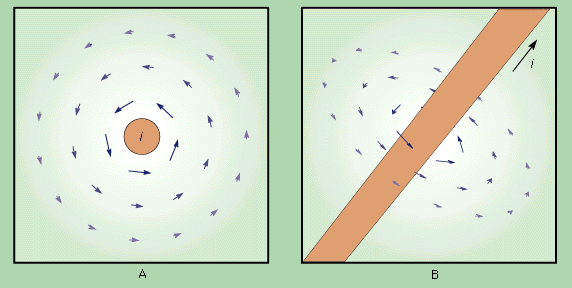
generates a magnetic field. For a long straight wire, the magnetic field has
a direction that encircles the wire on a plane perpendicular to the wire.
The strength of the magnetic field decreases with distance from the wire.
The arrows in Figure 2
Magnetic field of a long wire. (A) An end view, with the current flowing toward the...represent the size and direction of the magnetic field for a current moving in the direction indicated. Figure 2A shows an end view with the current coming toward the reader, while Figure 2B provides a three-dimensional view of the magnetic field at one position along the wire.
In subsequent figures, continuous lines will be used to represent the
direction of electric and magnetic fields. These lines emphasize the
important fact that electric fields begin on positive charges and end on
negative charges, while magnetic fields do not have beginnings or ends and
close on themselves. The magnetic field shown in Figure 2 is unusually
simple. Highly complex and useful magnetic fields can be generated by the
proper choice of conductors to carry electric currents. Under development
are thermonuclear fusion reactors for obtaining energy from the fusion of
light nuclei in the form of very hot plasmas of hydrogen isotopes. The
plasmas have to be confined by magnetic fields (dubbed "magnetic bottles")
as no material container can withstand such high temperatures. Charged
particles are also confined by magnetic fields in nature. Large numbers of
charged particles, mostly protons and electrons, are trapped in huge bands
around the Earth by its magnetic field. These bands are known as the Van
Allen radiation belts. Disturbance of the Earth's confining magnetic field
produces spectacular displays, the so-called northern lights, in which
trapped charged particles are freed and crash through the atmosphere to
Earth.
|