Your are here: Home > Communication > Electromagnetic Radiation > Forms of Electromagnetic Radiation - Radio Waves
Forms
of electromagnetic radiation
Radio waves
Radio waves are used for wireless transmission of sound messages, or
information, for communication, as well as for maritime and aircraft
navigation. The information is imposed on the electromagnetic carrier wave
as amplitude modulation (AM) or as frequency modulation (FM) or in digital
form (pulse modulation). Transmission therefore involves not a
single-frequency electromagnetic wave but rather a frequency band whose
width is proportional to the information density. The width is about 10,000
Hz for telephone, 20,000 Hz for high-fidelity sound, and five megahertz (MHz
= one million hertz) for high-definition television. This width and the
decrease in efficiency of generating electromagnetic waves with decreasing
frequency sets a lower frequency limit for radio waves near 10,000 Hz.
Because electromagnetic radiation travels in free space in straight lines,
scientists questioned the efforts of the Italian physicist and inventor
Guglielmo Marconi to develop long-range radio. The curvature of the Earth
limits the line-of-sight distance from the top of a 100-metre (330-foot)
tower to about 30 kilometres (19 miles). Marconi's unexpected success in
transmitting messages over more than 2,000 kilometres led to the discovery
of the Kennelly-Heaviside layer, more commonly known as the ionosphere. This
region is an approximately 300-kilometre-thick layer starting about 100
kilometres above the Earth's surface in which the atmosphere is partially
ionized by ultraviolet light from the Sun, giving rise to enough electrons
and ions to affect radio waves. Because of the Sun's involvement, the
height, width, and degree of ionization of the stratified ionosphere vary
from day to night and from summer to winter.
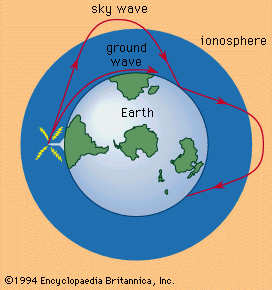
Radio waves transmitted by antennas in certain directions are bent or even
reflected back to Earth by the ionosphere, as illustrated in Figure 5
Radio-wave transmission reaching beyond line of sight by means of the sky wave reflected....
They may bounce off the Earth and be reflected by the ionosphere repeatedly,
making radio transmission around the globe possible. Long-distance
communication is further facilitated by the so-called ground wave. This form
of electromagnetic wave closely follows the surface of the Earth,
particularly over water, as a result of the wave's interaction with the
terrestrial surface. The range of the ground wave (up to 1,600 kilometres)
and the bending and reflection of the sky wave by the ionosphere depend on
the frequency of the waves. Under normal ionospheric conditions 40 MHz is
the highest-frequency radio wave that can be reflected from the ionosphere.
In order to accommodate the large band width of transmitted signals,
television frequencies are necessarily higher than 40 MHz. Television
transmitters must therefore be placed on high towers or on hilltops. As
a radio wave travels from the transmitting to the receiving antenna, it may
be disturbed by reflections from buildings and other large obstacles.
Disturbances arise when several such reflected parts of the wave reach the
receiving antenna and interfere with the reception of the wave. Radio waves
can penetrate nonconducting materials such as wood, bricks, and concrete
fairly well. They cannot pass through electrical conductors such as water or
metals. Above = 40 MHz, radio waves from deep space can penetrate the
Earth's atmosphere. This makes radio astronomy observations with
ground-based telescopes possible.
Whenever transmission of electromagnetic energy from one location to another
is required with minimal energy loss and disturbance, the waves are confined
to a limited region by means of wires, coaxial cables, and, in the microwave
region, waveguides. Unguided or wireless transmission is naturally preferred
when the locations of receivers are unspecified or too numerous, as in the
case of radio and television communications. Cable television, as the name
implies, is an exception. In this case electromagnetic radiation is
transmitted by a coaxial cable system to users either from a community
antenna or directly from broadcasting stations. The shielding of this guided
transmission from disturbances provides high-quality signals.
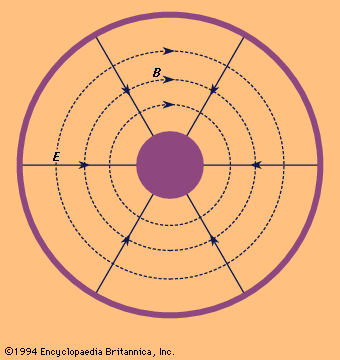
Cross section of a coaxial cable carrying high-frequency shows the electric field E (solid lines) and the magnetic field B (dashed
lines) of an electromagnetic wave guided by a coaxial cable. There is a
potential difference between the inner and outer conductors and so electric
field lines E extend from one conductor to the other, represented here in
cross section. The conductors carry opposite currents that produce the
magnetic field lines B. The electric and magnetic fields are perpendicular
to each other and perpendicular to the direction of propagation, as is
characteristic of the electromagnetic waves illustrated in Figure 2 Figure
2: Radiation fields in which vectors and are perpendicular to each other and
to the.... At any cross section viewed, the directions of the E and B field
lines change to their opposite with the frequency of the radiation. This
direction reversal of the fields does not change the direction of
propagation along the conductors. The speed of propagation is again the
universal speed of light if the region between the conductors consists of
air or free space.
Extremely low-frequency (ELF) waves are of interest for communications
systems for submarines. The relatively weak absorption by seawater of
electromagnetic radiation at low frequencies and the existence of prominent
resonances of the natural cavity formed by the Earth and the ionosphere make
the range between 5 and 100 Hz attractive for this application. There is evidence that ELF waves and the oscillating magnetic fields that occur near electric power transmission lines or electric heating blankets have adverse effects on human health and the electrochemical balance of the brain. Prolonged exposure to low-level and low-frequency magnetic fields have been reported to increase the risk of developing leukemia, lymphoma, and brain cancer in children.
|