
Spirited Away |
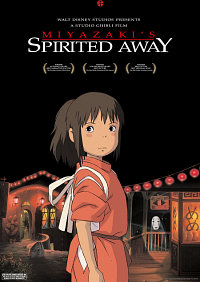 | Summary:Japanese box-office smash centers around a precocious 10-year-old girl as she encounters a borough housing mysterious deities. This award-winning Miyazaki masterwork dazzles animation fans appreciating the veteran director's trademark style, cleverly original storyline and classic characters. |
| Title Aka: | Sen To Chihiro No Kamikakushi |
| Company/Distributors: | Studio Ghibli;Dentsu;Tohokushinsha Film;Tokuma Shoten;Disney;Buena Vista |
| Year: | 2002 |
| Length: | 124 Minutes |
| Rating: |  |
| Genres: | Fantasy, Family, Kids |
| Format: | Feature Film |
| Content Level | N/A |
| Comments: | High Production Values |
"Spirited Away" (2002):
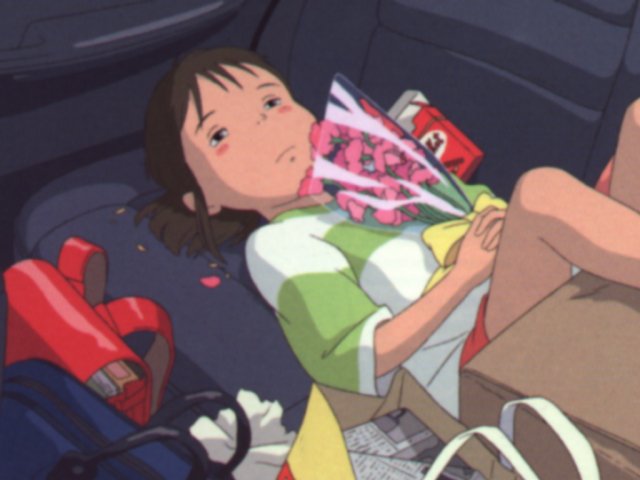
-If there's a single great thing to say about the veteran legendary film maker "Miyazaki", it would be that the man succeeds in creating a dignified sense of patience; more than the director imploys a sense of ill-bared consistency in his movie presentations. Miyazaki the man seems more fixated on emotional feel than he is graceful with commercial execution. Such are the great deal many commecial animated works and facets of the inescapable "Disney" realm, which unfotunately attempt to seep their way into this implied datum of commercialism (heck, such enterprises are the foundational presenters of this film). Miyazaki of course is no stranger to such fixations, as a seasoned producer and animation business man; as a creator he knows his audience, and furthermore, what he wishes to accomplish with them. This phenomenon of fancy figures however likely also implies the fact that such pursuits turn out to be degrees of such panned attempts at commercialization and distribution effeciency. Such are the methods of movie making and animation in general. Finding an audience & sticking with it (even if it might mean your attempts at artistic merit are less than palpable--EX: many Disney films). So it should come at no surprise to most, that the veteran film maker himself once stated that he's a great admirerer of Disney fandom; as are such, the grand commercial precedence of such influential figures as "Toy Story" director "John Lasseter" (one of the many people responsible for bringing this masterwork of animation to the big-screen overseas). Miyazaki of course has always been more concerned with creating empathy for his characters, rather than be reduced to exploiting them to the point of mere ludicrous fixation as 2-D figures. Miyazaki's movies have always shared their remnants of time thriving in that of a 2-D realm, but his vision and artistry thrive elseware in places containing 3 dimentions of both character, sight and sound. In what had thought to have been his last endeavor stated: "Princess Mononoke", the long-thought retired film maker is back at it again with his new installment "Spirited Away"; yet another Miyazaki film centering around a young girl (and yet it seems that such endeavors could only be looked upon as further inane installments only to the man himself). All his films of course are tiny little masterpieces in their own right, and such foundations of merit are almost a "given" sense in the anime way of things. His latest film, Spirited Away is no different, exept for the mere fact it has become the single highest grossing foreign film of all time before arriving in the United States; shattering previous records set by a more redundantly crafted masterwork "Princess Mononoke", and out winning a more precise money role in Japan set in 1997 by "Titanic". Despite it all in the end of things, it seems a shame that such films like "Spirited Away" (as if there were any others like it) will likely never garner anything resembling that of a limited art-house theatrical release. Such notions should never of course take away from the incarnate reality often times, that Hollywood furnace-fluid bombs often work their way into the theatrical circuit, faster than any whisked-away adventures like Spirited Away can merit its honesty in the eyes of the beholders. Spirited Away tells the clever story of a ten-year old girl by name of "Chihiro", who's family has recently discovered a new house in a quiet suburb (resembling that of Miyazaki's own country enriched "My Neighbor Totoro" after a housing complex development project). Chihiro is both indifferent and negative about her parents' new plan for her to move away from her old home and go to a new school. During a peaceful family car ride (which may mimic accounts of Miyazaki's own experiences elseware in the time of things), Chihiro and her parents stumble upon what her father believes to be an abandoned theme park. Carefully but childishly navigating their way through a long, dark tunnel; Chihiro's parents (mostly her dad) begin to point out an array of delicious smells emananting from the other side of the earth (which introspectively likely appears that way to a 10 year old, clinging to her mother's arm as if she's traveling through a mystical creepy forest). Eventually Chihiro's parents stumble upon some carefully layed-out food, which is assorted on what is believed to be a vacant carnival booth. Young Chihiro is both impatient and frightened, much like a young child awaited adult conversation as they carefully, quietly plan psyche-laden aspects of their own worlds of imagination. Soon, trouble arouses for young Chihiro, when she meets a young elusive boy by the name of "Haku". The two meet at crossed paths elongated at the view of an enourmous bridge; one resembling a piece of ancient Chinese architecture. Chihiro has discovered that cursed food eaten by her parents have transformed them into pigs. A form which inevitably is told of by Haku as a curse upon her parent's own greed and unfortunate mistake. With a hint of Miyazaki animation magic, lightness turns to dark really fast & Chihiro is trapped in a tapestry of scary creatures and mythical deities; who roam the areas of the supposed abandoned streets and huts like indifferent laborers (who are actually constantly preparing food for mythical gods--in a colorful pallete of Miyazaki goodness which almost look good enough to chew on). Haku is actually a "henceman" of the mysterious and powerful "Yu-Baaba", a towering monolith of a witch woman with an inherant cranium the size of a Totoro's chest. Chihiro is frightened by the occurences and the recent unfortunate transformation of her parents, in which Haku informs her can be reversed if Chihiro herself preforms a series of inherant tasks via the protocol of the mysterious world of the "ABURAYA" (which is actually an architectural antediluvian-style array of bath houses and mysterious but enchanting restaurants); residing is also a hint of post-industrial revolution maintanences of metal madness--such are the apparatus of the eccentric and wise "Kamajii", who is known of as the "boiler-keeper" residing over the enormous town bath house. Chihiro is told by Haku to go meet Kamajii in order to ask him for a job (it is said that once Chihiro establishes a job in the spirit world, she can possibly gain acceptance and eventually a ticket back home and for her parents to return to form--or so it is foretold in so many ways). In a meeting which is absolutely visually unforgettable, Chihiro proceeds to meet the "Susuwatari" (which literally translates to: ""traveling soot"); tiny toe-sized "dust-bunny" (of "My Neighbor Totoro" fame) like creatures which carry large (perspectively speaking) lumps of coal for Kamajii in a hot furnace which lays under the boiler for the bath house heating the huge supplies of water (exploited a great deal much later in the movie). Kamajii is both wise and compasionate, and feels a sense of empathy for young Chihiro, but also refuses her request for work; thus, Kamajii refers Chichiro to Yu-Baaba, the old woman sorcerer who runs the bath house. Journeying her through the large corridors and numerous levels of the bath house (which is just up-to-the-brim with mythical and strange creatures) is the sensible and older "Rin", a female worker of the ABURAYA who takes Chihiro under her wing. YuBaaba's quarters resemble large rooms filled with Chinese and Japanese house peaces which lead their way through vast mirror-filled halls, which Yu-Baaba forcefully, magically pulls Chihiro into via way of her powers (these scenes are as exhilarating as they are inherantly scary). Yu-Baaba is commanding and frightening as the elder witch of the bath house, (in an unforgettable English-dub preformance by "Suzanne Pleshette") and at the whim of Chihiro's own bursting requests to give her a job, instead "steals" Chihiro's name magically right off a signed contract paper. In order to compensate for Yu-Baaba's inherant demands and menacing deity revelations, Chihiro sticks it out in the toil of the bathhouse (having been given the spirited world name: "Sen") as she attempts to discover the meaning behind a lost artifact of Yu-Baaba; which holds the key to Chihiro's parents' transformation, and the more immediate questions surrounding Haku (who's actually close to the same age as Chihiro, and there's more info where that came from). The first 20 minutes or so of Miyazaki's film flows by like melting butter, smooth and leisurely; by the first half and two-thirds of the film Miyazaki's treasure of a visual marvel is a roller-coaster of wonderful small adventures and images; which thankfully never manage to appear like simple vignettes of exploration (at least up until the last third of the movie) but instead as a marvelous joy-ride through Chihiro's eyes, at nearly 2 and a half hours it's quite an adventurously lengthy roller-coaster, but which is every bit worth it, given Miyazaki's masterful attention to detail and colorful, magical motion. Completely sublime and creative narratives involve things like the enourmous "stink-spirit", which seeks the safe-haven of the bath house to much displeasure of its inhabitants (which include, frogs, pigs, birds, rats, mice, geisha women, a gigantic infant and random snippets of furiously creative monsters which evoke so much detail that they almost spew ludicrousness in tone). However, much of the real magic is dealt with the expressions and motions of Chihiro, her constant physical bickerings and adaptions to her surrounding provide the most imagination and humor in the story. And the more elusive happenings of the near-mute "Kaonashi" (AKA: "no face"). A black, sludge-like white-masked ghost which parrades around the bath house only to give young Chihiro a run for her money (literally-gold that is!). The film simply screams and blisters by with the formuliac magic happenings of Miyazaki's world, the color pallete of the film remains to be anonymously large with meticulous detail, while the actual backdrops and numerous locales of the environments seem to merit themselves more modestly in comparision to the wonderful, numerous characterizations. Every creature from the human Chihiro and Haku, to the constantly endearing tinyness of a humble little bird-like creature and his rodent companion are rendered with such grace; so it is perhaps an inherant shame that Miyazaki's execution often sagges in terms of the mere plot output, which narrowly works its way around a merit of around 2-hours. Nonetheless, these segments are still enchanting, imaginative and masterful in their own unique ways. However, such charicatures like the ones involving a twin of Yu-Baaba and the numerous likes of Miyazaki's own impolitic nature of mythical differentia, appear miniscule in the eyes of such erstwhile imaginative greatness. And yet, even so, the masterfulness of the water-color like bound animation seems to lack a certain accounterment of bite, overwrought in a more visually round "Princess Mononoke". No stranger to classic cel, Miyazaki has always employed a hand-drawn more creatively pleasant nature to the movement of his characters. They seem more bent on the interaction with their environments through unimplied reaction, than they are characterizations of devices in plotline. Even so, the characters in Spirited Away seem magically haunted by an overwhelming sense of inherant mysticism through motion and thriving quality. Miyazaki is not afraid to render such notions through blantant, fixated edges, colorfully rendered visualizations of simplistic beauty; emanated even further by character transformations. So should one go to see "Spirited Away" on the big-screen, and foremost above all, is it worth-it? Well, in such cases, as an admirerer of Miyazaki I'm inclined to say yes, since all of his films share this similar inherant glory of being somewhat away from reality in tone, but always true to the viewing audience in spectacle. And if even such examples are solemn proof as to the amount of artistic merit beckoning itself to animé's form of fandom based habitudes, such is proof that great works like "Spirited Away" should be seen on the big-screen, for which the man solely intended it. Whether for people 10 years old, or not. Even at such a ripe age of 62 still going strong in his vision and execution, Miyazaki doesn't seem to relent in his presentations of the best and brightest that he can offer. Spirited Away is one of his strongest works from simply a mythical, technical and even a spiritual realization art or work standpoint if nothing else. It embodies many inherant themes and ideas, and even more visual grace. If that's not reason enough to see it, I can't help but wonder if such heroics in the animation film making days are numbered. One thing is definitely for certain; after having seen movies like "Spirited Away", I should certainly hope not.
Click Here To See Overview! |
