
Samurai X |
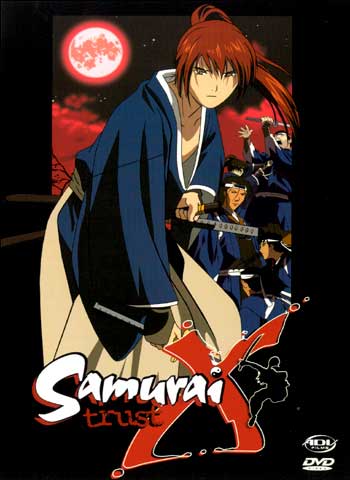 | Summary:Harrowing anime historical/drama chronicles the audacious struggle of an assassin amidst a corrupt shogunate. It's compelling characterizations, unremitting suspense and profound drama appeals to strong-stomached action fans seeking pulchritudinous, relentless delineations. |
| Title Aka: | Rurouni Kenshin (OAV Series) |
| Company/Distributors: | Watsuki/Sueisha;Fuji T.V.;SPE Visual Works;A.D.V. Films |
| Year: | 1999 |
| Length: | 4 Episode Series |
| Rating: |  |
| Genres: | Action, Drama, Romance, Historical |
| Format: | OAV Series |
| Content Level: | N/A |
| Comments: | N/A |
Synopsis:The so-called villains in "Samurai X" are not immanently evil, rather they are victims of retaining false and moribund ideals. In a harsh land and era defiled in blood and betrayal, it's difficult to see one's way through so clearly; "Himura Kenshin" is a youth who is torn apart by the apparitions and the in extremis views of reality. Particularly those found in warfare. "Kazuhiro Furuhashi's" sweeping epic is a methodical tale of the discrepancies and the instigations of such matters, and how they play out the disposition of sorrow and redemption. The players found in 19th century Japan are discovered at the peek of their corruption and clutter of arms n' filthy politics. The fall of the Tokugawa government is at the hands of the "Shinsen Gumi", the retainers as well as the infamous "Bakufu Clan". The skillful yet elusive "Choshu" was founded in order to oppose the corrupt radicals, their opposition consisting mainly of youthful and highly naive assassin. Yet, the cornerstone of such organizations lies simply in their ability to put down illustrious figures within the system of Shinsen Gumi and the advocators for the fall of Tokugawa. This is the foremost job of the assassins, and it's not a pretty sight. "Shinta" is a ripe youth amid a group of draggling nomads, presumably his parents but nonetheless amative strangers. Extremely frightened, Shinta's family are slaughtered brutally before his eyes; Shinta would then almost meet a terrible fate only to be saved by a swift derelict. Taking him under his wing, "Seijuro Hiko" is the master of "Hiten Mitsurugi"; the master art of swordsmanship. Under his guidance and ideals, Kenshin arises the promising emissary for hope and peace in the corrupt world; or so Hiko would have him believe. Like most youth, Kenshin is naive and unfledged, unaware of the danger at hand but nonetheless eager to participate in the bloodshed (For better or worse). Hiko proceeds to warn his pupil of the plethora of tarnished hearts and ideals, he would have him believe that a sword is only the means to kill and never a means to end killing. Review:There's a decisive moment in Samurai X when the characters are presented with a peculiar and highly arduous task, attempting to decipher loyalty from sheer equity. All of which are left within the extremist reality of "stalemate". Consequently, there is no clear answer for warfare The world of Samurai X is comprised of a plethora of different characters, and is (Not to mention) milestones beyond it's T.V. predecessor; and not just at a technical standpoint. This time around the animators have taken the brilliant (And also necessary) initiative to render Kenshin's world as historically accurate and gritty as possible; making the mood of the epic shine in comparison to the show's cornball antics. At the culmination of the Meiji era exist the "Kyoto Shugoshoko", sole advocators for the dying Tokugawa and it's corrupt polititians. Their key force is the "Shinsen Gumi". Caught into the mix are the opposing forces of "Bakufu", and the "Choshu Clan". Autonomous intifadas living under embedded ideals and some first-string assassins. At age 19 Kenshin decides to join up with the "Kihei Tai", a branch of Choshu consisting of rebels and strong warriors headed by the formidable "Katsura". Kenshin's indispensable skills prove extremely useful for Katsura's men, but under his preponderating blade Kenshin's soul remains questionable as to how guileless it may remain. By inference Kenshin is proffered a "sheaf" by Katsura to serve as leverage for a dying soul, tarnished at the hands of blood; something that could only become of being an assassin at such a young age. When the uprisings take a turn for the worst "Kenshin" and his new sheaf "Tomoe" flea to the remote countryside in hopes of attaining utter-icognito and concealment from the battle at hand. The two grow together as individuals learning of the trials and tribulations of love and alleged-deceit, living together as consorts. In turn Tomoe must choose between her fidelity of secrecy by Chosu or the inequitably valid truth of their relationship. Who's sole purpose is to evolve a broken soul to re-birth but instead ends up advocating pure redemption. It's interesting to witness the different parallels of Samurai X as they emerge from fixations of contradistinction to beautiful expositions of beliefs; there's also a psychological balance formed by the assignees as well as the new order adherents. Kenshin and Tomoe are truly unique characters because they are in a constant struggle of emotion, distinguishing between utter diligence to an old order (-- As well as old lovers --) and true appellation for a re-brith of idealizm. The two of them may not know exactly how or when to love one another, but such things cannot wait in a world of perfidy at the hands of upheaval. The true tragedy of Samurai X is the transformation of characters into the new light, part of them cannot escape the darkness of the old world but is crafted from the new one aiding callow but pure truths. Such is the means of war which play out the clash between dark and light, though there are many parallels to good and evil that just don't render themselves 'wight' by definition. What simply amazes me about this series is Furuhashi's incredible ability to juggle so many sub-plots faultlessly; many other animation directors would be lost in such a constant transformation of mood and disposition. One of the great pleasures in viewing Samurai X is it's incredible layers of character emotion, which do not evolve like pages turned but rather pages read then turned. Presenting all sides of the conceit before proceeding to exposition elements like action for instance. This is also something which is heavily abundant in the OAV as opposed to the spasmodic nature of the series; SX's angles and astute motions flow like water as does the blood n' gore on screen. If there's one thing that easily upsets people about Samurai X it is the extreme amount of abundant violence; second nature to the plot. This is not entirely unnecessary however considering the context of the young Kenshin character, from assassin to wandering samurai in post-Meiji Japan. The violence in Samurai X appears without being eulogized or rendered unrealistic in any sense, the result is often disquieting and subtlely explicit. Some of the OAV's more interesting characters come in the form of "Tahasugi", the almost deranged retreading soldier and Kenshin's right-hand "Izuka" (Who's more than he appears like an elusive "Tomoe"). The art in Samurai X is in a word, Spellbinding; it's characters sane, deep and mysteriously layered to perfection. It's the kind of wholeheartedly executed effort the animators need to boost it's intellectual terrain of the profound and the compendiums of battle notions. On top of it all is a stellar group including "Masashi Sogo's" brilliant screenplay, one of the most intelligent and engaging written for this mediium in years; as well as "Taku Iwasaki's" evocative score. But Samurai X's greatest achievement is arguably the incredible images it leaves itself, which succeed in conjuring up the show's most redundantly difficult platitudes into single elapsed images. Keep your eye's on Kenshin's revolving-toy, the baize-like cloth, the sword and the gravestones.... Click Here To See Overvew! |

 because the background contingencies of battles exist clearly outside the realm of soldiers n' arms. Not to mention the samurai. The interesting thing about Samurai X is that it begins to show us the wars occurring beyond the front lines of battle. Killing other human beings is indeed not a lifestyle but an oppression for our fellow protagonist Kenshin, a youth caught between the two worlds in Samurai X. A scrupulously crafted epic played like a somber yet sterling drama. For starters, the OAV is one of the most invigorating stories I've ever witnessed outside or inside the animation realm; played to such excellence that one can simply observe it's breathtaking character depth without really justifying it. In more ways than one the story flows with such eloquence and subtlety, that you almost begin to forget the slashing of swordsplay; and begin to witness the wonderful human emotion that is "Rurouni Kenshin". The erstwhile assassin and present wanderer of ninja/action genres.