
Perfect Blue |
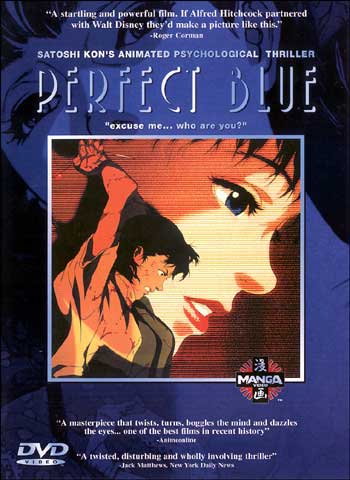 | Summary:Highfalutin, disturbing psychological thriller follows a discombobulated pop-idol through iconographic apparitions. Satoshi Kon's ambitious, terrifying "Hitchcock-esque" endeavor is ideal for mature audiences seeking rousing; bloodcurdling suspense. Surreal animation. |
| Title Aka: | N/A |
| Company/Distributors: | Rex Entertainment;Mad House;Manga Entertainment |
| Year: | 1997 |
| Length: | 83 Minutes |
| Rating: |  |
| Genres: | Suspense, Horror, Thriller |
| Format: | Feature Film |
| Content Level: |
|
| Comments: | N/A |

"Perfect Blue" (1997):
-Satoshi Kon's "Perfect Blue" has often been described by it's plethora of onlookers as: "Alfred Hitchcock meets Walt Disney"; flattering yes, yet still not always entirely accurate one might be inclined to say. This is a truly terrific and ambitious thriller, which somehow manages to constitude two distinct parallels. One of them being: the emotional and psychological 'breakdown' of a certain character (or is it two characters?). Also, it serves as a fast-paced thriller full of often shocking reveals & twists. However, the half of these in which the film succeeds is always a marvel next to the somewhat sloppy & unremitting style of "shocker" that it is. The 'hero' of this piece is known as "Mima", an inconsistently insecure 'pop-idol'; who is the type of person who might; let's say: enjoy looking in the store windows, more than she likes listening to her friends talk while shopping. Mima is an artifice for the media, employing the usual fanfare of 'pop-idolism' or so it would seem. With appearances in various concerts, photos in magazines & television ads; her pride & joy is with her close musical group "Cham". The trio has produced many instant hits in the past, but they are now but only a faded memory. The beginning of the film is set at Mima's "final concert, Kon's 'camera's eye' takes us to several distinct outdoor shots involving loyals of Cham reciting words of both anguish & apprehension. There is indistinctive 'chatter' rumoring Mima's role in a television series; (all ambient noise in the making but true enough for us at the moment). It would also appear that Mima is not entirely self-owned, there are abundant camera crewsmen, producers & agents surrounding the hubbub of events; all of them discuss the stability of Mima's pop-idol role. One might also be inclined to think that maybe Mima might have a word in all of this; the other notions might have one see otherwise. Whereas, Mima personally, is simply pleasing her adoring fans. She herself can't help it if her ambitions don't fill the shoes of 'idolism' or 'commercialism'. Judging from the visual occurences of "Perfect Blue", I don't doubt that Kon might have intended it to be a quasi-documentary about 'real' pop-idols in Japan. One can greatly imagine, the abundant research & development which could have gone into the characterization of "Mima". The often expressionless, emotionally torn pop-idol (not singer, 'pop-idol') who can't dispute between diligence & freedom of her music (let alone herself). And the notion does stand clear that the music belongs to her & not the fans, but it is always the fans who determine the layout of things; often with a price too great for people like Mima to handle. This is the foundation for Kon's film, which begins as a stylish approach to romp, & then ends up in utter incognito between two characterizations; one of these being Mima's. It's always fascinating to witness Kon's wonderful sense of timing & direction here, which is often handicapped by excessive exposition of ideas; something which Kon doesn't always suggest be served as reveal-fare, but ends up being so anyway. There are two halfs to Blue's suspense, one consisting of the Hitchcock-esque 'reveals' & the others being merely psychological. I enjoyed the film heavily for it's ambition & feeling, never for it's structure or dynamic display of content. When watching an animated movie like Perfect Blue, it is sometimes difficult to sort the two of these out; which is surprisingly the main reason why I enjoyed the film so much. In our opening scenes, Mima's final concert does not go over well with the fans; there is a very small group of misfits here which cause an understir of mixed feelings at the event (not all of them being non-violent). It's easy to carefully observe the elusive figure in the foregrounds & backgrounds of this scene watching Mima's concert. An ardent fan disguised as a security guard stops the ruckus caused by the small group. There is an almost poignant point during this scene in which: Mima stops the crowd's angst with her final song (which can be either somber or anti-climatic if you read the words right). Onward, Mima vows to never sing again & take up a career as an actress. And you can all imagine how well that goes over with the rough crowd. Things first start to take a turn for the worst, when Mima becomes a small cast member in the television series entitled "Double Bind". Things start out great of course, her close friend "Rumi" is pulling Mima along the way, & Mima seems to enjoy the more shadowed supporting roles. The following occurrences however are in classic company of Hitchcock's, or any suspense maker's world. Mima receives a horde of unwanted threats (some for her demise) in the form of e-mail, fax & the internet; some of them later being verbal & even apparitions. Her fears grow as the threats do like in most thrillers, & her friend carefully informs her not to worry. Mima's fears begin to turn into nightmares as she begins having hallucinations of 'herself' as a pop-idol stalking her; informing & tormenting Mima with her worst & closest fears. Also, Mima's roles in the Double Bind evolve progressively into depper & darker terrain, of kinkier roles & unforgivable career moves in the eyes of the fans; or so it would seem. Kon does a good job of seemingly never letting us know the plot's whereabouts. Perfect Blue is constructed into several hallucinogenic occurences, many of which are implied as neither reality or imaginary; in the end it is left for us to decide, utilizing logic and pacing as our weapon. In the end, it proves useless considering Blue never covers up for it's mistakes, by resorting to a conclusion which is like hard candy in a blender. Not easily processed nor understood. Kon's effort here in Blue is visually mesmerising, and he manages to take the course of the film with dramatic set-ups & surreal imagery; which act as leverage for the pop-idol apparitions. In turn, many of Mima's nightmarish experiences involve the murders of her fellow colleagues & aquaintances. Her characterization is one of being confined and trapped, willing to break free of the torment, but escaping it in confusion and regression. Actually, the film works fantastic as the regression of Mima's pop-idol character, but doesn't succeed as well as the graphic thriller of double-crosses & plot-twists. Though I felt Blue succeeded in all these areas, in the end it was too befuddled for it's own good in these respects. I won't spoil the surprise ending of Perfect Blue (and don't kid yourself, it does have a good one), which makes little sense if you really think & ponder about the answers which have been given to us. In the film, there is a redundant parallel between the pop-idol Mima & the 'fan-boy' (disguised in the intro); which is played to be the psychotic here. While the movie does little to redeem this small aspect of the film, it plays it out into further hallucinations; making everything appear lost in a climatic jumble (all the more entertaining, or so it would seem). In the end I feel Blue falls just short of being a masterpiece, but still just slight. It's engaging & taunting through it's first half, also the same around the next corner; while not nearly as gratifying or perplexing. There is a point that serves as an in n' out dream-scape of different events. It occurs with the 'fan-boy', "Rumi" & "Mima"; outdoors, indoors & both. I believe it ends in either two or three reveals, but the math escapes me at the moment. But at the same time, this is perhaps the film's message. Perplexing ideas interwoven to form a collection of lost (rather misplaced) events and memories; which play themselves out in a revealing (but conventional) ending of sorts. This alone prevents Perfect Blue from entering it's own realm of "perfection", but at the same time holds our attention for second & third helpings. If any of those things is even a hint of Kon's greatness in forming this film together, despite it's randomness & often sloppy execution (which is always visually marvelous by the way); it would not be as perplexing as the film's plot, to say that Kon's effort pays off. Hopefully those who truly love Perfect Blue will forget it's mistakes & get lost in the mayhem; which I admit to doing with quite a heavy interest.
|
