
Grave Of The Fireflies |
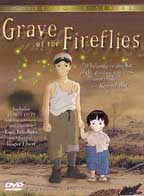 | Summary:Highly poignant, often disturbing, anime/historical/drama follows the struggle of young siblings durring post WWII Japan. It's masterful storyline, thought provoking drama and unforgettable characters make this gem a true classic. |
| Title Aka: |
|
| Company/Distributors: | Emotion;Central Park Media |
| Year: | 1988 |
| Length: | 88 Minutes |
| Rating: |  |
| Genres: | Historical, War, Drama, Classic |
| Format: | Feature Film |
| Content Level: |
|
| Comments: |
|
|
Synopsis:
"Why do fireflies die so fast?"... Though said out of mere synergy, this is a question which is cogitated rather than spoken of by four-year-old "Setsuko". The often distraught child's expression speaks wonders for her older brother "Seita", a fourteen-year-old son of a carabineer; amidst the brooding terminus of history's greatest melee of shells, explosions and the moribund. Now, I'm not about to conjure up an intellectual argument about the subject which has (Probably and most likely) become the most sensitive and brooding of all notions. Movies have been with us for over a hundred years now, and they have been there to convey the emotions and toils discovered in war. One can also argue that war is about struggle on so many levels of a physical and psychological bent. Movies throughout their popular history however, have for the most part displayed only the adulation of struggle; such ideas could be thought of as merely contradictory. However, movies often help us to share a flavor for such ideas. First and foremost, probably as close as we'll ever wish to become of such things. Moreover, I doubt anyone can argue the notion that images are far more powerful than any "lemmas" or lengthy chains of dialouge. "Grave of The Fireflies" is a film conveying a very different kind of struggle, and quite simply put; one masterful in so many ways. While the actual premise of the film is relatively basic, the subtle yet unfathomable images the film expresses are nothing short of spellbinding. A movie which in turn is so painstaking through it's utilization of characters and images, that it displays apsolutely no signs of consternation; something which is sadly enough, an aspect which too many films of this caliber share. The movie was directed by "Isao Takahata", the longtime colleague of the famed "Miyazaki"; who's illustrious presence in the world of anime seems unsurpassed. However, Takahata's film is so brilliant that it arguably surpasses the sheer quality of the veteran director's works. It may come of no surprise that one will keenly begin to observe the sheer detail while watching a movie like "Grave Of The Fireflies", one so powerful that I feel it surpasses any single film of such parameters. You may discover that many films do not even begin to measure up. Simply put, It's a film that cannot be missed.
Review:
If one were to simply describe the basic plot elements of "Grave Of The Fireflies", they may be in for quite a jolt; because quite honestly, there's really none as such here. It's a modest epic of survival between two youths, whom of which are victims of their own starvation; A janitor (Having already searched the remaining carcasses) picks up an empty metal container, what will be discovered inside however is the compendium of loss and life; young Setsuko's abided journey which begins and ends with a "discarnate-like" train ride. And the tyranny of war in it's most brooding and highest form; our youth. While much of the film's storyline is considerably desultory, Grave makes impeccable usage of it's opportunity to display it's secondary characters. Each one from the "aunt" at the bomb shelter and haven to "Seita's" moribund mother are painstakingly rendered and designed. Moreover are the epitome of detail one can observe with landscaping and the various gloaming beaches and sunsets. The dog-fight sequences and air-raids in the film (While considerably scarce to the plot) are also well-crafted and fast-paced; succeeding in making us part of the action while not diverting from the storyline intent. This is what I feel to be one of the high achievements of a film like Grave Of The Fireflies. You'll find it's not often one anticipates the arrival of quiet lexeme and elongated images of visage and lush environments. Such is the epitome of "Miyazaki's" works among others. I feel this film has surpassed the beauty of such conceits. There's no doubt in my mind that one of the most difficult aspects about Grave Of The Fireflies (Which I'm sure will apply to many) is it's sheer ability to depress with it's subject matter. Which can be considered too heavy by most viewers. I have no doubt that many will find it quite difficult to view this film. Nevertheless, those who can look past the apparent terminus of the "in-extremis-events" will witness some incredible film making in the works. It's often that Grave succeeds in conveying things which appear so valid and scrupulous, it almost hints at being incorporeal through artistic expression. Grave Of The Fireflies is the most emotionally invigorating anime film I've ever seen, never for it's elongated detail or simply dramaturgic-esque moments (Speaking of which, something it contains a lot of); always and foremost for it's trueness and modest allegory. An empty candy tin, a brooding train and a plethora of vibrant "fireflies" are among the most effective. Young but still maturated "Seita" looks upon a wry and highly upsetting situation, in which his younger sister buries the huge numbers of firefly cadavers. What he imagines in the following sequences is apsolutely heart-breaking, and sadly enough; incredibly foreseen through the movie's undeniably present adumbration. Something which frequently occurs, but is hardly expected nor wanted. Images in Grave are highly methodical and rendered through the highly unorthadox animation-technique of "Browning"; creating a more surreal and painstaking look. Following the departure of Seita and Setsuko's first refuge at a mean-spirited "aunt's" home, the movie enters a period of elongated duration and imagery which is perhaps the most touching of the film; the lasting bond between brotherhood and sisterhood, and it's often a crying shame that it happen to stem so quickly. The epitome of human emotion can be witnessed, it's brazen and unparalleled fight for struggle and impeccable will to remain blithesome in a world so defiled it's amazing it can hold such beauty. Such is the setting of Grave of The Fireflies, which is as beautiful as it is haunting and nostalgic. Though amid the most happy and vibrant moments of the film, it's perhaps impossible to be left unmoved. In one amazingly detailed scene (And believe me, I mean it when I say detailed), a starving Setsuko is gazing at her older brother returning from a disappointing frisk for food and/or hope. He soon learns that his little sister has developed a knack for constructing mud-aliment. Tears stream down from his face in disposition. In another scene, Setsuko attempts to gain any little somnolence she might have left in herself; Seita, though trying to console her is advocated. And perhaps from his own ironic liability. The rest of the world may inform Seita that he must act as a grown-up, but nonetheless he himself knows better. He must salvage any innocence remaining in his drudged hands and heart, something he often takes the blame for in Setsuko's place; an honor and humble diligence which is perhaps more important than any soldier's struggle in battle. The others however are perhaps luckier that Seita, he has to live with it after all. Alas, men-at-arms and their lovers return to garner the remainder of sustainable life, their ballad of sorrow is elapsed over music-records; which presently seem antediluvian rather than they appear well-deserved. With the hindmost of their journey, in an etiolated bench of a comely meadowland, Seita gazes upon the twilight of a vibrant and lush conurbation. One no longer consumed by the moribund, rather one of a huge candescent glow. Along with the fireflies not far behind and Setsuko fast-asleep. And thus, with this abysmal image perhaps the gleam of hope for Seita and Setsuko does not remain untouched in the darkness of shattered dreams and optimism. Lucky for them, the fireflies are their to help light the way. Even amidst the darkness of the film's end, the light of the fireflies remain long after the credits are over.
|

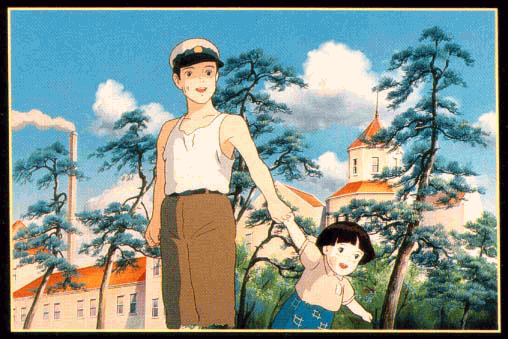 rather than at the hands of war and epic malignancy. But much like an epic, in more ways than one Grave proceeds to craft for us the meticulously detailed and perhaps harrowing struggle of "Seita" and "Setsuko". The film is constructed into a series of offbeat and surreal vignettes of character dialouge; as well as a fine treatment of some really grating imagery. Despite all this however, where the film presumably muddles itself into a systematic offspring of cliché melodrama, the movie succeeds heavily in flying colors. This is the true heart of a film which inspissates itself into some of the highest achievements of rendered animation thus far. Grave Of The Fireflies is indeed not only an astounding display of the human emotion, but also a clever exposition of impeccable artistry. The rudimentary section of our story finds us bemused by an erstwhile and dejected exegesis, arguably the most powerful of the entire film. Amidst the demise and destruction remains the baleful train station, there lies fourteen year old "Seita"; powerless and vacuous.