
Neon Genisis Evangelion |
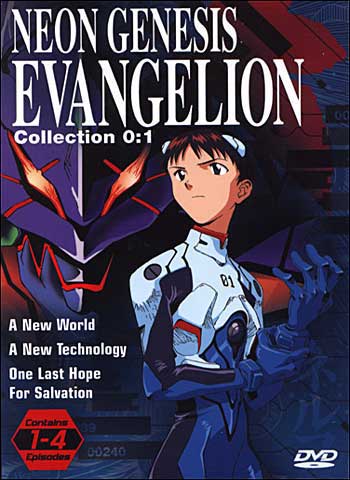 | Summary:Thrill-a-minute, mind-bending psychological drama concerns befuddled and precocious teens holding the antithesis to mankinds' subsistence. Illustrious, highly-controversial epic remains a roller-coaster ride for sci-fi/mech/action fans; adventurous drama lovers seeking massive social commentary. Furiously cryptic narrative. |
| Title Aka: | Shinseiki Evangelion |
| Company/Distributors: | Gainax;XING;Star Child;Movic;A.D.V. Films |
| Year: | 1995 |
| Length: | 26 Episode Series |
| Rating: |  |
| Genres: | Science Fiction, Drama, Action, Mecha |
| Format: | T.V. Series |
| Content Level: |
|
| Comments: |
|
"Neon Genisis Evangelion" (1995):
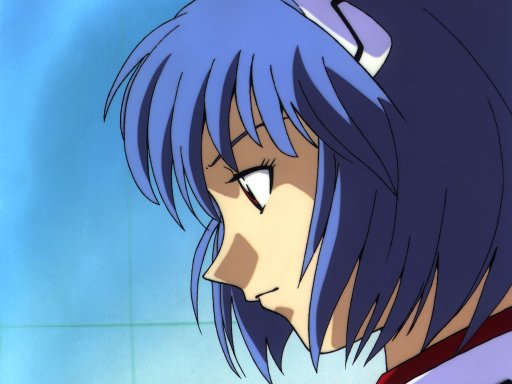
Ya know, it's always one thing to have a presented topic for an animation director. It's also one thing to have an animation director present a formula all their own. -- In the late 90s, the innovative "Shinichiro Watanabe" (having come off of such Kawamori endeavors like "Macross Plus) was assigned a small task by his executive animation producers; they wanted him to make a series which somehow involved space ships. Anything, so long as it involved space ships. Of course, many fans are aware that the resulting product was a little series called "Cowboy Bebop", which evolved into one of the most acclaimed titles of the late 90s. In the end, it would seem that remarkable vision & execution had a way of stepping in at the last minute; as did a plethora of talented efforts to boost the scenario to a high plain of artistry. As it sometimes goes without saying: the result is often monumental compared to the original intent of the studios, mangas or even the directors themselves. The same could be said about Anno's "Neon Genisis Evangelion", an innovative series erupting during the peek of animé's success in the United States. It foremost remains to be one of the most popular animes of the 90s, and also the most controversial. As an anime, it's a journey like most, in the way is successfully carries a series of emotions, twists, turns & ideas; but it's qualities exceed far beyond it's intended realms of entertainment, into something which has become almost pietistic in the realms of commercial anime & it's ardents. 'NGE', or so it's often called is primarily a mech series; really, are you surprised?... You might be more surprised to discover that Evangelion is more famous for one reason & one reason only; it's immense and often peculiar emphasis for it's abstract story, which has become well known for it's high implication of both spiritual and heavy religious themes. But unlike many animes which often manage to scream 'sanctimonious allegory', NGE is primarily a both philosophical & sci-fi exploitation plot. Rather than slip into awkward tangents or storylines, Evangelion keeps true to it's core & vision with a cast of extraordinary characters. Which have all become artistic beacons for fans as well as animators. As perhaps the most influential anime of the mid-90s (along with the incomparable "Macross Plus"), NGE explodes onto the scene, to the point when the audience is heavily involved with the fight. This epic battle is somewhat different from most, due to the fact that it involves a series of seemingly villian types known as "the angels" (there are evidently religious implications here, but for sake of argument we'll stay out of them for now). The angels are massive and hostile beings sent to destroy mankind, which all sounds bromide only if you look at the script on paper. The first rousing few minutes of the show serve as the key introduction of the show's main character "Shinji Ikari", an adolencent with a destiny to destroy the angels. Through some clandestine connections, Shinji later finds himself in the safe company of "NERV" agent "Misato Katsuragi". (who'd be a quasi-role model for the young boy given anyone in the show would pay attention). Misato comes across Shinji while an angel is destroying part of Tokyo. After both having successfully escaped a devastating blast from an "N-2 mine" (courtesy of NERV Headquarters), Misato informs Shinji of the crucial information which will eventually aid his victory, as the youthful instigator for the fight against the angels; in the form of none other than the young pilot of "EVA Unit-01". This of course, is designed by Shinji's father ("Gendou Ikari"). The two are emotionally distant, both feel neglected from one another; which makes their first meeting at NERV extremely brief. Shinji's refusal to pilot leads to some bad blood amid an argument with his father, and the summoning of the 1st pilot "Rei Ayanami". Rei is heavily injured, so Shinji decides to place the fate of the city on his shoulders. Well, if you're an anime fan you'll know that twenty minutes rolls by pretty fast, & young Shinji is caught in the middle of a battle to save Tokyo (#3 to be exact in this near future of advanced cities -- the buildings come up & down out of the ground as if a military exercise). The EVAs themselves are short for "Evangelion", gigantic humanoid mechanisms designed to fight the angels & to be only piloted by 14-year old "children". There is a dark, DARK history about the EVAs which is commonplace in fan-SPOILER discussion; as a reviewer I'm perhaps not obligated to enter that terrain. As much as NGE is concerned with intensive action & suspenseful situations (which by themselves make the show a masterpiece), the core of Evangelion's storyline is dealt with the incredible complexity of Shinji's character; the denial from his father, and the psychological transformations he undergoes. Which in themselves, have become classic & unforgettable. But Shinji encounters many obstacles, in the forms of new friends, classmates & guardians. Misato attempts to come off as a humble parent figure, but Shinji's defiance of Misato & NERV aid a sense of emotional hills & overlaps. It is perplexing and engaging to watch, accompanied by rich dialogue. Rei Ayanami is the most interesting & popular character of the series, her personality & appearance does a substantial job of being self-explanatory, but she is a peculiar and deep character in her own right. Shinji seeks emotional comfort from her but ends up in denial of himself & others, it is the solemn tragedy of his character which heals from inner-growth; a trait which fans have come to know and love (or loath, depending upon your point of view). Of course, there are many other characters including one of the head NERV operators "Ritsuko" (Which is like a cross between "Dr. Jekyl" & a comely young woman scientist), "Asuka Langly Soryu" is among the four children; (one of which undoubtedly arrives in the form of Shinji's close classmate). Asuka however, is a feisty red-head who's 'half-German/half-Japanese' (her EVA also sharing the same color as her hair pigmentation -- funny in itself). Asuka is often the most irksome and interesting character because of her brooding & mysterious past; which unravels as her relationship with Shinji & the others progresses. There are three panel operators at NERV HQ, as well as the elusive group of SELEE; Misato's boyfriend "Kaji". Oh, and there's that penguin that everybody loves. Anno does a good job of balancing the two halfs, the adult characters have their fill of conversation while the 'children' engage into verbal mettles of their own. Anno often utilizes silence to his advantage to convey a unique sense of emotion (some of which last for whole-minutes on end!). The first half of the series is bursting with action, light-hearted comedy, and is pretty much customary to mech/sci-fi. However, the show takes a dark & dramatic turn (quite literally) into the second and last halfs. These periods are both mindbending, profound & engaging; using up much of Anno's effort and vision. On a more disappointing note, the technical expertise of the show falls short in the second turn, but rarely does the enormous appeal of the show's emotion & characters. It is here where we learn the secrets of the EVAs, Rei Ayanami & the rest of the characters' fates; which come off as exciting, but perhaps not always the kind we easily imagine. The show's end has left fans with much contradiction, over the quality of budget & vision for the director at hand. Could such a show full of all that technical bent fall so short of modest animation for expressionistic purposes in the last half? Well, the answer is: I don't feel it hurts the show at all, considering it is Anno's vision as an animation film maker. Of course, everything I've said is only a small fraction of what NGE is really about. But if there's one thing that Neon Genisis Evangelion always shows us, it's that great characters, concepts and images can be pushed to the outmost limit of physical and emotional expression; through dialogue and characters. Characters which Anno teaches us to both love and often hate at the same time. It's not often that directors achieve this, especially with animated works. Further proof that NGE is no walk in the park, but a mesmerizing thrill ride; full of energy & deeper meaning. But at the hindmost, NGE's images are most unforgettable. Now, I must've seen this show at least twenty times; but I can tell you that it's just one of those series which just gets better & better with each repeated viewing. Enough times for either people like myself or Shinji to figure things out for ourselves.
-- WARNING: Contains Brief Strong Violence, Thematic Elements, Some Disturbing Imagery & Innuendo --
|
