
 |
Chemical Facts | home
back to Chemical Facts
 Origin and Effects
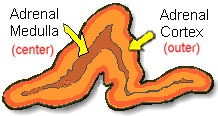
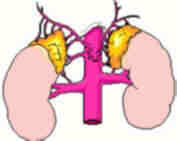 Adrenaline is produced in adrenal glands that are located above the kidneys. They are approximately 3 inches in length and about 1.5 inches in height. An adrenal gland is made up of two parts; one part is the medulla, which is the inner most part of the gland. The medulla is the part in charge of the making of adrenaline.
Adrenaline's natural abundance in nature is not known, because it is produced in every human body, and thus varies from person to person.
 Adrenaline has several effects on the body. At first it makes some of the smaller blood vessels close up while it makes the blood vessels in the liver and the skeletal muscles widen. By making the less important blood vessels smaller, and opening up the more important blood vessels, a better blood flow is created. With this better blood flow towards the skeletal muscles and liver, the muscles and liver are better able to function to increase in oxygen that they are receiving. Adrenaline is also responsible for the collapse of glycogen to glucose, increasing the sugar content in the blood. Adrenaline increases the contractions of the heart, which creates a stronger blood flow. It also increases the amounts of flowing free fatty acids, which allows the body to use them whenever necessary.
Other effects include: increase in the rate and strength of the heartbeat, dilation of bronchi and pupils, vasoconstriction, sweating and reduced clotting time of the blood.
Adrenaline is obtained naturally in the body and is made synthetically as epinephrine.
|
|
