ASPIRE
Project 2003
UMS-Wright
Preparatory School - Mobile
High School Division II
Physics
By Beko Binder, Donell Hill, Arthur McMillion, and James Wishon
Abstract Introduction
Problem Description Method
of Solution Results
Conclusions Future
Work Bibliography
Appendix Coding
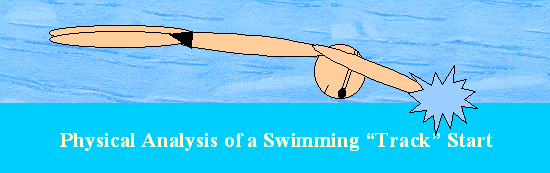
In many cases, the most important part of a swimming race takes place in the first few moments. A good start can separate a spectacular performance from a mediocre one.
In our experiment, we studied the relationship between the impulse applied to a starting block by a swimmer performing a “track” start, the mass of the swimmer, and the effort applied by the swimmer to travel from the block to the entry point in the water.
To collect data, we used a Vernier™ Force Plate to measure the force exerted by the swimmers, which was later used to calculate impulse. We also used a Sony® Handycam™, Pinnacle Studio 7 software, and a marked backdrop to determine the distance traveled before entry. Using the distance, we then calculated the effort exerted by the swimmer.
Initially, we predicted that the impulse provided by the swimmer would be directly proportional to the effort exerted during the start and inversely proportional to the mass of the swimmer, due to algebraic manipulations with respect to the units. Surprisingly, our results did not confirm our hypothesis, but with the introduction of a constant, we were able to calculate the impulse of the swimmers to within 10%.In many cases, the most important part of a swimming race takes place in the first few instants. According to Ross Sanders, race analyses performed on events in the 1999 Pan Pacific Championships showed that the “start times are significantly related to race times in most events regardless of the stroke…includ[ing] the…400m freestyle events” (Sanders 1). This means that a quick start can shave a significant amount of time off a swimmer’s race. In interviewing top swimmers, we found that almost all of them agreed with the advice that “you want a quick start to get off the blocks and into the water as soon as possible…in order to reduce resistance and avoid being caught in your opponents’ wake…because you want as little drag as possible” (Sims).
With one of our members being actively involved in the swimming community, we chose to perform this experiment in order to expand our knowledge on the science of a “track” type swimming start. In our experiment, we studied the relationship between the impulse applied to the block by a swimmer performing a “track” type start, the mass of the swimmer, and the effort applied by the swimmer during the start. We assigned the variable “J” to the impulse applied during the start, while “E” was defined as the effort (energy) exerted by the swimmer to perform the start. The variable “m” was used to represent the mass of the swimmer. We also introduced a constant, “H,” to our experiment at a later point.
In this experiment, we sought to discover and analyze the relationship between the impulse applied to the starting block by a swimmer performing a “track” type swimming start, the mass of the swimmer, and the effort applied by the swimmer during the start. By collecting the appropriate data relating to each of the variables that we studied, we hoped to be able to find a definitive relationship that would broaden our understanding of track starts, and eventually let us discover more efficient ways to combine the three variables for a better start.
However, when studying an experiment under imperfect circumstances in an open system, we were limited by the precision of our equipment and a certain degree of human error. Because the swimmers that were used in our experiment were highly trained, competition-level swimmers, the respective angles, velocities, etc of their start were assumed constant. However, any slight variation in any of the angles or speeds could have distorted our results to a slight degree.
We were also limited by a shortage of volunteer swimmers, which resulted in a much smaller testing “population.” In addition, we had fairly short time slots in which to perform our experiments, which resulted in a rushed atmosphere that made the experiment more prone to errors. Lastly, the fact that the Force Plate was set to measure forces up to 3500 N made it more likely that less precise measurements were being taken by the plate.
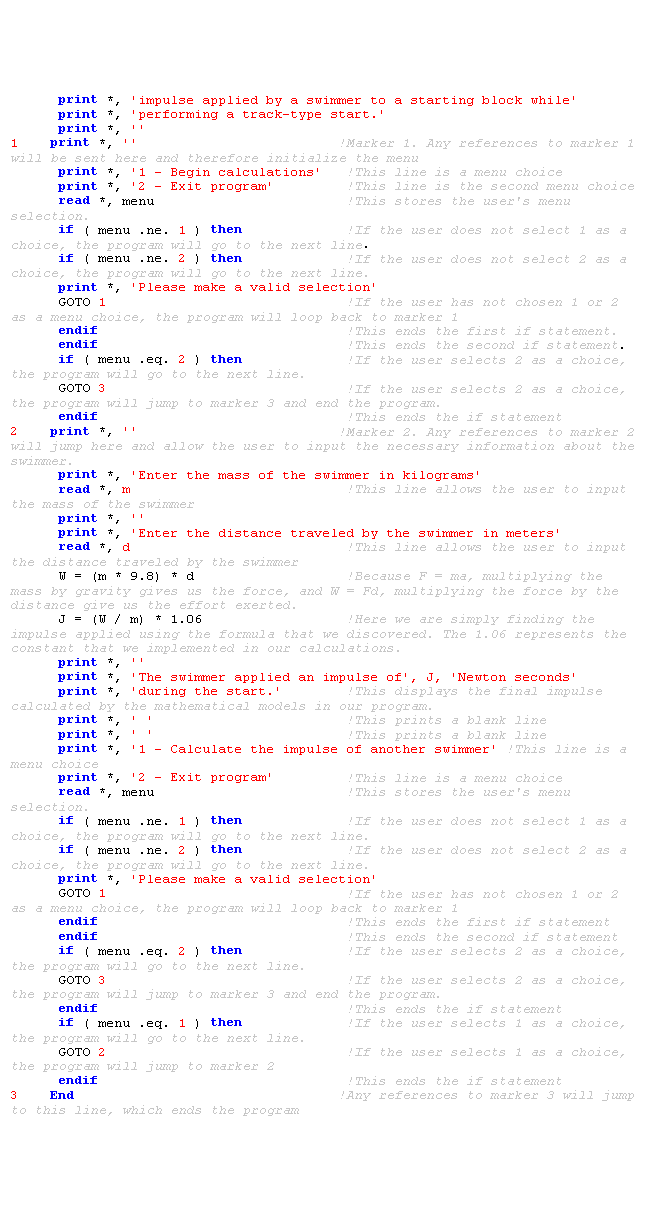
For our experiment, we used a modified setup that allowed us to examine the variables that we chose to study in great detail. First, we placed a modified starting block (20in x 23.5 in) on top of a Vernier Force Plate to spread the force of the start more evenly over the surface of the instrument. The Force Plate, which measured the force of each run, was connected to a Vernier LabPro™ that stored the data on a TI-89 graphing calculator. This data was then transferred to a PC and analyzed using Microsoft Excel, Vernier’s Logger Pro, and Vernier’s Graphical Analysis. Using the Logger Pro, we were able to integrate the data, which gave us the impulse applied during each swimmer’s start.
In order to calculate distance, we marked a black plastic backdrop with tape at every 0.25 m, making the marks at 0.5 and 1 m longer than the others. We then filmed the start using a Sony Handycam video camera. The film was transferred to a PC, and the video was broken down frame-by-frame using Pinnacle Studio 7 software that allowed us to measure the distance traveled by the swimmer.
In order to get several different data sets, we enlisted the help of 3 swimmers who each performed 3 starts, giving us a total of 9 starts.
After collecting our data, we used several sets of reasoning to come up with a relationship.
We know that every object as a certain momentum,
or tendency to resist a change in motion. Based on the laws of physics
quantifying this tendency, we know that
J = FΔt
(1).
In formula (1), J represents the total impulse created in a situation, F
represents the force exerted by an object or particle, and Δt is the
change in time during the condition. Taking this property into consideration,
we found the area under the curve of the graph of the force vs. time data
produced by the force plate (also known as integration). Integrating the
information from the run created results in units of Newton-seconds (Ns) since
we multiplied the axes (force in Newtons and time in seconds) to find the area
(see figure 1).
Figure 1-1
.jpg)
We then averaged the respective impulses applied by each swimmer and used the resulting impulse for the rest of our calculations.
Also based on the laws of physics quantifying the
state of matter, we know that
F = ma
2).
Formula (2) simply states that the amount of force applied by an object
(its weight) is equal to the mass of the object times the acceleration. From
formulas derived from experience in swimming, we were able to derive the
formula
E =
Fd
(3).
Formula (3) demonstrates the concept that the effort applied (energy used) by a swimmer to perform a swimming start is equal to the force (weight) of the swimmer times the distance traveled in the air before entering the water.
When we combined formulas (2) and (3), we were
able to come up with the following formula for the effort exerted by a swimmer
performing a start
E = d(ma) (4).
By manipulating the results from the impulse applied to the block, the effort exerted by the swimmer, and the mass of the swimmer, we were able to come up with a relationship between the three variables, J, E, and m:
J = E
(5).
m
Figure 1-2

However, the units of this formula do not cancel out. Rather than giving units of kilograms times meters per second, also known as a Newton-second, the results that we got were in units of meters squared over seconds squared.
Because the actual numbers came within such a close range of the predicted results, we concluded that there was some factor that we did not quite understand. In order to complete the formula, we introduced a constant, which we designated “H.” We determined that in order to fully complement the rest of the variables in the existing equation, “H” has to have units of kilograms times seconds over meters. Although we are not sure what the units of H mean, we suspect that they may represent the amount of mass that has to pass over a certain distance in a certain time in order to complete the start. Therefore, we were able to come up with a formula that represents “H”:
H = 1.00 kg * s
(6).
m
By incorporating the constant “H” (Formula (6)) into Formula (5), we were able to come up with a complete relationship between the impulse applied to the starting block by a swimmer performing a “track” type swimming start, the mass of the swimmer, and the effort applied by the swimmer during the start:
J = H * E
(7).
m
This means that in order to reduce the amount of effort applied in a track start, the swimmer must reduce both his or her mass and impulse.
We also hope to be able to perform experiments that are more precise in the future, with better equipment and more mechanization to reduce human error. Lastly, we hope at some point to be able to perform similar experiments on other types of swimming starts and compare those results to the findings from this experiment in order to understand the pros and cons of each type of start.
Sanders, Ross. “Start Technique
– Recent Findings.” Moray House School of Education, The University of
Edinburgh, Holyrood Rd, Edinburgh. 5 January 2003. <http://www.education.ed.ac.uk/swim/papers4/rs5.html>
Sims, Anne Marie. Interview. 23 January 2003
Appendix
Figure 1-1
.jpg)
This is one of the Force vs. Time graphs created by plotting the average data the starts of one swimmer. The integral of the graph shown is the known impulse of the swimmer, “J.” Data was collected every 0.02 seconds for approximately 1.5 s. Each swimmer’s averages provided a slightly different graph, due to their respective weights and the respective strength of their starts, but the general shape of their raw graphs all consisted of basically the same shape.
Figure 1-2
.jpg)