Forms of Marine Pollution
Heavy Metals
These include Cu, Pb and Hg.
They are essential for life but only in small amounts.
Once useful levels are exceeded they can be very toxic.
They readily accumulate in filter feeders such as Clams.
Heavy metals affect the reproductive system and can cause infertility.
They are very persistent and remain in the marine environment for long periods of time (Haynes & Johnson, 2000).
Cyanide
Cyanide is a compound of Carbon and Nitrogen.
It is generally found as Hydrogen Cyanide.
Cyanide is very toxic, and is lethal even at lethal at relatively low concentrations.
It does however disperse relatively quickly in the marine environment.
Cyanide kills animals by stopping the respiratory and nervous systems from working properly (Halim, 2002).
Polycyclic Aromatic Hydrocarbons (PAH’s)
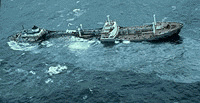
These are constituents of crude oil.
They are very persistent in the marine environment and very difficult to clear-up.
PAH's are extremely carcinogenic and can even be lethal at high enough concentrations (Haynes & Johnson, 2000).
click the picture to link to full size
Organochlorines
These are the active ingredients of pesticides and herbicides.
The organochlorines group includes substances such as DDT & PCB.
They are very persistent in the marine environment.
Organochlorines vary in toxicity.
They are generally designed to act on the respiratory or nervous systems (Haynes et al, 2000).