 I started skydiving back in 1968 at the Taft County Airport, Taft California. By 1970 I had acquired 100 parachute jumps. In January of 1970 my roommate and I decided to build a van that we could live in and tour the US. We put on an extended top and inside, installed every moderen convince known to man. We traveled up the coast of California and then on across the United States and stopped in Morristown, TN. Here my roommate decided to live with his sister and left me to continue the trip along with my dog Otis. Being a commercial pilot and having 200 flying hours, I went to the nearest airport to seek out information about skydiving clubs in the area. Surprisingly, I ran into a farmer who was a jump pilot and he told me of a club out of Knoxville that he flew for. I was in heaven. I decided to use Morristown as my home base and travel the sky diving circuit.
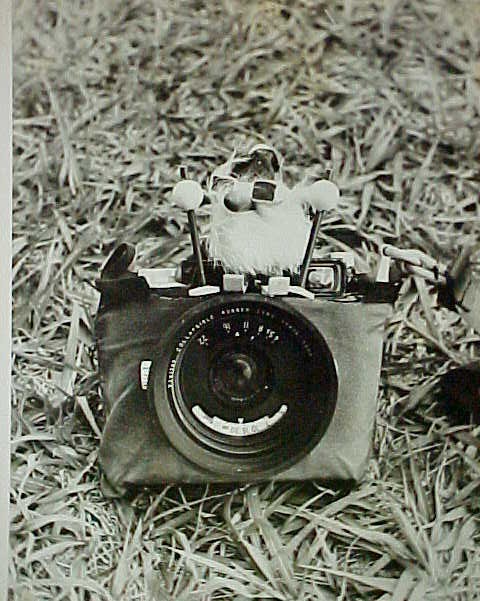
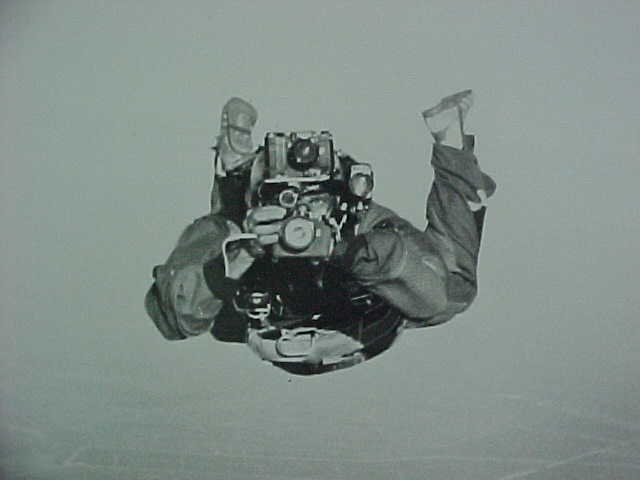
Being a pilot and already a jumper, I seemed to fit right in. Before I started my trip across the country, I picked up the skills of photography and sewing. I learned to make all the cushions and curtains for the van. These skills proved to be invaluable when it came to the skydiving industry. I noticed that the jumpers, being very out going, wanted photographs taken of themselves, especially in freefall. This is where my skills of working with tools and being a candle maker (making candle models) really paid off. I decided to build camera mounts for two cameras and bolt them to my helmet. They were a super8mm movie and a 35mm Nikon F still camera. The still camera used a 35mm wide angle lens and a motor drive. To align the helmet mounted cameras, I acquired a military Neuton ring sight. I sometimes used a third camera, a manually operated Nikonos underwater camera, that I had strapped to the back of my left hand. Since then I have made around 800 camera jumps and have carried as many as three cameras at a time. Again being handy with tools, I decided to add a photo lab to my van. Black & white photo processing in my van was simple enough, but when Unicolor came out with a three color process, I decided to include color processing. Now I could go to parachute meets and take freefall pictures during the day time and process them that night. You can't imagine the look on people's faces when I showed the jumpers an 8 x 10 glossy photo of their jump from the previous day. Get the picture?
Along with the skills of a photographer, I realized that parachutes like any other form of equipment, need repair. I already had a sewing machine with me in my van, so I thought why not make use of it. I decided to see if any of the jumpers needed someone on the spot to make repairs. Guess what the answer was? This encouraged me to get my seniors and eventually my master riggers parachute license. Not only could I fix other people's equipment, but I could fix mine as well. This lead me down the road of becoming a parachute manufacturer where I designed and test jumped my own parachutes. Boy, talk about excitement!
Besides these interests, flying is my second love. Being around airplanes really caught my interest. I decided to obtain my aircraft mechanic's license. How could I fly and not know how to work on my own planes? I had two Cessna 182's which I used for a parachute club I started in Birmingham called Alabama Aero Sports. I even taught a course in skydiving for UAB Special Studies. As if this were not enough, I decided to teach flying and obtained my instructors and instrument instructors pilot license.
Currently I fly with the Civil Air Patrol and am a member of the Birmingham Composite Squadron 34. Here I use my skills as a flight instructor and aircraft mechanic to maintain my flight experience and keep our squadron plane in good condition.
Hope you have enjoyed this story. I believe that one should try to realize his/her own dreams. Blue Skies and may the wind always be at your back!