
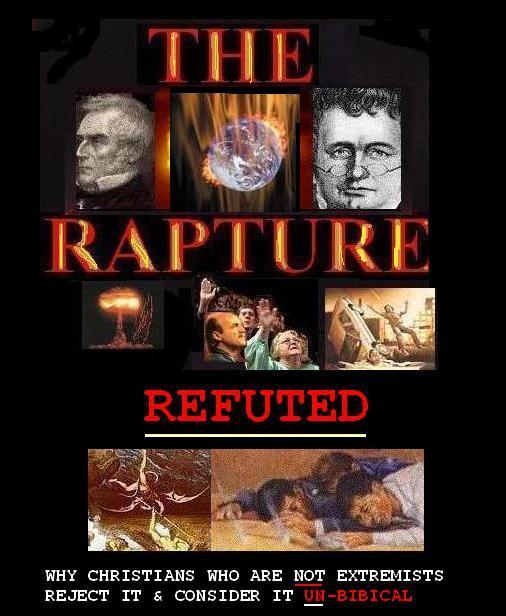
Great Points:
In the United States, several million people have succumbed to an extraordinary delusion. In the 19th century, two immigrant preachers cobbled together a series of unrelated passages from the Bible to create the famous "Left Behind" series.
‘Talking in Tongues’ for Fun and Profit.
by Cyril Blakeley, DD
The Christian Journal June 23, 2004 What makes the story so appealing to Christian fundamentalists is that before the big battle begins, all "true believers" (ie those who believe what they believe) will be lifted out of their clothes and wafted up to heaven during an event called the Rapture. Not only do the worthy get to sit at the right hand of God, but they will be able to watch, from the best seats, their political and religious opponents being devoured by boils, sores, locusts and frogs, during the seven years of Tribulation which follow.
The true believers are now seeking to bring all this about. This means staging confrontations at the old temple site (in 2000, three US Christians were deported for trying to blow up the mosques there), sponsoring Jewish settlements in the occupied territories, demanding ever more US support for Israel, and seeking to provoke a final battle with the Muslim world/Axis of Evil/United Nations/ European Union/France or whoever the legions of the antichrist turn out to be.
The believers are convinced that they will soon be rewarded for their efforts. By clicking on www.raptureready.com, you can discover how close you might be to flying out of your pyjamas. But the rapture is currently being delayed by an unfortunate decline in drug abuse among teenagers and a weak showing by the antichrist (both of which score only two).
That their beliefs are bonkers does not mean they are marginal. American pollsters believe that 15-18% of US voters belong to churches or movements which subscribe to these teachings. A survey in 1999 suggested that this figure included 33% of Republicans. The best-selling contemporary books in the US are the 12 volumes of the Left Behind series, which provide what is usually described as a "fictionalised" account of the Rapture (this, apparently, distinguishes it from the other one), with plenty of dripping details about what will happen to the rest of us. The people who believe all this don't believe it just a little; for them it is a matter of life eternal and death.
WHERE DID THIS 'RAPTURE' IDEA COME FROM? ...And Why The Non-Extremist Mainstream Christians Reject The 'Rapture' Belief As Non-Bibical
But just how did the 'rapture' belief come about anyways? That is a very long story. But basically, the beginnings of the rapture theory can be traced back to Nelson Darby. Today, it seems that amoung Evangelical Fundamental Protestants, anyone who does not accept the 'rapture' belief is "Unorthodox". However, such "unorthodox" ones would included their Protestant peers: Presbyterians,Methodists, Episcopalins,Lutherns,Disciples of Christ Church, and Quakers.
All these also reject the teaching of hellfire as well. While Evangelical Fundamental Protestants proudly proclaim the rapture as "orthodox" Bibical Christaintiy...many are unaware that this is a in the history of the Christian church a fairly new belief. How new? Well according to a History Channel's program on Millenial movements in America when William Miller first began preaching about the end of the world and the rapture, "Methodists LAUGHED at HIM (William Miller)and were reported saying: "Who ever heard of such unorthodox teachings?"...So. what was once deemed "unorthodox" by mainstream Protestants is now deemed "orthodox" by Evangelical Protestants.
One Catholic writes:
"The Rapture doctrine, which was the invention of the Plymouth Brethren led by John Nelson Darby (1800-1882), has today been adopted by most Baptist, Pentecostals, Assemblies of God, and a variety of other fundamentalist sects. The idea that Jesus Christ will return for His true Church just before the beginning of the Great Tribulation in a secret gathering or "catching away" was an important part of Darby's teaching.
The movement in which this teaching began originated in small groups in England and Ireland about 1828 and by 1831 was part of the official teaching of the Plymouth Brethren. By 1860 the "rapture" had made its way to the United States.
Two examples of this are the Assemblies of God and the United Pentecostal Church which were not founded until early in the 20th century. At about this same time the Rapture made its way into the theology of the Southern Baptist Church, which had not previously known of the teaching.
In the 2nd Ecumenical Council definitively states and places in the Nicene Creed these words: "He shall come again in glory to judge the living and the dead and His Kingdom shall have no end." This council of the Church, held in A.D. 381 in Constantinople, pronounced for all time what we as Christianis believe about the 2nd coming of Christ. He will establish His rule on earth."
The Rapture
By: Aristobulus (Roger) Allen (A Catholic Priest)
Not only do the Eastern Orthodox, Roman Catholics, and Anglicans deny such a teaching but all "mainstream" Protestants do as well. The Rapture is not to be found in the doctrinal statements of Presbyterians, Lutherans, or Methodists (at least not in the main bodies of each of these groups). It is not in the teachings of their respective churches.
Finally, the Rapture doctrine is dangerous because it teaches Christians that they will be spared all tribulation, wrath, and danger in the last days. The need for urgent preparation of one's heart and soul is diminished because Christians will be secretly taken away from all that pain. No need to worry, we'll just fly away. Unlike the Early Christians, the end-time Christians have a get-out-of-tribulation free card called the Rapture.
Lastly, the words of the Lord in John 16:33, "These things I have spoken unto you, that in Me you might have peace. In the world you shall have tribulation, but be of good cheer, I have overcome the world."
In a little-noticed resolution passed overwhelmingly by the 2001 General Assembly of the Presbyterian Church (U.S.A.), delegates declared that the theology of the series is "not in accord with our understanding" of the New Testament Book of Revelation. The resolution urged pastors to lead their congregations through studies of the novels if they are causing "confusion and dissension."
In addition, the Lutheran Church-Missouri Synod said the books by Tim LaHaye and Jerry Jenkins are "filled with very serious errors about what the Bible really teaches." A critical analysis in December 2000 by the late A. L. Barry, then-president of the church, remains on the synod’s Web site.
By contrast, the Assemblies of God Web site carries a friendly interview with LaHaye from 2000, along with the denomination’s stance on "the rapture" as a "blessed hope." For the sinner "to be left behind will involve indescribable suffering as God judges a rebellious and disobedient world" according to the Assemblies’ doctrinal statement.
Recently joining the fray was evangelical scholar Ben Witherington III of Asbury Theological Seminary a prolific author of New Testament studies. In the August issue of Bible Review magazine, Witherington noted the popular appeal that apocalyptic literature has in unsettling times, "Unfortunately, not all apocalyptic thinking is good apocalyptic thinking, and this is especially true of the so-called dispensational theology that informs these novels," Witherington wrote. "The most distinctive feature of dispensational theology is what I call the ‘Beam me up, Scotty’ belief."
In a similar vein, Bill Hull, a Samford University research professor, told Associated Baptist Press recently that "dispensationalism," in which God tests humans in certain time periods, remains a minority view among theologians. The ideas, spread in the 1860s by English evangelist John Nelson Darby, gained popularity with the publication of the influential Scofield Reference Bible in 1909, which contains long footnotes outlining Darby’s views. A dispensationalist precursor to the "Left Behind" series was Hal Lindsey’s The Late Great Planet Earth -- a record-breaking best seller in the 1970s.
The supernatural plot in the LaHaye-Jenkins novels, published by Tyndale House, has true believers taken from the earth in a "rapture" that precedes seven years of suffering -- the great tribulation -- for those left behind. Drawing on images in Revelation, the books predict an Antichrist demanding universal loyalty and acceptance of a "mark of the beast" on their bodies. Plagues and suffering ensue until Jesus returns to establish a 1,000-year reign on earth.
Bill Hull, former dean of Southern Baptist Theological Seminary in Louisville, contends that the "Left Behind" series perpetuates "a massive misunderstanding" of scripture. Hull discounts LaHaye’s account of "a secret rapture where unbelievers don’t know why people have disappeared. He notes that Revelation 1:7 says that when Christ returns "Every eye shall see him." The present dean of the Louisville seminary, Danny Aiken, told the news service that he agrees with the books’ general theology, but is concerned about liberties the authors take with scripture.
At least one survey has shown that only half of the series’ readers can be called evangelicals. But even nonevangelicals have at least a vague sense of awful predictions in the Bible. Months after the September11 skyjacking attacks, a Time/CNN poll found that 59 percent of Americans believe that prophesies in Revelation will come true. Nearly a fourth think the Bible predicted the terrorist attacks specifically.
Two critiques of the novels have appeared over the past year in Bible Review. British scholar N. T. Wright, who has engaged in debates with liberal Jesus Seminar leaders, wrote in the August 2001 issue that the huge U.S. success of the "Left Behind" series "appears puzzling, even bizarre" on the other side of the Atlantic.
The dramatic end-time scenario of believers being snatched up into heaven is an incorrect interpretation of 1 Thessalonians 4:16-17, Wright said. That passage about meeting the Lord in the air "should be read with the assumption that the people will immediately turn around and lead the Lord back to the newly remade world" -- similar to residents meeting a visiting emperor in open country, then escorting him into the city, he said. Paul’s words to the Thessalonians, according to Wright, are not the same as Gospel passages about "the Son of man coming on the clouds" (such as Mark 13:26 and 14:62), which "are about Jesus’ vindication, his ‘coming’ to heaven from earth."
Witherington’s column in Bible Review a year later seconded Wright’s interpretation of the Thessalonian verses, arguing that, according to Paul, those meeting Christ in the sky would return to earth to reign with him there. Witherington also disputed an "unwarranted" view by dispensationalists that the last generation of Christians are "exempt" from tribulation. "Why should the last generation of Christians expect to do less cross-bearing than previous ones?’ he asked.
BrotherRog (The Network of Progressive Christianity - Forum) Posted: Dec 10 2004, 02:27 PM
What Presbyterians Believe
Eschatology
[June 1994 Presbyterian Survey*]
* Now Presbyterians Today
What Can We Hope For?
The promise of Reformed eschatology is both personal life after death and the redemption of all creation.
By Lee C. Barrett
On the one hand, contemporary "dispensationalists" like Hal Lindsey offer detailed accounts of the last days, rivaling Jurassic Park for sensational action. According to these epic scenarios, specific events like the establishment of the Jewish state in Palestine have initiated the spectacular end of our present era. The drama will culminate in the "rapturing" of believers out of automobiles and office buildings and into the heavens, followed by a time of terrible tribulation and the return of Christ to earth to rule for a thousand years.
On the other hand, the "mainline" pulpits, perhaps embarrassed by the "pie-in-the-sky-by-and-by" orientation of earlier generations, are strangely silent about "the end times." One analyst of contemporary Christianity remarked that many Protestants seem to be hoping for nothing more than present personal "holism" and some form of social justice.
If psychological and societal health exhaust Christian expectations, he concluded, the services of a good therapist and participation in a social action project should satisfy human yearnings adequately, making Christianity superfluous.
Eschatology, the doctrine of the final destiny of both human individuals and the entire cosmos, is caught between fanciful speculation and benign neglect. Both attitudes are harmful. The proliferation of end-of-the-world epics distracts us from the serious business of living the Christian life now and violates the humble limitations of human comprehension. On the other hand, the failure to say much at all concerning our ultimate hope leaves the church without a message powerful enough to grip the human heart enduringly. Is it possible to say something intelligible about our expectations without falling prey to escapist fantasies?
Two themes are prominent here. First, we can be assured that God's purposes for the entire created order will be achieved. God's creative energy and sublime artistry will be magnificently displayed. Rather than being obliterated, the cosmos will be renewed, perfected, purged of impurities, and subjected to the rule of God.
"Rather than being obliterated, the cosmos will be renewed."
One issue concerned the relation of resurrected individuals to the renewed earth. Would the saints exist in the purified earthly environment or merely view it from a heavenly perspective?
Another issue concerned the exact nature of the soul's state between death and the resurrection of the body and final judgment. What is the difference between the soul's joy immediately after death and its joy after the future resurrection of the body?
In spite of these tensions and ambiguities, we can find wisdom in the dual perspectives of Reformed eschatology. Both the "resurrection of the individual" and the "renewal of all things" address profound human longings. Humans ask ,"What will ultimately happen to future generations and this planet I have called home?" Does my life add up to nothing more than a pile of decomposing organic matter? Will humanity continue to torture itself with economic exploitation and war, destroying other species until either we blow ourselves up or a solar explosion puts this globe out of its misery?
"somehow swords will be permanently beaten into ploughshares and the lion will indeed lie down with the lamb."
We long to know both that our personal lives will not vanish without a trace into the void and that somewhere, somehow swords will be permanently beaten into ploughshares and the lion will indeed lie down with the lamb.
My body is not a prison to be escaped from or an inconvenient piece of clothing to be discarded by the soul. My body is an integral part of me. Who I am cannot be divorced from the bodily particularities that have shaped my experience. Our resurrected selves will not be totally new selves unrelated to our past selves.
The failure to say much concerning our ultimate hope leaves the church without a message powerful enough to grip the human heart in an enduring way.
The theme of a "final judgment" of individuals underscores the eternal importance of the personal decisions that determine the course of our lives. It is a graphic way of insisting that what we have done with our lives is not a matter of indifference to God. Of course the imagery of the separation of sheep and goats, of lurking demons, and of unquenchable fire does not mean that God will literally torment certain individuals forever. We should be extremely loathe to put limitations on the extent and power of God's reconciling love. It counteracts the attitude that says "As long as I get saved, everything else can go to hell."
Talk of the "end times" brings the destiny of future generations and God's creation as a whole to center stage. The expectation of the coming "Kingdom of God" has a corporate, social dimension in which the human race's aspirations for justice and community will be satisfied. The initiation of God's realm in the life, death and resurrection of Jesus gives us the strength and courage to enact love and justice more fully in our current situations, confident of God's final victory over inhumanity.
The reminder that the full manifestation of God's reign will be brought about through God's own activity in God's own time warns us against ascribing redemptive power to our own political efforts and projects. The final triumph of love and justice will be God's gift to the universe, not a human achievement.
Humanity is not the only show in the cosmic town. The vision of "a new heaven and a new earth" portrays the eventual participation of the entire created order, the universal family of which we are members, in God's victory celebration. The "end" that Christians await will not be the destruction of the universe, but its fulfillment.
All we really require is the assurance that our future rests in God's loving hands. Lee C. Barrett, formerly on the faculty of the Presbyterian School of Christian Education, is now professor of theology at Lancaster (Pa.) Theological Seminary, a seminary of the United Church of Christ. 1999 Presbyterians Today.
What Lutherns say About 'The Rapture.'
'God's Word does not teach the Rapture. Nowhere does our heavenly Father say He will remove anyone from the tribulation spoken of in Revelation; however, as the End Times occur, your gracious heavenly Father promises to give you all the strength needed to face even the most difficult suffering.'
billiefan2000 (From Beliefnet's Luthern's Forum)
4/15/04 12:27 PM 1 out of 14
Say what is the Lutheran: Missouri Synod Churches stance on the Rapture.
What is the Lutheran viewpoint on the rapture?
Lutherans aren’t real keen on the rapture, primarily because it’s a theological view that has little support in the Bible. Our task, then is to be among people sharing that love, not looking skyward, hoping to be taken to heaven while others are left behind. Put another way, we Lutherans are not real keen on the popular bumper sticker: “Caution, in case of rapture this car will be driver-less.” We simply can’t see God allowing a bunch of driver-less automobiles being left to careen off on-coming traffic.
