
The Rules of Being A Good JW:
Religious addicts are extremely loyal, even in the face of evidence that the loyalty is undeserved.One of the messages that children of religiously addicted parents learn is the need to be loyal. This message also enables the cycle of control to continue.
Fun=Sin?
One reason it is difficult to have fun is because everything was so serious and frightening. The constant injunctions to beware of the sinful - and the confusion that arose out of those so-called sinful things being fun - take the simple pleasures of life. Living in the moment is difficult for all children of dysfunction, but it is especially difficult for the children of religious addicts. After all, from infancy, you are preparing for paradise.
Religious addicts have difficulty having fun
The excessive emphasis on outward behavior is a heavy burden for anyone to bear, and it becomes especially difficult for young people who hear more about holiness than they do about love and forgiveness.
Religious addicts have difficulty with intimate relationships
Learning to be "yourself" is difficult. You were given rigid rules of conduct and rigid ways of thinking. All addictions signal a dysfunctional relationship with oneself. When our relationship with ourselves is unhealthy, we cannot have healthy relationships with anyone else: spouse, children, friends, co-workers. In religiously addicted families there are certain common denominators: rage, judgmentalness, rigidity, perfectionism, sexual dysfunction, control, manipulation, and at the core of it all, a pervasive sense of inadequacy and lack of self-worth.
Abuse
Religious addicts live by many dogmatic rules; this is how they try to control the uncontrollable. Religious codependency is the result of trying to coexist with these rules. Religious addicts manipulate with guilt. Who dares not to side with 'Jehovah's Organization?' How can wanting your family to reap the rewards of paradise be abusive? When there is no balance, when religious addicts give their families no choice, when there is no room for differing opinions and beliefs, it becomes abuse. When they restrict their families' lives, continuing to force them into a belief system under threat of rejection, punishment, or abandonment, it becomes abuse.
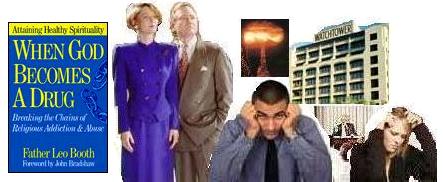
Adapted from When God Becomes a Drug, by Leo Booth
Continued to Breaking The Chains of Religious Addiction & Attaining Healthy Spirituality
Back To Main Page
