

Victoria lies in the southeast corner of Australia. The capital of Victoria is Melbourne. It has a population of 4.4 million of which 3.1 million live in Melbourne. It covers an area of 227,600 square kilometers which is about the same size as England, Wales and Scotland combined. Victoria however is approximately only 3% of Australia's total land mass but has 1/4 of the population. Victoria has 1,800 kilometer coastline which borders on Bass Strait, which separates the mainland from Tasmania. About 35% of Victoria is covered by natural forest while mountainous regions are found in the north-east, where during the winter snow settles upon them. The highest peaks in these mountains are Mount Bogong (1986 meters ) and Mount Feathertop (1922 meters ).
The daily temperatures range from 14 - 23 C in the costal area during the summer months and between 7 - 14 during the winter.
Victoria adopted their flag circa 1953. The flag of Victoria is a British Blue Ensign defaced with the state badge. The badge depicts the Southern Cross surmounted by the St Edwards Crown. The stars in the Southern Cross range from five to eight points.

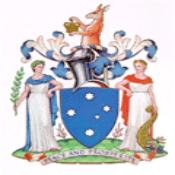
COAT of ARMS
King George V granted a Coat of Arms to the State of Victoria in 1910. This made Victoria the second state to receive their "arms". In 1973 additions were made to the Coat of Arms and a Royal Warrant was issued by Queen Elizabeth II. The description of the Arms is as follows;-
Arms: Azure, five Stars Argent representing the Constellation of the Southern Cross.
Crest: On a Wreath of the Colours, Argent and Azure, a demi-Kangaroo proper holding in the paws an Imperial Crown
Supporters: Dexter, a Female Figure (representing Peace) proper vested Argent cloaked Azure wreathed round the temples with a Chaplet and holding in the exterior hand a branch of Olive also proper; and Sinister, a like figure (representing Prosperity) vested Argent cloaked Gules wreathed round the temples with a Chaplet of Corn and supporting with the exterior hand a Cornucopia proper embodies the motto: "Peace and Prosperity".

FAUNAL EMBLEM (bird) of the State of Victoria is the HELMETED HONEYEATER.
The Helmeted Honeyeater ( Lichenostomus melanops cassidix )which was proclaimed in 1971 is the larger and more brilliantly coloured race of the Yellow-tufted Honeyeater. These attractive honeyeater's are now restricted to a small area on Woori Yallock Creek near Yellingbo on the outskirts of Melbourne. The Helmeted Honeyeater is particularly vulnerable to habitat disturbances as it requires a combination of manna and swamp gums, with tea-trees and shrubby bushes alongside grass-lined watercourses.
The birds are about 20cm in total length with the upperparts of the body olive-grey with the outer wing and tail feathers greenish-yellow. Underparts are yellowish-green with dark streaks. The sides of the head are glossy black with golden ear-tufts and a yellow throat. Both crown and fore-head are golden yellow with the latter displaying plushlike feathers projecting slightly over the base of the bill and forming a distinctive helmet.

FLORAL EMBLEM of the State of Victoria is the COMMON HEATH (Epacris Impressa Labill).
It was proclaimed in 1958 by the Victorian Government which was the first Australian State to give official recognition to such an emblem.
Common Heath was first collected in Tasmania in 1793 by the French botanist, Jacques-Julien Houton de Labillardiere. The generic name Epacris is derived from the Greek 'epi', meaning 'upon', and 'akris', meaning 'a hill', referring to the elevated habitat of some species.
The specific name impressa, Latin for 'impressed' or 'indented', refers to five dimples on the outside of the basal part of the floral tube. Common Heath is a slender, upright shrub which grows to about a metre in height. The rigid, alternate leaves are stalkless and fairly narrow. They range from 4 to 16 mm in length and are sharply pointed. The tubular flowers up to 25 mm long are arranged singly in the leaf axils and are often so densely packed around the stem that the cluster of flowers assumes a cylindrical brushlike appearance.
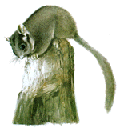
FAUNAL EMBLEM (animal) is the LEADBEATER'S POSSUM (Gymnobelideus leadbeateri)
The Leadbeater's possum lives only in Victoria and was proclaimed by the Government in 1971. It is confined to the mountain ash forests of the central highlands. This possum is regarded as one of the rarer members of our fauna. McCoy originally found the species in 1867 north of the Wonthaggi area of West Gippsland, and a few more were found up to 1909, when the possum was thought to be extinct. It was a great surprise to science when the species was rediscovered near Marysville in 1961.
The length of Leadbeater's Possum is about 40cm from nose to tail tip. About half of the animal is taken up by the tail. Soft, dense fur covers the body, becoming progressively longer on the distinctively club-shaped tail. The colour of the animal is a dark greyish-brown with whitish under-parts. The face is quite beautifully marked. It is a nimble species which jumps from branch to branch and it feeds upon insects living in the foliage.




 HOME NEXT
