Michael Sturtevant
Period 6
9/29/98
<h1><center>Uniform Accelerated Motion Lab #3</center>
Purpose:
To analyze uniform motion
Procedure:
Supplies:
ramp
metric ruler
tickometer
car
wax tape
First gather all the supplies u need for this lab. Cut out as many 1 meter long strips of the wax tape as your group needs (1 per person). Then find a place where you can set up your ramp. After you have found a good place and set your ramp up at about a 20-40 degree angle, tape the wax tape to the end of the car, and thread the other end all the way through the tickometer. Then assign people in your group to do specific jobs:
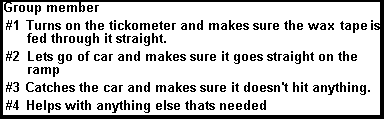 Then have them do their jobs. Have #1 turn on the tickometer and have #2 let go of the car anf make sure the car is going in a straight line so it doesn't fall off the ramp. Then have #3 catch the car when the car is at the end of the ramp.
Repeat those steps until every person in your lab group has their own piece of wax tape. Then each person has to count the number of dots made on the wax tape by the tickometer (start counting where the dots begin to be spaced far enough away to be counted easily). Mark off a line through every tenth dot until u get to the end of the tape. Those marked off sections are called intervals. You use them to figure out the velocity, acceleration, and displacement of the car.
Then have them do their jobs. Have #1 turn on the tickometer and have #2 let go of the car anf make sure the car is going in a straight line so it doesn't fall off the ramp. Then have #3 catch the car when the car is at the end of the ramp.
Repeat those steps until every person in your lab group has their own piece of wax tape. Then each person has to count the number of dots made on the wax tape by the tickometer (start counting where the dots begin to be spaced far enough away to be counted easily). Mark off a line through every tenth dot until u get to the end of the tape. Those marked off sections are called intervals. You use them to figure out the velocity, acceleration, and displacement of the car.
Data:
Intervals | Ticks/Interval | Length
(cm) | Velocity
(cm/tick) | Acceleration
(cm/tick˛) | Displacement
(cm) |
| 1 | 9 | 2.9 | 0.32 | 0.035 | 2.9 |
| 2 | 9 | 5.4 | 0.60 | 0.031 | 8.3 |
| 3 | 9 | 7.8 | 0.87 | 0.030 | 16.1 |
| 4 | 9 | 10.5 | 1.2 | 0.033 | 27 |
| 5 | 9 | 13.4 | 1.5 | 0.033 |  |
| 6 | 9 | 15.4 | 1.7 | 0.022 | 55 |
| 7 | 9 | 16.9 | 1.9 | 0.022 | 72 |
| 8 | 9 | 17.9 | 2.0 | 0.011 |  |
Calculations:


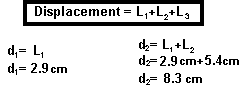


Results:
The Relationship of the graphs is that you can use them to find the real displacement there would be after so many seconds. To do this you take the slope of the velocity graph and use that to find the line of best fit for the acceleration graph. Then you find the area under the acceleration graph and that gives you the the known point of the velocity graph. You can then take that point and find the area under the velocity graph. Then you can find known point of the displacement graph.
This shows all the graphs are related and can be used to find where a point would be after different ammounts of time.
Conclusions:
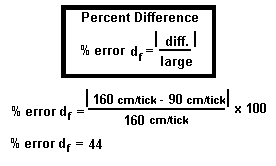
I was very sucessful in finding the velocity and got only a 4.5 percent error, but i had a 44 percent error on my displacement. I'm not quite sure what happened , but i think the car stopped accelerating towards the end of the board, and thats what caused such a large percent error. We could have possibly fixed by having the board at more of an angle, so the acceleration would have remained the same.

