
This does not apply to portraits or very close-up work. The rule of thirds simply says that a photograph must be divided into thirds, both vertically and horrizontally. At least one full third (vertical, horizontal or a combination of the two) must be background for a nice picture. Here is an example:
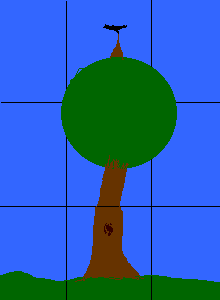
Notice how the tree and the little bird on top of it (your foreground) take up about one third of the photo, and the sky (your background) takes about two thirds of the picture. At this point, I think I should say that you must have at least one third of foreground (your main subject) in the photo.
Here are Bob Lazaroff's (photo contest coordinator of Popular Photography Magazine) top 10 tips for winning photo contests:
10) Be your own critic. An interesting subject dosen't necessarily translate into an interesting photograph.
9) Consider the entire composition. Are there distracting elements in the picture? If there are, enter a cropped version or another picture entirely.
8) Gotta look sharp! Unless your image is purposefully blurred, the photograph should be sharp.
7) Capture the unexpected. When shooting oft-photographed subjects, surprise judges with a novel version.
6) The photograph shouldn't need an explanation to succeed. I judge photos on the photos...not on the stories behind them.
5) Edit your work carefully and thoroughly. Only submit the images you feel could win. Just because the rules say "...up to 20 images," don't feel that you need to enter 20.
4) Never submit original slides.
3) Label your images with your name and phone number.
2) Don't be afraid of rejection. Many of our winners have had previous submisions turned down. Presistence can lead to success.
1) Never send glass-mounted slides. Too many glass-mounted submisions arrive shattered and have made thigs very dangerous around the light table.
Many amateur photographers have to, at least once in a while, deal with the problem of redeye . What is it? It’s when light (usually form your flash) reflects off the retina, or back of, a person’s eyes back to your camera, and on the photo you see red in the pupils of the person’s eyes. There are a few solutions to this annoying problem. Here are a few of the most commonly used solutions to this problem:
Did I forget a site? Want your site here? Or, would you like to add a tip to this page? Email me, Alex
