Badminton Stuff
Interesting Badminton Facts
One type of badminton is the type that you play in your backyard or at a picnic. But badminton as a sport is played indoors with much more high-tech equipment.
Modern racquets are complex alloys of carbon graphite, boron, ceramic, aluminium and steel in various proportions. These racquets are very light, less than 3.5
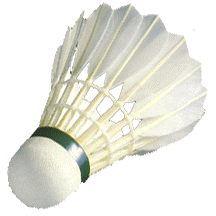
ounces and can be strung very tightly. The shuttlecock is made of feathers, not plastic, and weighs between 4.74 and 5.50 grams. The best shuttles are made
from the feathers from the left wing of a goose. 16 feathers are used to make a shuttle. Shuttles normally cost about $20 per dozen and lasts about one game
at the most. The net is five feet high, not the height of a volleyball net.
To play competitive badminton you need explosiveness, lightening quick reflexes and rapid hand-eye coordination. Why you ask? Well the shuttlecock has
been clocked in excess of 180 mph. That's faster than the fastest tennis serve, and occurs regularly during rallies at the top level. In fact, in
doubles games there are often 40 or 50 shots in 20 seconds.
A badminton match consists of constant highly concentrated action; running, jumping, twisting, stretching, running backwards, throwing and striking. In a
typical match the athletes cover every inch of the court and run more than one mile.
Want some stats? Lets compare a Wimbledon final to a world championship final in badminton.
| Tennis | Badminton |
| Time | 198 minutes | 76 minutes |
| Ball/Bird In Play | 18 minutes | 37 minutes |
| Rallies | 299 | 146 |
| Shots | 1004 | 1972 |
| Shots Per Rally | 3.4 | 13.5 |
| Distance Covered | 2 miles | 4 miles |
| *Match Intensity | 9% | 48% |
*Match Intensity is the actual time the bird/ball was in flight, divided by the length of the match.
Note: the badminton player competed for half the time, yet ran twice as far and hit twice as many shots!
Want more stats? According to scientific experts (Department of Physical Education at Baylor University) badminton is one of the finest conditioning
game activities. During a typical 3 game match, lasting 45 minutes the shuttle will be in play for 20 minutes. In this time the player will make at least 350
changes of direction of 90 degrees or more and strike the shuttle about 400 times. About 150 of these stokes will be full arm swings (with the racquet, of
course). Major league pitchers frequently have less arm swings than this in a game. Pulse rate can increase from 72 to 125 for a person in normal condition.
Click Here For More Interesting Facts
Gary's Badminton Rackets And Accessories From . . .
Badminton Comics
Badminton Drills ... For The "Real" Experts ... (Joke)
1. The first drill involves smashing the shuttle down the line of the court next to yours. This shot is not only very hard to return by your opponents,
but it also allows you to meet the people next to you and arrange future matches while you walk over the get the bird. One word of caution though,
if you screw up and smash down the line in your opponents' court, they may return the shot and you will have to exert more energy and hit the bird again,
so try and hit it well into the next court.
2. Another drill is missing the perfect kill shot when your opponent pops it up just on your side of the net. For many an unskilled player,
the first instinct is to whack that shuttle hard, but this is not good. Your opponent is just testing you to see if you will hit it.
You should learn to miss the shuttle completely as you swing. The benefit here is that you tell your enemy that you know they are toying
with you and that you could have whacked it if you wanted to. This will show them that you are not a rookie.
3. The flip side of the last drill is hitting the drop that hangs two feet above the net. This allows you to test their knowledge and also
to practice your sprinting to the sidelines if they don't seem to know that they shouldn't hit it.
4. The half court clear - This shot is a great one. Most amateurs will hit a booming clear to the back line of the court, but do not seem to
realize that even if the shot doesn't go out at the back, that their opponent will hit another deep clear, which will just bring everyone's game
down a notch in quality. You should hit a short clear. It will never go out the back of the court, and your opponent will have to decide whether
to hang a drop shot, do a short clear or smash into the court next to you. With so many decisions to make he'll probably surrender on the spot.
Other Badminton Web Sites . . .
 University Of Ottawa Varsity Badminton,
 Ontario Badminton Association,
 Badminton Canada,
 International Badminton Federation