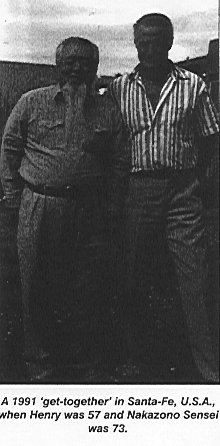
Sensi Williams said to me:"Ellis, as my assistant, it's your duty to ask Sensi if we can leave the mat at 9.00p.m. so we all have time to get to the pub". What a fool I was! I did ask Nakazono Sensei and he was very angry with me and said he travelled across the world to teach us Aikido, and all we wanted to do was goto the pub! Well, when he put it like that , it did make us feel bad. However, he didn't seem to understand that this was our vaction from work... I reminded Nakazono Sensi of this incident
when we mat in Santa-Fe recently, and we were able to laugh about it.
The important thing I have not mentioned so far is the vast difference in technique between Abbe sensi's old style and Nakazono Sensi's new style, which was a far flowing movement - it seemed so much softer and yet so strong. We quickly adapted to this new style, and it was then that Abbe droped a "bombshell". We all would all have to be regraded to meet with the present standards of the Aikikai Hombu (Headquarters) in Tokyo. The grading was
physically and mentally demanding, and at the end of it he lined-up all eightDan grades and said he accepted all out grades with the exception of one. He looked at this student for what seem like an eternity, then said: "Necessary sell your gi (uniform) while price is high". Even after 37 years that sentence has not been forgotten. He took away that student's grade.
In 1963 I was Nakazono Sensi's assistant at a national Martial Arts demonstration at the Royal Albert Hall in London - that was a very proud moment for me
as a young back belt, and also a proud moment for my parents, as this was the first time they had ever seen me in a Aikido demonstration.
Abbe Sensi then bought over from Paris a young 5th Dan, Masamichi Noro Sensi. This was the first time we had seen a sensei (teacher) in a white hakama (traditional uniform), and Noro turned out to be perhaps the most graceful of all the teachers I have seen to date. There then followed many other fine teachers, like Hiroshi Tada Sensei, Tadashi Abe Sensei and Nobuyoshi Tamura Sensei.
For me the most effective of all the Japanese masters was, without doubt, Kazuo Chiba Sensei. I was with him for several years and once partnered him on television. At that time Chiba Sensei and I were teaching Aikido at out dojo, which was situated at The Times news paper in London, and we were asked to take part in a 30-minute World Service broadcast on the BBC World Radio. Sensei asked me to do the talking, because at the time his English was so good. A television producer heard the broadcast and asked if we would do a demonstration
on Anglia TV, to which we agreed. Whilst we were waiting for our 'slot', they took us to the hospitality room, where the bar was stocked with just about every drink you could imagine. The hostess asked if we would like a drink, and I thought a whisky would go down well. I asked "Sensei, can we have a drink?". He said we could, but before I could order, Sensei had asked for two orange juices.
Some Aikido I have seen in recent years depresses me because it can be carried out by two Aikidoka who practice together on a regular basis, like a couple of dancers
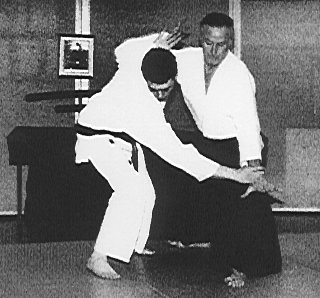
who know each others movements. I honestly think that a majority of students take up Aikido for self-defence, so if I wanted Yoga I would sudy Yoga, and if I wanted to dance I would take dancing lessons. I believe Aikido no only has to look good, but also has to be effective.
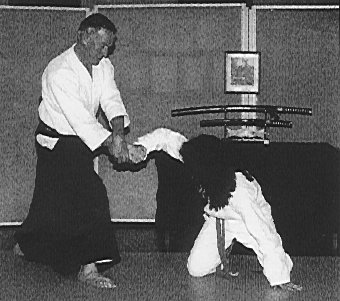
Abbe Sensei not only taught Tori (performer of technique) to have good posture and balance, but Uke (receiver of technique)had to attack on balance also, since it is easy to throw when he comes off balance. He used to teach with a shinai (bamboo sword), with which he would hit and say: "My
English is not very good, but my shinai speaks fluent English". You can tell a student 20 times what he is doing wrong before he gets right, but the shinai speaks only once, with