Lab #2
Michael Sturtevant
Period 6
9/29/98
Lab #2: Motion
Purpose:
To analyze random motion.
Procedure:
Supplies:
metric ruler
tickometer
car
wax tape
First gather all the supplies u need for this lab. Cut out as many 1˝-2˝ m long strips of the wax tape as your group needs (1 per person). Then set up a place where you have about 5 yards of open, flat space. After you have found a good place, tape the wax tape to the end of the car, and thread the other end all the way through the tickometer. Then assign people in your group to do specific jobs:
 Then have them do their jobs. Have #1 turn on the tickometer and have #2 quickly give the car a push. Then have #3 wait until the car has gone about 90cm, then have him/her give the car a second push. Group member #4 then catches the car when the tape has gone all the way through the tickometer.
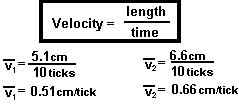
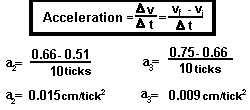
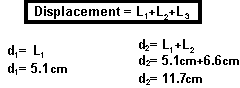
Repeat those steps until every person in your lab group has their own piece of wax tape. Then each person has to count the number of dots made on the wax tape by the tickometer (start counting where the dots begin to be spaced far enough away to be counted easily). Mark off a line through every tenth dot until u get to the end of the tape. Those marked off sections are called intervals. You use them to figure out the velocity, acceleration, and displacement of the car.
Then have them do their jobs. Have #1 turn on the tickometer and have #2 quickly give the car a push. Then have #3 wait until the car has gone about 90cm, then have him/her give the car a second push. Group member #4 then catches the car when the tape has gone all the way through the tickometer.
Repeat those steps until every person in your lab group has their own piece of wax tape. Then each person has to count the number of dots made on the wax tape by the tickometer (start counting where the dots begin to be spaced far enough away to be counted easily). Mark off a line through every tenth dot until u get to the end of the tape. Those marked off sections are called intervals. You use them to figure out the velocity, acceleration, and displacement of the car.
Data:
Intervals | Ticks/Interval | Length
(cm) | Velocity
(cm/tick) | Acceleration
(cm/tick˛) | Displacement
(cm) |
| 1 | 10 | 5.1 | 0.51 | 0.051 | 5.1 |
| 2 | 10 | 6.6 | 0.66 | 0.015 | 11.7 |
| 3 | 10 | 7.5 | 0.75 | 0.009 | 19.2 |
| 4 | 10 | 7.3 | 0.73 | -0.002 | 26.5 |
| 5 | 10 | 6.5 | 0.65 | -0.008 | 33 |
| 6 | 10 | 5.9 | 0.59 | -0.006 | 38.9 |
| 7 | 10 | 5.3 | 0.53 | -0.006 | 44.2 |
| 8 | 10 | 5.7 | 0.57 | -0.004 | 49.9 |
| 9 | 10 | 5.7 | 0.57 | 0 | 55.6 |
| 10 | 10 | 9.3 | 0.93 | 0.036 | 64.9 |
| 11 | 10 | 14 | 1.4 | 0.047 | 78.9 |
| 12 | 10 | 14 | 1.4 | 0 | 92.9 |
| 13 | 10 | 14 | 1.4 | 0 | 106.9 |
Calculations:
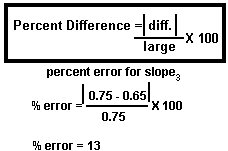

Results:
the relationship of the graphs is that you can get all the information you need from 1 graph.
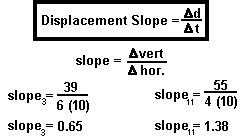
the Slope of a point on the Displacement vs. Time graph is equal to the velocity of the given point you took the slope for. This is proved by taking the percent error. You should have a small percent error. The reason there is error, is because of the tangent was not perfectly parallel to the slope of the line.
The slope of a point on the Velocity vs. Time graph is equal to that point on the Acceleration vs. Time graph. This is verified by also having a small percent error.
Conclusion:
This was a successful lab because i had low percent errors on my graphs.
https://www.angelfire.com/al/KiKn2/physics2.html

