|
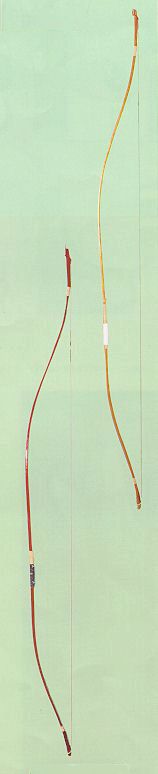
There are three basic types of yumi in use today: a standard bamboo yumi, lacquered bamboo yumi, and synthetic yumi made with fiberglass or carbon-fiber. The yumi of choice for most kyudo practitioners is the standard bamboo yumi which is made today very much the same as it was hundreds of years ago. With its simplicity and clean lines the bamboo yumi is unsurpassed in beauty and elegance.
A bamboo yumi is not particularly delicate but it is susceptible to extremes of climate and physical abuse. For this reason, many schools and kyudo clubs recommend that novice practitioners use synthetic yumi. Generally speaking, kyudo should be practiced with natural materials but a bamboo yumi is quite expensive, often costing upwards of five or six hundred dollars. For beginners, who have not yet perfected the technique of shooting with a Japanese bow, the potential for damaging an expensive bamboo yumi is great. Yumi made from carbon-fiber or fiberglass-covered wood yumi are a durable, less expensive alternative. These bows usually cost less than three hundred dollars and are practically indestructible given normal use.
Lacquered yumi, are special-made by only a few bowmakers today. As a result, they are extremely expensive, often costing two or three thousand dollars or more. Consequently, they are generally used only for special ceremonies, and then only by the most advanced of practitioners. Yumi are available in a variety of lengths and pull strengths. Most beginners start with a yumi that has a pull of ten or twelve kilograms. After a year or more of practice they will then move up to bow with a higher pull strength. On average, an experienced female practitioner will use a yumi of fourteen to sixteen kilograms, while a male practitioner will use a yumi with a slightly greater pull strength, around eighteen to twenty kilograms. All this, of course, depends on experience and body type. |