1 OCT 2000 The Straits Times, Singapore
Tap right brain for creative kids
All children are born geniuses and should not be dismissed as stupid if they do not do well in rote-learning.
Instead, stimulate their right brain
By LOH KENG FATT
MR JOHN CHOO was worried when his six-year-old son showed little progress in kindergarten.
"He was then in a void-deck child-care centre. He was hyperactive, he couldn't focus and he scored zero in spelling, English
and Chinese," says Mr Choo, a director in a telecommunications firm.
So he and his wife transferred him to The Brain-Based Schoolhouse to try out a different learning approach. This is a
child-care centre and pre-school at Tanjong Pagar.
 "He was there for 10 months last year and it was fascinating to see what the teachers did to get him to remember or
understand things," Mr Choo says.
"He was there for 10 months last year and it was fascinating to see what the teachers did to get him to remember or
understand things," Mr Choo says.
"Instead of rote learning, for instance, they would use flash cards to stimulate the brain's memory powers," he adds. His son
has since gone on to do well in his Primary 1 class this year.
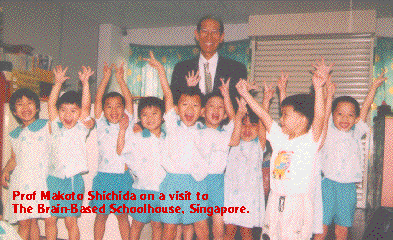
This turnaround story confirms what Professor Makoto Shichida, 71, already knows. To him, no child should be dismissed
as stupid if he appears not to benefit from conventional educational methods like rote learning.
He was in town yesterday to conduct an early-childhood education seminar for 250 parents at the Westin hotel. He will also
be giving another seminar tomorrow at the same venue.
His interest in alternative learning techniques started when he was teaching English to junior high-school students in Japan
many years ago.
"I saw a boy who had a very low ability to memorise things," the author of 60 books tells Life! via e-mail from Japan before
he came to Singapore.
"This made me do research about how the brain functions," he says. It has also led him to believe that all kids are born
geniuses because the early years are the greatest time for them to pick up and absorb knowledge.
His 40 years' experience comes from exploring, and maximising, the potential of the right brain, especially in the child's first
three years.
The qualities of photographic memory, quick language acquisition and fast mathematical understanding reportedly reside in
the right brain, some scientists say.
Once the right brain is tapped, Prof Shichida says, the kid will benefit from having a greater imagination and creativity.
This is unlike left-brain-centred education, as practised in many schools, which is built upon logic, possibly shutting off the
students from accepting unproven possibilities.
But in a fast-paced world today, this is suicidal because countries have to compete relentlessly with new ideas and thinking.
And these can come about only if the learning environment is made conducive.
That is why Brain-Based Schoolhouse teacher Cecilia Chan makes her flashing of word cards at high speed seem like a game
to the children in her K1 and K2 classes. This way, she gets their full attention.
Mrs Chan, who has learnt some of Prof Shichida's methods, says that after one to two months, the kids are good enough to
sort out the sequence of some 35 to 40 cards even if they are all jumbled up.
Prof Shichida says Singapore parents can build up such photographic memory by stimulating the right brain at home.
"Show your child 10 small cards at first. Let him memorise the words on them. Gradually, increase the number to 40," he
adds.
"The fundamental point is to enable him to enlarge his vocabulary because words help enrich thinking," he notes.
But if all this sounds like serious and hard work, relax. Prof Shichida also places great emphasis on parents spending as
much leisure time as possible with the kids.
"Tell or read many stories to the child to nurture his rich imagination," he says.
This sits well with a parent, businessman Jim Ang, who says: "It is no use training your child to be smart if, at the end of the
day, he is not a happy and well-adjusted boy."
For more details about Prof Makoto Shichida's seminar, call 6220-9555 or 6220-2005.
Copyright © 2000 Singapore Press Holdings Ltd. All rights reserved.

