 Uzbekistan
Uzbekistan
UzbekistanJuly 2008
Day 16th – Sunday July 27th (Cont)
The Uzbekistan border was really just a continuation of the Kazakhstan border – a dusty collection of small offices with a sentry gate. We were led to an office, then sent to customs who asked, jokingly, if we had any guns or explosives (Trev wanted to say “only my arse” but bit his tongue). Then passport control. We were pleasantly surprised when we looked at our watches to discover that it had only taken an hour to cross both borders – a little faster than the Aktau port fiasco.
This was my second visit to Uzbekistan. I had made a quick visit on the way back from Beijing in 1996 (as part of the package), whereby I stayed at Tashkent and
visited Sumarkand. I had been very impressed by the latter.
If you have no life, you can check out my previous trip to Uzbekistan:
Start on Thursday July 4th
Once we had left the border, the road surface continued to be dust and deteriorated into large rocks. We had reached the old original Silk Road or rather track. In the heat (it reached 47’C today, a new record for the trip), the road tyres took a battering over the lack of road surface and within an hour, we had our first puncture on the right hand side back wheel. Trev changed the wheel in sweltering heat with moral support from me and the occasional movement of replacement tyres.
Less than 30 minutes later we were off again with the same heat and same awful road.
Trev was still driving and when we got a second puncture in the tyre we had just replaced, we started to think we were doomed. We were out of normal road tyres, so we replaced it with one of the off road tyres (we were carrying 4 in the back). 30 minutes later, nothing had passed us in either direction. We were really out there on our own in the middle of flat desolate land with nothing to see in any direction. I am sure we saw eagles or vultures circling overhead on the thermals.
I took over the driving (if only to try and remove the curse), yet within the hour, we discovered we had a slow puncture in the other left hand side back tyre. So it was off with that and on with another off road tyre. We were now down to two off road spares with three road tyres sitting useless in the back.
In between these punctures, we had to pass through a few of the numerous police checks. A barrier would be down across the er, road. I would take our passports and vehicle documents to the cabin to be examined by policemen in various states of drunkenness. Three of them were playing cards at one post and asked me to sit down. They eventually lost interest when I told them that we had no vodka or cigarettes. Which was true in that we only had at least 10 litres of red wine.
At another checkpoint, I was questioned by a rather non sober policeman who spent more time watching a TV. He flipped through my passport and I worked out later that this was where I lost my customs’ declaration form (how much hard currency you are carrying etc) and a mandatory form when you try and leave the country.
The road was being resealed (or sealed for the first time) by giant rollers and suddenly from out of nowhere, we were presented with a brand new sealed road with no potholes or traffic on it. This stretch was definitely not on the current maps. Result!
Behind the wheel, I cranked up the MP3 player and let rip with a speed of 65 mph.
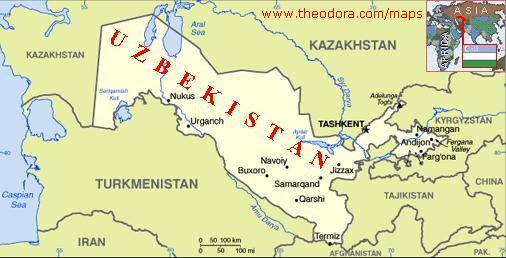
We were now passing through the Karakalpakstan region, a further extension of the flat, barren landscape and another place we couldn’t pronounce. According to the map, there were no towns or villages for 250km. With almost zero traffic, it was easy to see why. If a truck passed us coming the other way, it became a talking point and a photo.
Reaching Kungrad in the late afternoon, the desert abruptly stopped. Lush greenery (pre-dominantly cotton fields) appeared which supported the cattle and goat herds that started to appear along with the donkeys and carts.
Around 6pm, we passed around the town of Hojeli which had a lovely montage of late afternoon rural scenery – men on horses rounding up cattle or goats, locals walking their cows home, watermelon, peaches and grape stands everywhere. We also passed cars full of watermelons. There was the strange juxtaposition of locals squatting to make piles of bricks by hand out from the clay in the ground with a backdrop of oil refineries. The modern world with the old world. Power versus poverty. There were long walls of mud bricks everywhere. The light was marvellous. How I wished we could have just stopped and spent a few days taking photos.
We reached the large town of Nukus (renamed ‘Nuke Us’) at 8pm, an hour before dusk. It was easy to negotiate the grid road system to find the Nukus Hotel which seemed to full of ‘Mongol Rally’ people (including the Spanish cars we had seen the night before in Beyneu) and a separate party of British Toyota Landcruisers.
Fortunately, they took US Dollars because we failed miserably to find an ATM in town. We would discover that Uzbekistan does not believe in ATMs. The hotel had secure parking that cost $2 extra.
The room had no fan or air conditioning and was sweltering. If you opened the window, a swarm of mosquitoes would invade. With no Uzbek cash to eat out, we were forced to set up a kitchen in the en suite bathroom (the Son of Karsey Kitchen) and rely on our own supplies of red wine. With closed windows and a gas stove in stifling temperatures we sweated until the sweat stopped sweating. You make sacrifices when you have to and we drank to forget that we had just spent twelve hours driving through two borders with three punctures in searing temperatures and couldn’t stop sweating.
Nukus (population 230,000) is the isolated Karakalpak capital, "a quiet city of tree-lined avenues and nondescript Soviet architecture and gateway to the fast-disappearing Aral Sea"(LP)
Today, Trev drove 208 miles (3019 total) and I did 140 (1655 total) = 348 for the daily total = 4664 miles after 16 days.
Uzbekistan Background
The Lonely Persons guide summarises Uzbekistan as “Ancient villages meet staggering architecture in this mysterious, land-locked country…it is the most historically fascinating of the Central Asian republics. Within it are some of the oldest towns in the world, some of the Silk Road's main centres and most of the region's architectural splendours”.
The CIA summarises its history as “Russia conquered Uzbekistan in the late 19th century. Stiff resistance to the Red Army after World War I was eventually suppressed and a socialist republic set up in 1924. During the Soviet era, intensive production of "white gold" (cotton) and grain led to overuse of agrochemicals and the depletion of water supplies, which have left the land poisoned and the Aral Sea and certain rivers half dry. Independent since 1991, the country seeks to gradually lessen its dependence on agriculture while developing its mineral and petroleum reserves. Current concerns include terrorism by Islamic militants, economic stagnation, and the curtailment of human rights and democratisation”.
Uzbekistan is another huge country - slightly larger than California with mostly flat-to-rolling sandy desert with dunes and as we discovered, sudden broad, flat intensely irrigated river valleys. Its population is getting on for 27.4 million with a very low £1300 average annual income. 88% of the population are Muslim (mostly Sunnis)
Its major natural resources are natural gas, petroleum, coal, gold, uranium, silver, copper, lead and zinc. Consequently, its major industries are textiles, food processing, machine building, metallurgy, gold, petroleum, natural gas and chemicals.
The CIA summarises it’s current existence as “Uzbekistan is a dry, landlocked country of which 11% consists of intensely cultivated, irrigated river valleys. More than 60% of its population live in densely populated rural communities. Uzbekistan is now the world's second-largest cotton exporter and fifth largest producer; it relies heavily on cotton production as the major source of export earnings. Other major export earners include gold, natural gas, and oil.”
Whatever they say about a democracy, President Karimov runs it as a police state. We would be stopped by more police checkpoints here than any other country. The following day, we dealt with over 20 police check points in one day!
Day 17 – Monday July 28th
We didn’t know it now, but today would be our last legal day in Uzbekistan. We were still keen to make up time so got up early, packed the Disco and waited for the 7am complementary breakfast of fried egg, hot dog sausage, bread and black coffee. Bitten by mosquitoes, we were just glad to escape. Our security man let us out and we headed south east.
We knew we were in for a long day’s drive and we still had diesel in the tank and two jerry cans. Hopefully enough to reach Bukara. The first 200 km were a continuation of the rural scenery and small villages and more men on donkeys herding goats.
We passed through Urgench (pop 140,000) the capital of the Khorezm province and a "standard-issue Soviet grid of broad streets and empty squares, 450km northwest of Bukura" (LP)
Then the Kyzylkum Desert (or ‘Desert we can’t pronounce’) appeared and suddenly the lush greenery was usurped by dull yellow scrub land surrounding the undulating road. The desert would drag on for the next 300km.
En route, without Uzbek Som currency, we had to use our jerry cans to replenish our fuel supply. We passed by the Amu Darya River and could see Turkmenistan on the other side. So close and yet so far. The Amu Darya river is the longest river in Central Asia, stretching for 2500 km.
There were some road works en route and the road got pretty bumpy but we eventually reached Bukara around 4pm. With no signs, it took a while to find the old centre, with interesting detours through the narrow alleyways of the old city and looks on faces of the locals that said “what the hell are you doing here in that thing?” We needed cash badly and back in the modern section, we found a large bank.
Leaving Trev in the Disco, I had to first convince the security guard why I was entering the bank and was then led to a counter in the back where three attractive giggly girls/bank clerks, took my $100 and passport and exchanged it for Uzbekistan Sum. The largest note was 1000 but I got mine in 500s and you get about 10 per US Dollar. I was presented with a stack of currency – nearly three inches worth. More giggles and offers of marriage etc.
Back at the Disco, I whacked my wad and we headed for the old centre. It was still sweltering but Bukhara was the one place I hadn’t seen. On our original schedule, we were supposed to spend a day/night here. On our new schedule, we could give it a couple of hours at most.
Bukhara has been inhabited for at least 2500 years. Located on the famous Silk Road, city has long been a centre of trade, scholarship, culture, and religion. It was originally Uzbekistan’s capital only to be usurped in the Nineteenth Century by the economic powerhouse of Tashkent.
With a population of 255,000 it is Uzbekistan’s fifth largest city but gives the impression of being a sleepy town. Guidebooks sometimes criticise Bukhara for being too twinky and rebuilt/manufactured for the tourist industry, but we found it great place to explore. The locals were friendly and appreciative of our visit, yet they didn’t hassle you. Late in the afternoon, it was still over 40’C and we were forced to keep pouring cold Fanta down our throats.
The Ark-Citadel was the residence of Bukhara khans. It still has imposing walls and entrance façade. It was gradually strengthened over the centuries until the wooden part of Ark building was burnt down during a fire in 1920.
Up the road, the Kalvan Minaret built in 1127, was initially the tallest structure in Central Asia. The minaret made in the form of a circular-pillar brick tower, narrowing upwards, of 9 meters (29.53 ft) diameter at the bottom, 6 meters (19.69 ft) overhead and 45.6 meters (149.61 ft) high. It has 13 bands of decoration and was the first ever structure to have the blue azure tiles as a feature. This would be copied and all Madressas are now tiled in a similar colour. When Genghis Khan came across this minaret he was so impressed, that he let it stand while destroying everything else.
It forms the centre piece of the Poi Kalyan complex which means “The foot of the Great.” The Kalyan Mosque next door was completed around 1514 while the Miri Arab Madrassah was built later that century.
We also came across the Ulugbek Madrassah which was built in 1417 and the Abdullaziz-khan Madrassah opposite built it in 1651 – 1652 and it is the last large Madrassah in Bukhara. I could go into more detail, but we were there long enough to snap photos. Have a look at them. You’ll see that Bukhara is a wonderful place to visit.
Bukhara has 140 monuments so we hardly did it justice in a couple of hours, but what can you do. We were on a mission and were behind schedule. So we left town at 6pm and headed for Samarkand. There was a repeat of the previous evening’s rural activities - men on horses rounding up cattle or goats, locals walking their cows home, watermelon, peaches and grape stands everywhere etc.
Darkness fell and we faced terrible night driving. Donkeys and carts, bicycles and people were all walking on, or to the side of the road, but none of them had lights so we never saw them until the last few seconds. They seemed oblivious that vehicles may not spot them in time. This was compounded by the fact that some large trucks also did not have back lights and we would almost drive into the back of them. I have no idea how we missed all of them but it was exhausting driving. It was like waiting for a ghost to jump out in front of you. Regardless of whether Trev or I were driving, both of us had to keep totally alert all the time. Things got especially heated when we were blinded by oncoming headlights and couldn’t see a thing in front of us. Trev had a near miss with a dog – one lucky dog. It was crazy driving and just what we had wanted to avoid by originally planning enough time to just do day-time driving.
Reaching Samarkand around 11pm, we followed the road into the centre. Taking a guess, I found the famous Registan historic complex (lit up by spotlights – it looked magnificent) and nearby we found the Bahodir Bed & Breakfast Guest House. Run by a father and teenage son, it is well known on the backpacker circuit. The teenage son led Trev to park the Disco in a garage while I sorted out the room. We must have looked exhausted, because the father insisted on making us tea, cutting us fresh watermelon and providing biscuits.
We splashed out on the air-con room for £12.50 and I took a walk around midnight to pick up some cold beers. We were both completely wired by the night driving and needed the beer to decompress. Uzbekistan beer is excellent – especially the stronger stuff). Our mileage on the dodgy roads today was exceptional especially with all the police checks. Outside every town, there was a police check and we were stopped at half of them so they could peer at our passports and inside the Disco.
Today, Trev drove 390 miles (3409 total) and I did 134 (1789 total) = 524 for the daily total = 5188 miles after 17 days.
Day 18 – Tuesday July 29th
No rest for the wicked. Four hours after getting to sleep, we got up, packed, collected the Disco and then walked to the main historic centre five minutes away.
When you stay anywhere in Uzbekistan, the hotel/accommodation is supposed to provide you with a slip of paper/receipt to prove where you stayed. Sometimes the Immigration paper-pushers on the border will ask to see them to prove you went where you said you did. We had got one from the Nexus Hotel the night before, but I thought it strange that our man at the Guest House asked us to return his. We didn’t know it then, but he had realised that we were now overstaying our visa permission and he didn’t want the secret police knocking on his door to find out why he had let us illegal tourists stay for the night. We would discover this later.
Meanwhile, I wanted to give Trev a brief tour of Samarkand’s most famous sites. These are on the World Heritage List so it would have been rude not to.
Samarkand is the second-largest city in Uzbekistan (pop 405,000) and most noted for its central position on the Silk Road between China and the west and for being an Islamic centre for scholarly study. The Registan was the ancient centre of the city.
Quoting my own stuff from my previous visit “Samarkand (Marakanda to the Greeks) was already a great walled city when it was taken in 329 BC by Alexander the Great, who said "Everything I have heard about Marakanda is true, except that it's more beautiful than I ever imagined". After a succession of Persian, Turkic and Arab rulers, in 1220 it was literally obliterated by Genghis Khan. This might have been the end of the story, but in 1370 Timur made it his capital and over the next 35 years fashioned it into a new city, Central Asia's cultural epicentre. His grandson Ulugbek ruled until 1449 and made it an intellectual centre as well. It declined when the Uzbek Shaybanids made Bukhara the capital in the 16C.”
“Samarkand's centrepiece, the Registan, is an ensemble of majestic madrasses, an array of azure mosaics and vast, perfectly proportioned spaces. It was medieval Samarkand's commercial centre and the plaza was probably a wall-to-wall market. The Ulugbek Madrassa on the left is the original, finished in 1420 under Ulugbek here). The entrance portal of the Shir-Dor (tiger) Madrassa, opposite Ulugbek's and finished in 1636, is decorated with roaring tigers, flouting Islamic prohibitions against the depiction of live animals. In between is the Tillya-Kari (Decorated with Gold) Madrassa with a broad mosque courtyard inside. We were awe struck by the beauty of the whole complex. The mosaic work was superb. The detail inspiring.”
At 7am, we had the place to ourselves with no tour buses. The Madrassas were not open, but we walked around the outside of the whole complex enjoying a quiet early morning stroll. A couple of security guards offered us a chance to climb one of the minarets, but I had done it before and Trev was not bothered about the dark narrow claustrophobic climb.
Up the road, we visited the famous Bibi-Khanym Mosque which was commissioned by the 14th Century warlord Timur for his wife in his new capital. The entrance is 35 metres high, the tallest in Uzbekistan and very impressive. Nearby the local bazaar was kicking into action. A local kid with his donkey and a cart full of ripe watermelons tried to stop his mates from climbing aboard for a ride.
As with Bukhara, it would have been nice to have had the time to explore the town properly but we wanted to drive to Tashkent and try and reach the Kazakhstan Embassy and get a new visa sorted out before heading for Tajikistan. This was the best/easiest place to do it.
The problem was that we had 300 km to cover on a decent road but the traffic was heavy and there were police checks and radar traps everywhere. We knew it would be tight and Trev motored as quickly as possible while I looked out for the radar traps – these would be police cars hidden behind trees or buildings with radar guns.
Inevitably, we were flagged down by a couple of policemen who proceeded to point out that we had driven through a 50kph area at 97 kph. We played dumb and pretended that we did not understand what they were talking about. A form was produced. It would be a $100 fine. We still played dumb. I challenged them by indicating that there was no traffic sign with the speed limit. He pointed at a 50kph signpost in his highway code and I pointed down the road and shrugged my shoulders as if to say “well, where is the 50 kph sign?” We stalled and continued to act like dumb tourists.
After 10 minutes, unable to speak English, they abandoned their quest and let us go. It had been the second time I had talked us out of a traffic offence, but it added to the delay. After that, we were careful to obey the 50kph through the towns. We were still stopped by other police checkpoints to look at our passports.
We rolled into the huge city of Tashkent just after midday. We had missed the Kazakhstan embassy opening times, but decided to try and find it anyway. Stuck on a side street and bogged down with the one way system, we drove around town, with me jumping out to ask people. No one knew where it was. It was a sweltering day and the endless traffic lights drove us mad.
There was a scary moment when we hit reserve on our fuel tank. Tashkent is a huge city, so there must be petrol stations everywhere. Right? Well no. The garages are on all on the outskirts and some do not sell Diesel. We had 30 minutes of mild panic while we attempted to find a garage. Eventually, I asked a local who was able to give us directions to a garage, but we were running on fumes then. Thankfully, we were able to fill up the tank and both jerry cans.
Cutting our losses, we headed for the Immigration Office to check up on our status. It was closed between 1 and 3pm, so we parked up, and caught a metro down to the Kazakhstan Embassy, successfully finding it on foot. A security guard said it would be open at 5pm for an hour. The metro got us back to the Immigration Office and we entered a packed room of people waiting to be seen.
Our Uzbekistan visa said that we were allowed to enter the country between the 20th and 28th of July. Underneath, it said we were allowed to stay nine days. We understood this to be that we could enter the country between those two dates and we would be allowed to stay for up to 9 days from that date. These dates had been chosen based on the original route via Turkmenistan without the delay at Baku. Now, we were starting to think that the 9 days only applied between those 2 dates and that we were now one day over our permitted stay. The only thing to do was check with the officials.
This was problematic. No officials spoke English at the Immigration Office. As the only obvious tourists in the packed office, we stuck out and a woman came up to us
to ask if she could help. We explained our predicament and she translated. The official told us to wait to see someone behind a glass counter, except that the official wasn’t there and there were about 30 people all trying to hussle their way to the front Sweating like dogs in the non air conditioned office, we stood outside and pondered our choices.
A man appeared who could speak good English. We explained our predicament again
and he felt that since we were only one day over our stay, that if we got to a border tonight, they would probably let us over. It may take a few dollars. Or we could wait and see what the non-existent official at the counter said.
So we went back inside the sweatshop, took a look at the haphazard queue, the still non-existent official and concluded “We are going to get nowhere here. Let’s make a run for the border.” In retrospect, when you see what happened to us, you may suggest that we should have hung around to try and sort it out there and then but with no one speaking any English, we felt rather helpless. We felt it would be easier to explain it on the border where, in our experience, someone could usually speak English.
Now that we had discovered that we were fugitives and like Butch Cassidy and the Sundance Kid, we made a run for the border. Some of you may shake your head and say “what the hell were you thinking” but remember that three years ago I had bribed my way in and out of Moldova. Some countries are ‘flexible’. What’s the worst thing that could happen? Deportation?
We headed east away from Tashkent on the A373, past Angren and as dusk fell, we drove around what looked like large reservoirs beneath the hills we were climbing. The Disco’s engine started to overheat for the first time since some climbs in Turkey. This road was a gradual incline that went on for ever. We crawled past trucks that were barely moving. The scenery was the most spectacular we had seen in Uzbekistan (except for the rural settings).
The Fergana Valley is a region of Uzbekistan that is stuck out on its own with Tajikistan and Kyrgyzstan surrounding it on various sides hemmed in between the Tian Shan mountains to the north and the Pamir Alay mountains to the south and didn't look like a valley to us. I’m not sure how they ended up with this maverick of outposts but it is obviously a hot spot with military personnel/bases in the area (it was the birth of Islamic extremism in Central Asia in the 1990s). At the top of the pass, we had to, er, pass through various tunnels under the mountains and soldiers guarded both entrances and at various points within the tunnels. Not the greatest guard duty to pull. As we descended the long inclines on the other side towards Namangen, I remember thinking, “I’m glad we didn’t have to climb up the other way”.
It was dark before we reached the tunnels and pretty much pitch black on the way down. Our headlights were minimal. Some trucks did not have backlights which made the descent interesting.
We had been driving for nearly seven hours, and had been stopped at endless police /army checks. Not one official spotted that our visas were out of date. They were obviously just going through the motions of looking at our passports. When we reached Andijon, we spotted the sign for the border crossing which lay 30km away. It was a small, unlit road and by the time we got to the border, it was just past midnight. We drew up at a barrier, where a soldier eventually let us through. We passed our passports to a customs official and waited for the shit to hit us.
Sure enough, he came back and tried to indicate that we had overstayed our visa. My only idea as a defence was that we had both set our watches to a day earlier so it looked like we thought it was the 28th July. His English was poor but he said he had overstayed by two days. It was only 12.30am and once we had accepted that it was July 30th, I argued that 30 minutes into a new day was not an entire day overdue – plus, we’d been kept waiting at the barrier.
They didn’t know what to do, and they couldn’t communicate much in English, but they knew that they couldn’t let us through. We played the dumb ignorant tourists. We have valid visas for Kyrgyzstan. Why can’t we just go through. We are only a day late.
No go. There were discussions between the custom officials, the army guys and the guy in charge of the border post – all younger than us. Someone went to make a phone call. “So what do we do next?” We asked. They tried to communicate that we would have to get an Exit Visa from OVID – the immigration/secret police. “How do we do this?” we asked. You have to go to their office in Andijon. “Where is it?” They didn’t know. “Well if you don’t know where it is, how can we find it”? Well that’s your problem they replied.
A lot of this communication was done using body language. We were stalling. I thought that if we just kept coming up with excuses, they’d get bored and let us through, but this set of young officials were ‘by the book’ people – what in England we call ‘Job’s worth’ as in “It’s not worth my job to let you get away with that…”
Someone came back with a mobile phone. They had found a translator who could speak basic English. She explained what we already knew. We would have to get an Exit Visa from OVID. She didn’t know where it was either. We went round in circles. Just stalling. We were told that we could sleep in our vehicle at the border and drive to Andijon in the morning. What’s the point? Even offering money didn’t work. More stalling, but we were beaten by the police state. They were just too scared to break the rules.
We asked for a hotel in Andijon. They came up with the Elite Hotel which was ‘open always’. I kept trying to find out where the OVID office is. “The hotel will tell you” it had to tell OVID who was staying there. When one of the officials asked me for a ‘present’, he got short shrift. “You want a present? You can have presents if you let us through. Otherwise piss off”. I was bored with the situation and frustrated by finally being beaten by this country’s bureaucracy. They had the upper hand and from now on, we could only follow orders.
With nothing else to do except sleep at the border, we returned to Andijon. By the time we reached there, it was around 2am. There were, not surprisingly, few people around to ask directions and our hotel was off the main street. It took a few locals and a few attempts, but we found the Elite Hotel – shrouded in darkness. There was a power cut. The young male receptionist said that this was a regular occurrence.
Yes, there was a room, one of the best in the hotel. It was a suite, full of imposing furniture – a huge lounge, a double bed and large en-suite bathroom. There was air conditioning. A TV with satellite channels and a fridge. It cost $53 – not a fortune for us, and after the long day we’d just had (20 hours), we would have taken anything. Once we checked in of course, we realised that we had no air conditioning, TV or fridge. We did a have double bed which we shared doing impressions of Steve Martin and John Candy in ‘Planes, Trains and Automobiles’ (anyone who has seen the movie knows what I am talking about – “Hellava Game!” and “Those aren’t pillows”)
Trev was out like a light, dreaming of escaping speeding fines. I was still wired by the long day. At this point, ever the optimist. I thought that it was just a case of getting an ‘Exit Visa’ from OVID and heading back to the border crossing. We could still be in Kyrgyzstan tomorrow. It wasn’t as if the immigration people told us that we were criminals…
Today, Trev drove 305 miles (3714 total) and I did 226 (2015 total) = 531 for the daily total = 5719 miles after 18 days. No wonder Trev was shattered, especially after all the police checks today.
Day 19 – Wednesday July 30th
Andijon (pop 350,000) is the Fergana Valley's largest city but will forever be linked with an incident om May 13th 2005. The rise of extreme Islamic Fundamentalists had led to a number of bombs exploding in Tashkent and President Karimov was not a happy man. When he backed 'Monkey Boy' Bush after the 9/11 event, he got US support and used it as an excuse to kick some fundamentalist ass. In Andijon "two dozen powerful local businessmen were jailed for being members of Akramiya, a localextremist Islamic movement. A group of their allies stormed the prison where they were being held, touching off a massive but largely peaceful demonstration in Andijon's main square. The authorities over reacted and somewhere between 200 and 1000 civilians were killed by government troops in the ensuring melee" (LP). Un-surprisingly, the US and the West were unimpressed by this undemocratic force and the US withdrew its aid to the country while the EU applied sanctions. All this was bad news for us.
Unable to sleep, I was up early. The power was on. The air conditioning was on. The hot water was on for a welcome shower. I could use my travel kettle, make coffee and assess the situation we were in. In daylight, I was amazed at our suite. It was full of lavish furnishings including a sideboard and dishes and a large fridge. I went to see the guy on Reception. “How do we find OVID” I asked. He told me to follow the local minibuses with ‘222’ on the windscreens. They went right past the OVID building and he gave me rough directions.
I dragged Trev up from his slumbers and said I’d go and visit OVID. Trev said he’d come with me. We left our stuff in the suite and got in the Disco, saw a 222 minibus passing by and followed one through the busy morning traffic which was a different scene to the deserted streets that we had arrived in last night. For the next 30 minutes, we followed whatever 222 minibus we could see – they would stop to pick up passengers and another would pass by to pick up or drop off locals at the next stop. It was a bit like a ‘follow that taxi’ scenario. We followed one minibus for a while and he was obviously wondering who the hell we were, especially since we’d pull up behind while he unloaded passengers or picked up someone.
We followed various minibuses until we realised that they were turning around and that we had missed the OVID office. I asked a local and we retraced our route until we found a non-descript concrete building. Parking up outside on the road, we entered the main reception which was a lot less crowded than the Tashkent office. I tried to explain our problem and we were led up a staircase to an office where I assume the Supervisor was based.
He spoke little English. I attempted to explain that we had overstayed our visa and that the border guards had told us to come here to get an ‘Exit Visa’. He looked very serious. We had broken major laws. We were now illegal in his country and we had a serious problem. His initial response was that we had to leave the country immediately via the airport and abandon our vehicle. I showed him my ‘Russian Statement’ about what we were trying to do. We also sat down with a map and tried to explain the hold up in Baku, the ferry ride to Kazahzstan and altered route and genuine mistake with the visa dates.
All we wanted to do was to get an Exit Visa and head for Kyrgyzstan where we still had a valid visa. He tried to explain that he could not issue an Exit Visa. Only the authorities in Tashkent could do this and it could take days. Trev and me looked at each other and using body language said ‘Well, that’s the trip over. We’re fucked.”
We then did some classic method acting of looking like a close friend had died, utter despair etc.
The Oscar performance earned us a reprieve. We were told to wait ‘ten minutes’. We would end up waiting all day. Throughout the day, there was an endless parade of people coming into the office with enquiries. Other policemen, the army, individuals. Policemen and army personnel would walk up and shake our hands when they entered. They were very polite. The room was hot and humid with no air conditioning. We sat there and sweated a lot. We had nothing to do except answer questions and pass over details and documentation. With no clarification of what was happening, I started to work out a route whereby we would drive back to the UK via Russia and actually come back with the Disco. After all, we hardly wanted to leave it here.
Sometime in the morning someone appeared who spoke some English. The staff downstairs were obviously keeping an eye out for an English speaker. The lady was Kazahzstani English teacher who had married an Aussie guy, maybe twice her age (“part of my mid life crisis” he told us). So we repeated our story – about our quest to reach Mongolia for charity, the delays, the mistake with the visa and a white lie that we had been told in the OVID office in Tashkent to drive to the border (it was true, but it wasn’t the police who had recommended it). She translated to the supervisor and suddenly it all made sense to him. We were told to wait.
In-between dealing with a continual series of people, the supervisor attempted to type up our paperwork. There were templates on his PC that he had to edit and he took hours. He had a young assistant who seemed to do nothing except play with his mobile phone, smoke, and do the occasional errand – like taking me downstairs to find some cold drinks. It was obviously just an attempt to give someone a job where a job didn’t exist and a typical old Communist habit.
The supervisor had indicated that we would have to wait in Andijon while someone went to Tashkent to organise the paperwork and it could take a few days. We had attempted to explain that we were running out of time and that now, our only way to reach Ulan Bataar on time would be to sacrifice Kyrgyzstan and head directly to Kazahzstan. To do this, we would now have to return to Tashkent to get a Kazahzstan visa from the embassy. If we had to go to Tashkent, it made sense that we sort out our Exit Visa paperwork at the same time.
Fortunately, someone else who spoke English was brought upstairs around midday and translated all this to our bureaucrat. He seemed to agree. Through our translator, he told us that we could return to our hotel, pick up our stuff and return by 3pm. When we would be leaving at 3pm for Tashkent with an officer to accompany us.
We were grateful that our trip could possibly be saved. Nothing was definite, but we had a glimmer of hope. So we followed the 222 minibuses back to our hotel, amazed that the return journey only took 20 minutes and packed our stuff at the hotel. Outside in the blazing sunshine, we reorganised the back of the Disco to get one of the seats ready, now that there would be three of us. A local guy with a flash 4x4 started to chat in English. He was a tour guide and when we explained our story and our plans, he told us that the border crossing north of Tashkent was closed (due to road works) and that we would to drive 70km south of Tashkent and cross there.
We retraced our way back to the OVID office using more 222 minibuses and were back at the requested time. Our man was still dealing with enquiries and trying to complete our paperwork. He was probably the slowest typist I could ever remember watching. It was like watching paint dry. Then he had to print everything out in triplicate on a dot matrix printer. Doh!
A large ledger was filled in with our details. It was eventually passed over to us and we were asked to sign. We weren’t sure about this move. We had anticipated a large fine for overstaying our visa and this ledger seemed to be confirmation that we had broken their law. But there was no sign of a number to indicate a fine. So we eventually signed and resigned ourselves to the fact that if we did have to pay a fine, there was nothing we could do about it.
We didn’t leave at 3pm. I indicated that we needed to exchange some more money but was taken downstairs where an office exchanged US dollars. Meanwhile back in the office, we just sat and read our books. This was going to take a while.
Finally, at 5.30pm, with no warning we were told we could go. An officer arrived with an overnight bag. This was Shuhratbek and he would be our guardian angel for the next 48 hours. He didn’t seem to know much English. We weren’t sure if he knew English and was keeping quiet to find out what we were talking about. But over the next two days, we realised he really didn’t know much English. By then, we were slagging off and laughing at their hopeless bureaucracy. If he didn’t get that message then we had nothing to worry about. Later on, he told Trev that his supervisor had told him to make sure we left Uzbekistan “with a smile on our faces”.
Outside, Trev squeezed into the backseat so that our escort could sit up front with me.
We set off to retrace our route back to Tashkent, but I was directed along a different road – a shortcut of 35 miles. Ironically, we were stopped at endless police checks and Shuhratbek would have to leap out with all the paperwork and explain that we were ‘deportees’ and that he was accompanying us to Tashkent to complete the Exit Visa. He must have done this six times at least and we started to feel sorry for him until we thought, well it’s their system. He will have to live with it. At one place he came back with cold bottles of water. With the late start, we were rewarded with more rural scenes at dusk, just like our two previous evenings. I will never forget Uzbekistan as the night drew in.
Having just negotiated the road in the previous evening, we were a little apprehensive about a second night journey. Night driving was a nightmare. Nothing was visible in the pitch black. Somehow we had managed to avoid killing a person or animal but when some of the trucks don’t have back lights, its like a game of Russian Roulette behind the steering wheel.
As we started to climb up the steep pass (the one I had originally thought ‘I’m glad we didn’t have to do that one”), I had to turn up the Disco’s heating to cool down the rapidly rising-to-red heating indicator. The officer must have wondered what I was doing. It was a sweltering night and we were flooding the interior with hot air. I tried to explain using body language. We had no air-conditioning which he was obviously used to and he must have wondered how we could live with just the windows open. I showed him how to turn on the mini-fans that Trev had screwed to the dashboard surface and he seemed happy with that breeze.
We passed back through the tunnels past the Army security. There were floodlights on either side of the tunnels to make sure you could see the soldiers and they could see you. Then it was a steep descent back down the pass on the other side. With complete darkness and two off road tyres that lost their grip on corners, I eased us down the twisting road. I was going round the corners at 20mph. We were in no hurry.
So I was driving down the pass in the darkness and negotiating another sharp corner at a reduced speed. There was a concrete barrier between us and the opposing traffic. A donkey appeared out of nowhere in front of me and I narrowly missed it. Before I had time to think, another donkey to the left walked right in front of the Disco. It bounced off the left headlight that shattered. Trev had been dozing and woke up with the sound of a thud and shattering glass. “What happened?” he asked. “We just hit a donkey” I replied.
Shuhratbek and I left the vehicle. An elderly shepherd walked up. We walked back with a torch and found a donkey lying in the road, blood pouring out of it’s nose. It was still alive but only just. The shepherd and our officer dragged the body off the road.
Then the negotiations started. I had killed part of his livelihood. I argued, using body language, that he should have never been crossing the road at that point – if there was a concrete barrier in between the two lanes, just how far had he walked with his donkeys in the middle of the road by the barrier in the dark. Shuhratbek talked to the shepherd, probably told him that we were fugatives and finally and said”50 Dollars”.
“50 Dollars?” I replied surprised. There was more negotiation. “5 Dollars” he said.
Big drop, I thought, but handed over the 5 Dollar bill. We left the shepherd scratching his head wondering who the owner of the donkey was!
The (now dead) donkey was off the road, the shepherd had been paid for his loss and there was nothing else to do but drive on. I continued to drive in the same cautious manner, but my confidence had taken a beating. I was peering into the distance looking for any movement.
We drove into Tashkent from the east and headed for the airport which lay just on the outskirts in the south west. I think we knew Tashkent better than our escort. By the time we reached the airport, it was 12.30am. It had been a long day and we were thinking what office would be open at this time at night. Trev escorted Shuhratbek into the airport while I looked after the Disco. Sure enough, they were back 15 minutes later because nothing was open.
Our escort suggested that we sleep in the Disco overnight at the airport. No way, we argued. We can find a cheap hotel and come back tomorrow morning. The back passenger seat was hardly big enough to sit in, let alone sleep.
So we headed up the road and started what turned out to be a futile effort to find a hotel. We tried three in quick succession and everyone was fully booked. On the main strip, running west out of town, we tried the tall Astoria Mir Hotel. This looked well beyond our wallet, but it seemed to cater for Uzbekistani people rather than foreign tourists. They had an available, affordable triple room. They asked for our passports and Shuhratbek explained our story, but without valid visas they wouldn’t let us stay. It was the police state gone mad. Here we were with an official Immigration Officer and the hotel was too frightened to let us stay in case they got in trouble with…Immigration. Doh!
We were pretty resigned to sleeping in the vehicle. Outside the hotel, however, Shuhratbek got talking to a woman. He told us to leave the Disco in the Hotel car park which had a 24 hour security guard. We jumped in a taxi with the woman and headed down various back streets and were led into a decrepit old tower block and got a tiny lift up to the 7th floor.
The woman had a run down flat she obviously let out to people who needed a bed. Trev and me could take our pick from various long couches/blankets in the lounge. Our escort took a separate bedroom. There was a cold shower and a basic kitchen. Whatever, it was better than sleeping in the Disco at the airport.
Today, Trev drove 0 miles (3714 total) and I did 241 (2242 total) = 241 for the daily total = 5960 miles after 19 days.
Day 20 – Thursday July 31st
By the time Trev and I had awoken and showered, our escort had popped out and found fresh bread and a watermelon. He prepared it, as we used our travel kettle to make coffee. The lady owner came by. Our escort paid for the accommodation though he never told us how much and declined our offer to pay for it.
We packed and grabbed an illegal taxi back to the Astoria Mir, which the taxi driver didn’t know, got lost and then had to ask the way. The Disco was still there, so paid our security guard his $2 and drove to the airport for the Immigration office opening at 9am.
I can summarise most of today by one word...waiting. Trev (as the vehicle owner) and Shuhrabek headed for the office at 9am while I sat by the Disco, parked illegally and waited. Shuhratbek had a folder full of all our paperwork. Surely it wouldn’t take long.
After an hour, there was no sign of them and a traffic warden asked me to move the Disco into the car park across the road. The heat was already stifling so I sat on a bench under some shady trees and just read a book.
They finally appeared around 11am and Trev told me that they had needed something faxed from the Andijon Office (because obviously the paperwork in triplicate was not enough paperwork to deal with) and they had had to wait for ages. Now something had to be stamped at the OVID office. Our Immigration Officer was now getting messed about by a system his own Department – but a different office. Trev concluded they were having to deal with a real ‘Job’s worth’ at the airport.
So we drove to the OVID office which we had visited two days previously and parked up, En route, Trev ran a red light (the traffic lights were endless in Tashkent and you would be stopped every 100 metres on some roads), right by a traffic policeman. Our escort had to jump out, flash his badge and talk us out of a fine. It was like having a guardian angel looking after you.
I was getting worried. I needed to get to the Kazahzstan Embassy before noon to see how long it would take to get a visa. If it could be done in a day, we could have one by tomorrow afternoon. I had stalled all morning expecting our Exit Visas to have been given to us first thing.
There was only one thing to do as they headed for the OVID office. I told them I was jumping in a taxi to the Kazahzstan embassy and I would text them to meet up. I don’t think our escort was happy to let me go, but we had explained to him that if we didn’t get a visa tomorrow, we would have to wait until Monday and so would he!
My taxi driver flew through central Tashkent and was at the Embassy within ten minutes. An official was processing people to be allowed in. They were just about to close their gates on a dozen people. I walked up and said ‘Visa Application?’ and he waved me through and shut the gate. I was the last person in that morning.
Of course, there was one problem. I didn’t have my passport with me and had to explain it was at OVID getting a visa. Leaving my daypack in a locker I was ushered from the reception area to an air-conditioned office. A female official could speak good English, so I explained that we were getting Exit Visas today and how long would it take to get a single entry visa for Kazahzstan. She told me it could be done in a day if they got the OK from their counterparts in Astana, the capital. She gave me the relevant forms and told me to come back at 10am tomorrow. This was excellent news. There was still a chance we might pull this trip off.
I texted Trev and asked where I should head for. The airport he replied. The Immigration Office was closed for lunch and they were waiting for it to open. I caught a bus down to the airport and saw the Disco back in the car park.
So I sat under the shady trees from about 1pm until 4.30pm when they emerged triumphant with two Exit Visas in our passports. It had only taken seven and a half hours. It was like watching an official suffering from his own bureaucracy! Our passports had printed statements which read “Was turned out of the country for breach of stay regulation in the Republic of Uzbekistan.”
With legal visas in our passports, we could now legally stay in a hotel so we checked into the Astoria Mir with a triple bedroom and fan. There were squat toilets and showers along the corridor. Trev and I paid for the room. It was the least we could do.
Now that we knew there was a pretty good chance that we would escape this confounded country tomorrow, I popped across the road, got some ice cold beers and Trev and me emptied the Disco in the car park. Trev worked on the damaged headlight and I sorted out all the gear. One of the problems was that during our long drive through Uzbekistan, one of our jerry cans had leaked diesel all over the back of the vehicle. It had coated anything on the floor under the spare tyres – all our spare equipment. It was a good job that Shuhrabek didn’t know the English for “What the hell is that terrible smell?” which had permeated everything. Even our cereal tasted of diesel. So by emptying the vehicle I was able to wash some of the evaporated diesel silt out. I could also reorganise everything left so that anything we needed on a regular basis was easily available.
We offered our escort a cold beer and he sat on a bench outside. He did seem to spend a long time on his mobile during his two days with us, but it may have been his wife on the phone! Later on, we noticed he was talking to a younger guy. We were introduced to his younger brother. I think he was trying to impress him by the fact that he was being driven around in a right hand drive vehicle and a foreign one at that.
He concocted a story that we had to drive somewhere to get a piece of paper. Trev was elsewhere. I told him I’d had two beers and didn’t want to drive. “It isn’t far”, he suggested. So the three of us climb in and it soon becomes obvious to me that they are not sure where we are going because they are making last minute decisions. I start to get fed up. “We’re just giving your brother a ride aren’t we?” “No, no - paperwork”. “What paperwork? We already have our exit visas”.
Eventually I was told to stop and Shuhrabek pretended to go somewhere to get a piece of paper. He came back with nothing. “Where’s the paperwork?” I asked. “Closed”. Yeah, right. Sure enough two minutes down the road, we dropped his brother off. “If you wanted a taxi ride, why didn’t you just ask”. I was really pissed off with the episode.
More to the point, when they were making their minds up where to go, I ended up making an illegal U turn (their direction). I made it right in front of another traffic cop. My escort had to get out, flash his credentials and talk us out of an on the spot traffic fine. It was a good job because I did not have my passport, driving licence, vehicle documentation and I was probably over the drink drive limit. That would have been great. We just get our escape papers and I get locked up for breaking half a dozen other laws.
Back at the hotel, Shuhrabek lay low. He knew I was pissed at him. The room was sweltering. The fan hardly counteracted the heat. A wedding reception was going on in the hotel. We had hoped to get invited in for a free meal and drinks but no invite was offered. We probably still stunk of diesel.
Trev and I planned a route from Tashkent to Mongolia, and estimated that we could just about do it in a week with some very long days. But it would all depend on getting the Kazahzstan visa tomorrow. If we didn’t, we would probably be driving home. It was a restless night, especially in the hot room.
Today, Trev drove 44 miles (3758 total) and I did 44 (2286 total) = 88 around Tashkent for the daily total = 6044 miles after 20 days. We just split the mileage done over two days (today and tomorrow) since we were both in and out behind the driving wheel for short journeys.
Day 21 – Friday August 1st
We checked out of the hotel and headed to the Kazahzstan Embassy for it opening at 9am. We had filled in the necessary paperwork. There was a line of people seated and we joined them. The Embassy didn’t open until 9.40am and there was the usual scramble to get in. An official tried to sort out those who had been waiting and those who were just trying to jump the queue. We were eventually let in. Shuhrabek handed our passports over, only when we were entering the Embassy. We found this comical because even though we had Exit Visas from Uzbekistan, we had no valid visa for any neighbouring country and with our vehicle we couldn’t move without one.
Once inside, Trev said “I wonder what would happen to him now, if we suddenly asked for diplomatic immunity and he couldn’t touch us?” Returning to my helpful lady, I passed over our passports and paperwork. Someone wrote down a telephone number and told us to call at 4pm to make sure that the visas were confirmed. The Embassy would re-open between 5pm and 6pm to issue the visas.
We had a few hours to spare. We hadn’t done much in this country except drive and wait around for bureaucracy to crawl into action. So I suggested that we go to the Choro Bazaar in the North West of the city – the biggest market in town. Shuhrabek was unsure. “Difficult to get to” he concluded. I think I diplomatically pointed out that firstly we had a map, secondly, we seemed to know this town better than him and thirdly that if we had managed to drive from London to Mongolia then finding a market would not be that much of a challenge in a town of two million people. “Big City” he argued. “No, London big city. Tashkent piss poor city.” “What is piss poor?” “Er, it means…small.” Coming from the regional capital of Andijon, I guess Tashkent was the biggest city he knew, though he told us he had visited the neighbouring countries of Turkmenistan, Kazahzstan and Kyrgyzstan. Even so, Tashkent is the biggest city around this entire region of Asia.
Sure enough, with Trev driving and me navigating, we found the market in about 15 minutes. No problem. Shuhrabek looked impressed. We parked up outside the market and there was just the worst smell in the world. It turned out that the battered old van next to us was full of carcasses/unwanted meat that were decaying in the heat. I think we nearly gagged. “Well, we know where to find the Disco”, Trev concluded, “Just follow the flies or hold your nose.”
We had a mooch around the huge bazaar, past the endless stands of vegetables, fruit, the clothes section, the tools section. There were a few souvenir stalls and we bought suitably tacky souvenirs." Tashkent's most famous farmers market, topped by a giant green dome, is a delightful slice of city life spilling into the streets off Old Town's southern edge. It it grows and is edible, it's here. There are arces of spices arranged in brightly coloured mountains; Volkswagon-sized sacks of grain; entire sheds dedicated to candy, diary products and bread; interminable rows of freshly slaughtered livestock" (LP).
It was lunchtime and since we hadn’t eaten since yesterday’s breakfast of watermelon and bread. I suggested eating here. Our escort asked a stall owner for a suitable place and he led us to an air-conditioned westernised restaurant. “No, cheap place.” I had spotted the place I wanted to eat earlier and led us back to it. Outside, meat was being grilled on large spits. Smoke everywhere.
Shuhrabek looked at us and gave us a look of “You want to eat here?” Yes. I would trust a local place anywhere. As we walked inside, the place was full of market people eating – always a good sign. Secondly, the food is cooked fresh. No microwaves in this place. Thirdly, its typical Uzbekistan food. We didn’t come here to eat hamburgers.
Inside, it was cool with the occasional smoke coming in from the outside BBQs and there was a pool/fountain next to our table where they cooled the bottles of lemonade. We requested “Uzbekistan food” and Shuhrabek ordered us the traditional lunch of kebabs and a rice concoction. It was delicious and filling. I think our escort was both embarrassed by us choosing to eat in a place like this, but equally impressed that we were willing to try his country’s food, enjoy it and ask for more while he picked at his.
It must have been strange for him to accompany us. We put up with anything, wanted to experience everything and seemed to drink beer or wine whenever the opportunity arose. Today, it was another horrendously hot day, and endless bottles of cold lemonade were consumed. When I look back at what we spent in each country, we bought more cold drinks in Uzbekistan than anywhere else. The heat was oppressive.
We managed to smell our way back to the Disco. The mobile abattoir was still parked next door, a couple of hours riper in the heat. Trev and I discussed who would drive such a vehicle and how he would explain to his wife how he smelt when he got home. “You smell like shit” must have been her welcome home to him every day. I think we can conclude that the driver was single. It was the worst smell I can ever remember. One of those smells that you breathe in and your brain registers how bad it is and has a decision to make – tell your stomach to throw up or tell the throat to just gag. We did the latter, but it was a close run thing.
So with time to spare, we conducted a magical mystery tour around the centre. We had previously criss-crossed Tashkent in our attempt to find the OVID office and Kazahzstan Embassy but today we took a different route and came across a splendid new sight by accident.
Since I was last here back in 1996, they have built themselves a brand new Senate (Parliament building) and in front of the grounds, there are a series of walk through water fountains which were great fun. It’s difficult to describe (look at the photos) but there was a 100m long line of water shooting out from a wall into a pool. You could walk underneath these (and get soaked at the same time). Meanwhile, there were sunken paths across the rectangular pools so you could walk across these and it looked as if you were walking on water like Jesus.
I guess this was all new. It wasn’t in the latest version of the ‘Lonely Persons Guide’).
While I messed around and got told to put my T-shirt back on by officials (“but it’s 40’C, gimme a break”), Trev and our escort sat under a tree and chatted. Shuhrabek opened up and told Trev he was 27 with a wife and child and that he was under orders to make sure we left with a smile on our faces. We relaxed and took a stroll around the gardens (with the fir trees protected from the relentless sunshine by their own shades). As you would expect in a police state, we were not allowed anywhere near the new Parliament building. Democracy rules. Not! Within the grounds of the Senate was the Crying Mother Monument. Fronted by an eternal flame, it was constructed in 1999 to honour the 400,000 Uzbek soliders who died in World War Two.
We still had time to spare, and eventually found an internet café. Trev and I hadn’t been in one since Baku, so it gave us an hour to catch up with emails, bore friends with our lack of progress, and plot our progress on the official web site map. Our man attempted to call the Kazahzstan Embassy at 4pm as instructed and got a wrong number. So we drove down there anyway. We knew it was opening at 5pm when we would find out our fate.
There were various people hanging around outside. We were amazed to bump into the Subaru team from Scotland. They had been in town for three days and checked into a luxury hotel while their battered car got a full service and a new exhaust system – the roads had taken their toll. We had last seen them at the Aktau port when we had all crossed on the ferry. We exchanged stories. They were still intending to aim for Kyrgyzstan but like us needed a Kazahzstan visa to head north to Russia afterwards. We had the more reliable vehicle while they had time to spare.
Suffice to say, we handed over our passports, paid $20 each for the new visas and now finally could leave Uzbekistan at last. We said goodbye to the Subaru Team, wished each other well, and told our escort that we could finally head for the border.
There was a sign in English at the Kazahzstan Embassy that confirmed that the nearest crossing was closed and that we would have to head south to the next available crossing.
So, we drove south 70km or so down the highway towards Sumarkand and found our way to the border. Shuhrabek didn’t seem to believe us about the other closed border closer to Tashkent – ‘No, don’t worry about it, we always drive to a border further away than the most direct one. After all, after 6000 miles, what’s an extra 100 mile detour…). Trev was glad to be behind the wheel and back on the road again
When we reached the border, Shuhrabek took all his triplicate paperwork and our passports and went to see the Uzbekistan Immigration. There were various heated discussions. We stood around while they sorted their system out – we had legal exit visas so where was the delay. It turned out that Immigration were not sure if we would be let into Kazahzstan (even with a valid visa?) so the top man decided to walk all the way to the Kazahzstan border to ask and walked back. It must have taken him 30 minutes.
Meanwhile, we spotted another Mongol Rally vehicle which had arrived from Kazahztsan and were now getting the Uzbekistan treatment - endless waiting, empty out your vehicle of everything while we search it etc. We got chatting. It had taken them five hours to get across the Kazahzstan border which was only letting one car through an hour! On top of that, they had spent 7 hours trying to find a border to cross including the one we had been told was closed. It was!
We found it highly amusing that even an Immigration official couldn’t understand his own Immigration system. At one point, I thought we were going to be turned back to get another piece of paper from Tashkent, but the top man finally reappeared and said we were good to go. It had been nice to have someone deal with all the border procedures for us (something that Michael Palin etc must take for granted having a ‘fixer’ at every border). We just had to follow Shuhrabek around like lost puppies.
As we said our goodbyes, Shuhrabek told us that I had misunderstood the dead donkey compensation and that it was not $5 but $50. I thought it was. Shuhrabek had paid the extra $45 just to get us out of there and asked if we could repay him because he needed to get a taxi back to Tashkent and then an overnight bus back to Andijon.
No problem. We thanked him for all his help and as ordered by his superior left Uzbekistan with a smile on our faces. But I can’t say I ever want to go back in the near future.
Roadkill: donkey, dog x 2, hedgehog, goat, cat, rabbit, roadrunner, UFO
Fuel - £60.89
Costs in Uzbekistan for 6 days (in British Pounds Sterling)
Accommodation - £79.50 (6 days)
Food - £15.81
Other - £49.09
Total - £205.29
Grand Total So Far - £1507.62