South Korea (Part 3)
South Korea (Part 3)
South Korea (Part 3)March/April 2003
My Korean buddies, Mr Jeung and Mr Kim, had a few days off work and fancied a roadtrip with their foreign friend. We rolled out of Seoul's thick traffic in Mr Jeung's spacious utility vehicle and hammered it to the other end of the country on the expressways. Like Japan, these are toll roads but 450km only cost £12. In Japan, it would have been £40. Petrol, however is more expensive. It costs about £0.65 a litre. In Japan it was around £0.50 when I left. Mr Jeung's vehicle ran on LPG Gas which costs much less than petrol.
Busan, in Gyeonsangnam Province in the South east corner of the country, is the second largest city (3.8m pop) and principal port of South Korea. It was the only major city to have escaped capture by the Communists during the Korean War and took in 4 million refugees at the time. Despite its superb location, nestled between several mountain ranges and peaks, it came across as another loud, expansive city full of broad 8 lane highways and rushing traffic.
Late in the afternoon, we headed past the northern suburbs into a peaceful deciduous forest to visit Beomeosa, another large temple, which my escorts had never visited. Founded in 678 AD and rebuilt in the 17th Century, it was a world away from the concrete jungle down at sea level. Despite the gloomy afternoon, the complex was brightened by the surrounding cherry blossoms. The Main Hall was another "sublime example" (LP) of Korean Buddhist art and architecture. The interior was a wonderful collection of standing deities, before which, a dozen women did their bowing and kneeling ceremonies.
Excellent Photos of Beomeosa temple (As before, click on S. Korea in first index on left, then scroll down to "Busan" on next index on left and click on 'Beomeosa Temple')
In darkness, we drove to the Taejongdae peninsula. From the cliffs we watched a fleet of octopus boats, all covered in lights, set out for their nightly trawl. Downtown, we hit the Jagalchi Fish Market. The huge market was awash in fish stalls. Endless collections of fish laying in rows or live in plastic tanks with fresh water running into them. One strange sight looked like a bucket of live inflated pink condoms. These were sea silkworms and looked like an acquired taste. There was a huge indoor market of fish restaurants where live squid was available for swallowing before they choked you to death. Despite the seafood on offer, we had meat and potato stew cooked over a BBQ. These were the first potatoes I had eaten in Korea. Its always bloody noodle or rice.
Photos of Jagalchi Fish Market (spot the pink condoms and the pigs heads)
Our accommodation was in Haedundae, a tourist resort on the other side of the river. We had a 19th floor condo (free through the Seoul subway company). It was pretty sparten but comfortable. No beds, we lay futons down in the living room. Down below, was a permanently moored ex cruise ship, covered in bright lights and now called the Ferris Flotel. It looked very swish.
We passed the National Museum (scene of my hellish schoolkid influx) and saw at least 1000 of the little buggers approaching it in long lines. Not surprisingly we didn't stop. I discovered that Gyeongju has a street called Parujeong Haejangguk ("soup to relieve hangovers") Street, which must be one of the most original names for a road. More tombs, more pagodas and out to Daebin Beach near Gampo on the east coast.
The small, rocky islet located 200m off the coast is the site of the famous underwater tomb of the Silla King, Munmu (AD 661 to 681; not the longest reign). It is perhaps the only underwater tomb in the world. Munmu had made it known that on his death (which obviously happened a lot sooner than he expected and he probably slurred while pissed at the Posokjeongji drinking games), that he wished his body to be burned and the ashes buried at sea close to Gameunsa Palace which was near Daebin Beach. The idea being, that his spirit would become a dragon and protect the eastern shores of the Silla Kingdom from Japanese pirates. It didn't work. During the 1592 Japanese invasion, they trashed the palace and stole the huge bell (four times the size of the Emile Bell up the road which is the biggest in Korea). Still, he had the last laugh. The Japanese boat carrying the bell sunk on the way home. They are still looking for it now. The underwater tomb was not discovered until 1967. Again, there wasn't much to see ("Look! A rock!"), except for the stall holders with their expansive and smelly collections of dried seaweed.
We spent a delightful afternoon pottering up the picturesque eastern coast road, full of small fishing ports, rocky peninsulas and cliffs and some decent sandy beaches. Yet again, the LP Guidebook made no mention of this beautiful drive, which was a lovely contrast to the interior landscapes. We stopped at the Kanggu fish market, where local prices are 10 to 20% cheaper than in Seoul. Serious crab country. The stalls were heaving with them. Some of the monsters were 2 ft across with their long legs stretched out. The stallowners would lay them on their backs in rows, still snapping away and pour water over them. There were also hundreds of octopus and squid handing from washing lines and tubs of live fish.
Mr Jeung, who loves his seafood, negotiated with a woman by her tubs. She pulled out four decent sized live fish, cut off their heads, filleted them, removed the skin and washed them. The heads were still breathing in a bloody pile of ex fish parts, next to the chopping board (which was nice). She sliced up the fish, produced a small tub of wickedly hot horseradish sauce, some crythantanum leaves and chopsticks and hey presto, we had a snack by the sea in the sun. Shots of soju hooch accompanied it. Then Mr Jeung went and bought two large Yandock crabs. They were still warm (if that’s possible for a recently live crab). He'd crack open the legs, pull out the flesh in long 6 inch strands and hand them around. Then he took the main body of the crab beneath the shell, pulled out the meat and then drunk all the green gooey liquid from the shell. It looked disgusting. I taught him the expression "looks like shit, but you can eat it!". He also bought a large bag of shellfish for later.
Further up the coast, we popped into another small fishing hamlet with a lighthouse. There (amongst the hoards of schoolchildren fieldtrips) was an interesting sculpture. On land, there was a huge four metre tall bronze hand with the fingers reaching out to the sea and in the water about 200m away was an identical hand reaching towards the land. There were also bright fields of yellow rape blowing in the breeze where everyone took a 'prat shot".
The twisting, undulating coastal road, took us all the way north to the outskirts of Sokcho. Taking advantage of all the cheap seafood, we stopped for supper at another outside fish restaurant under a tarpaulin. Sat around a hot BBQ coal fire sunk into a barrel, the female owner cooked "Maeun tang" in front of us. It was a huge bowl of spicy Ywoolck fish soup. You literally grabbed chunks of it with your chopsticks and spent the rest of the time spitting out fish bones. It was damn tasty, especially with kimchi and Soju to give it some extra bite. Once Mr Jeung had started on the Sojo at the previous meal, Mr Kim, a bit of a lightweight with the Soju, had been the designated driver.
Our accommodation was another free condo in a massive resort on the outskirts of Seoraksan National Park. Once comfortable, Mr Jeung boiled up the shellfish. I'd had a can of tuna fish for breakfast. This was my 4th fish meal of the day! I was, to say the least, no matter how many different varieties and recipes, getting very bored with fish today. But you don't argue with someone who has all the beer and Soju supplies.
We awoke to miserable weather and the rest of the shellfish for breakfast. Doh! It was bucketing down outside. The snowy mountains around us were covered in mist and cloud. It was completely different from my visit; the first place I saw after leaving Seoul. Unperturbed, we set off for a small local temple complex called Hwaasa, which was in the hills near a large granite outcrop called "Rice Rock". Why? Because during the Korean War, locals would hide rice supplies around it so people could find something to eat. "Well, they obviously weren't short of water" I remarked while looking like a drowned dog in the heavy rain.
Naksan temple lay just south of Sokcho, I had missed it first time around. It was burnt to the ground during the Korean War and was reconstructed in 1953. It is famous for its 15m tall white statue of Gwaneum, the Goddess of Mercy, which looks out to sea from atop a small pine covered rocky outcrop. It is one of the very few Korean temples that overlooks the sea. The Main Hall (only built in 1990) was one of the best I'd seen. Freshly painted on the outside, the interior was full of carved wooden statues, none of them in gold paint or even varnished. They were back dropped by hundreds of small wooden Buddha statues. Although it looked like the results of an exotic woodwork class, it was absolutely superb, especially with a monk chanting away. He was high tech though. He had a microphone attached to his tunic so everyone could hear him through the speakers.
I needed the Goddess of Mercy today. Despite the rain, there were about 500 (I know, I counted everyone of the little bastards) school kids in their colour co-ordinated plastic macs touring the large complex. Not that they noticed anything. They were too busy splashing each other, yelling, taking "prat shots', dropping their mobile phones in puddles, and getting in the way of my Kodak moments. God I hate Korean school fieldtrips. Their teachers, obviously as enamoured by the weather as I was, hid in pavilions and smoked their cigarettes while their little darlings ran amuck. I learnt the Korean for "Bugger this for a game of soldiers". Even the monk turned his speakers up. And then as suddenly as the marauding hoards had entered my life, they disappeared back to their warm dry buses and all was at peace with the world again. We pottered around and kept finding wonderful annexes. This temple complex must look stunning in the sunshine.
It was a miserable drive back to Seoul. Up and down the wet, twisty mountain roads, steamed up windows, no views. We stopped for lunch at a secret restaurant, near a barn of cows (the first livestock I have seen in South Korea. Like Japan, there are no grazing animals. They are all kept inside buildings). We ate Mak Guksu; a vegetable, meat, buckwheat noodle concoction with cold chicken broth poured over it and kimchi side dishes. It made a change from fish.
Later that night, I discovered that Baghdad had fallen. So why were there 'Stop The War" protests going on, when the war was nearly over? With Korea's tradition of students riots, I guess the authorities don't take any chances. Incidentally, every male does two years military service in Korea, but they can opt to join the police force and become a "riot policeman" which explains why there are so many about. Maybe someone could give them batons and they could direct traffic like the 'useless jobs" people in Japan. With their continual presence on the streets, however, Seoul feels like one of the safest cities in the world.
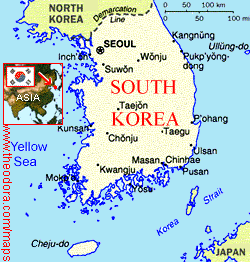
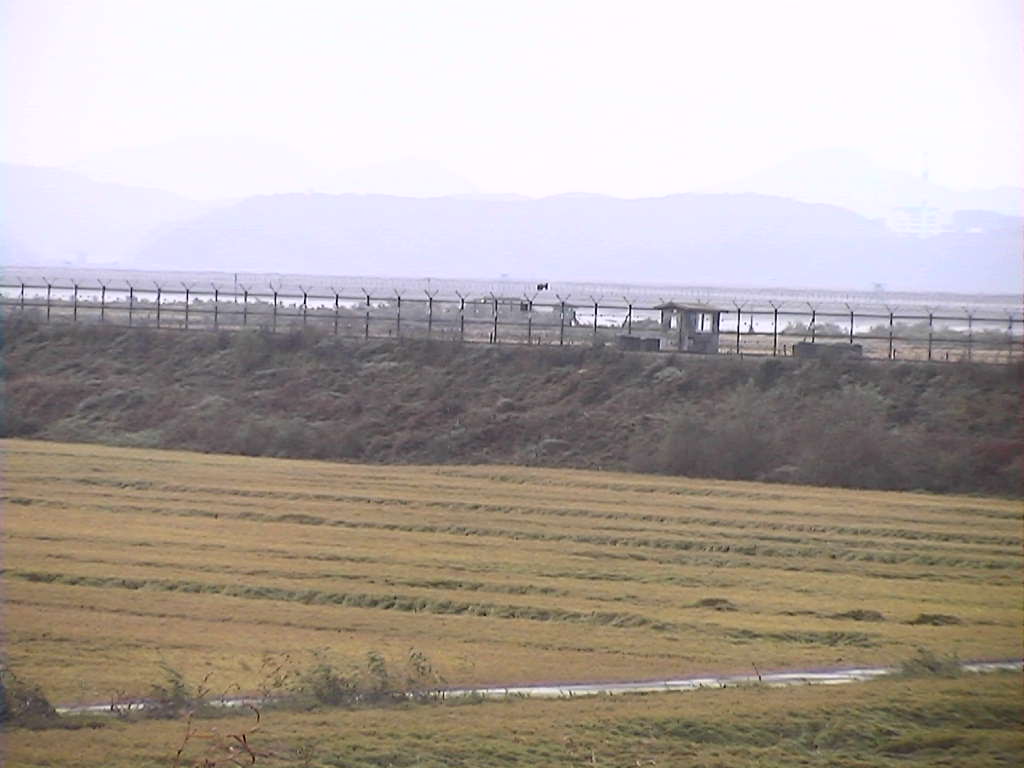
Picked up outside a hotel, we spent an hour fluffing around picking up a Belgium couple, two Kiwi men and another American couple all at different locations. We had a very apologetic Korean girl as our guide. She could speak English very well, I just couldn't understand a word she said. Finally, we motored out of smoggy Seoul (a dust storm had descended from Mongolia and everyone was coughing for days afterwards) along the wide Han River Estuary, with coils of barbed wire everywhere. The DMZ winds 155 miles across the Korea Peninsula from this estuary in the west to a point just below the 39th Parallel on the East Coast. A Military Demarcation Line runs through the centre of a largely undeveloped area (I wonder why), 4 km wide. The DMZ is actually less than 50km from Seoul. Its a bit like living in Croydon, London and Watford is the end of the world. Come to think about it, Watford is like the DMZ.
Photo of Usual view approaching the DMZ
Another Photo of Usual view approaching the DMZ
Yet Another Photo of Usual view approaching the DMZ
There are a series of sights to take in which were all rushed. The first 30 minutes stop was at Imjin Gaki, near the DMZ border. This is famous for the "Bridge of Freedom"; the only bridge crossing the Imjin River and at that time connected between North and South Korea. It is famous because in 1953, 13,000 war captives were allowed to cross back over it into the South. Under the wooden bridge was a tacky shallow blue pool in the shape of the Korean Peninsula.
The area is famous for the intense battles that took place during the war, but this hasn't stopped the Koreans from building a funfair here and the usual tat shops necessary for any tourist visit. There was a Peace Memorial, a Peace Bell, a peace this and that. And also an old steam train that once ran to northern Korea and a sign (allegedly, because I never saw it) saying "This train wants to run". So did I when the bus loads of Koreans turned up. I never got time to visit the Main Hall "where you get a view of the lifestyle in North Korea". I suspect you walked into a dark cell with a bucket of water, a stale piece of bread, and a bucket to shit in. I did come across an interesting little sight; the 'Stones of Peace Wall' (symbolising "a stepping stone for the reconciliation of the Korean people"). It was a sort of a sculpture but really a glass covered board with 86 labelled rocks collected from battlefields from all over the world. They ranged from the 480 BC Greek Persian War to the 1991 Gulf War and covered most of the continents. I thought it was an interesting concept. I also thought it would be a great job. Visiting battlefields just to pick up a rock. I could stretch that project out for years.
Photo of Freedom Bridge/Wooden bridge at Imjin Gaki
Photo of the Peace Memorial at Imjin Gaki
Photo of Peace Bell at Imjin Gaki
Photo of the Stones of Peace Wall at Imjin Gaki
We had arrived here in a small tour bus, but climbed aboard a large bus packed with Korean tourists for the foray into the DMZ. They turned out to be hopeless at keeping to the schedule, so I took advantage of this and always turned up late for departure. At the checkpoint, we had our passports checked by a soldier. There were a handful of bored looking soldiers in khaki uniforms all brandishing large calibre weapons. No camera shots allowed from here onwards (except in a few harmless places). We crossed over the river (which means that Freedom Bridge is not the only bridge over the river but don't tell the tourist board) and made for the 3rd Infiltration Tunnel for a 45 minute stop.
Northern Korea loves to dig tunnels under the DMZ. The first two were detected in 1974 and 1975. Then in 1978, a North Korean engineer escaped and provided intelligence concerning Communist tunnelling activities and a third one was discovered. This one was only 44km north of Seoul and scared the shit out of the Seoulites. The Communists are still digging. A 4th tunnel was discovered in 1990, large enough to accommodate tanks and trucks. The 1.6 km long Third Infiltration tunnel is 1.95m high, 2.1 m wide and penetrates 435m south of the Military Demarcation Line. It runs through bedrock at a depth of about 73m below ground. It was supposedly capable of moving a full division per hour, plus weapons. But they must be small soldiers and weapons.
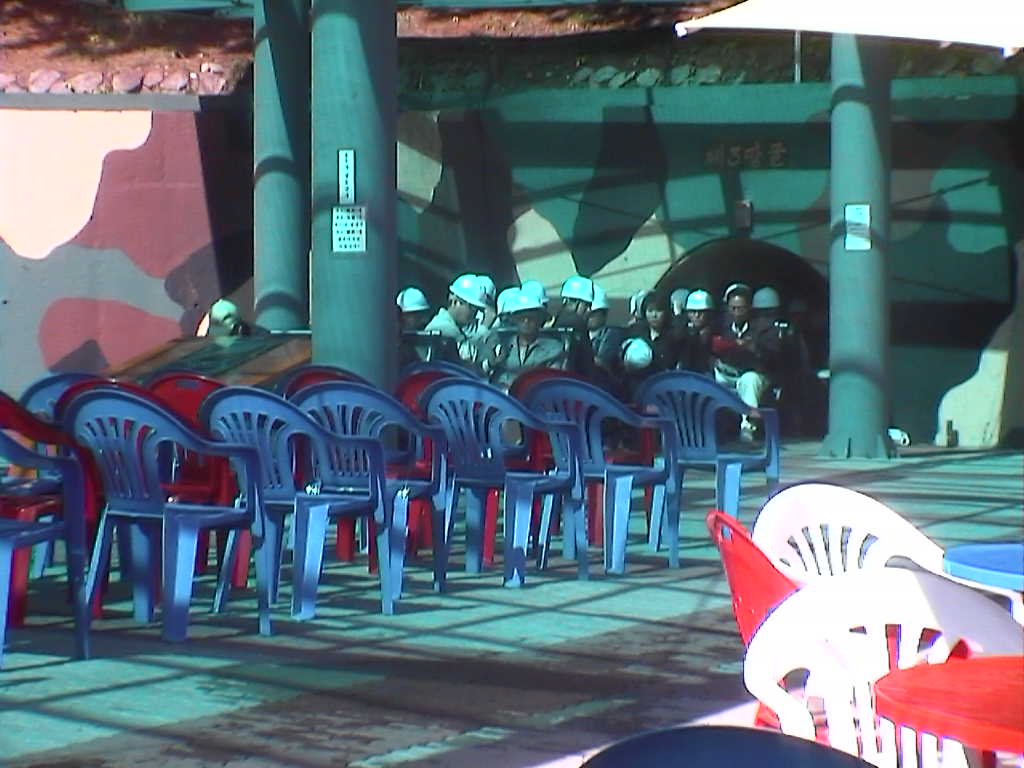
The South Koreans have tunnelled down 300m to connect to the Communist tunnel. You climb aboard a roller coaster type carriage and get taken down a 30 to 40' angled slope. You are given white hard hats to wear and the tunnel ceiling is very close to your head as you go down. Then you exit, and walk 225m along the old Communist tunnel, where the original dynamite cavities are highlighted in yellow paint ("all pointing towards Seoul" our guide said). It was very damp and I had to slightly bend my head to walk along the narrow granite burrow. At the other end is a locked door and some barbed wire. Er, that's it. I learnt that the North Koreans had painted the tunnel in charcoal and when discovered by the South, claimed they were mining for coal. Doh! Yeah, a really believable story. I can't work out why the South didn't fall for it. All things considered, this is the best part of the DMZ tour. You feel as if you are seeing part of modern history and its always an interesting experience to go underground. Back on the surface, we were rushed around an information centre which had some interesting footage, but we were hustled into a state of the art theatre to watch a film about the wonderful wildlife that now thrives in the DMZ, unless, presumably they step on a landmine. The DMZ has become a sort of unofficial National Park that noone can visit.
Photo of Third Infiltration Tunnel Entrance
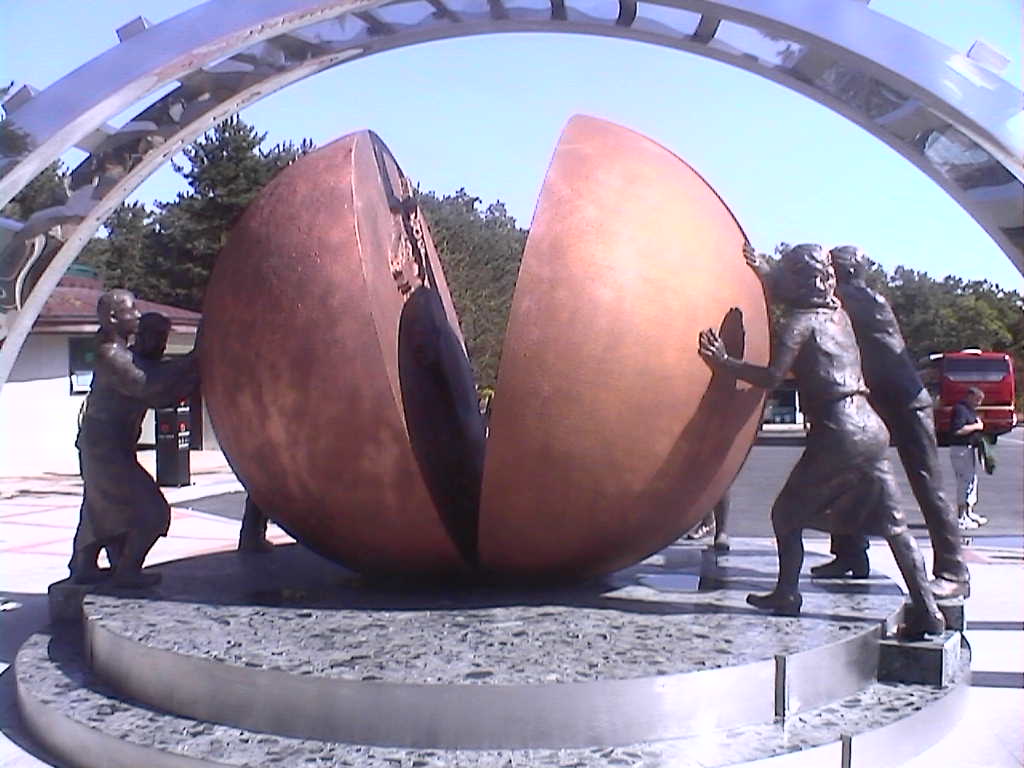
Photo of Interesting Sculpture Near Entrance
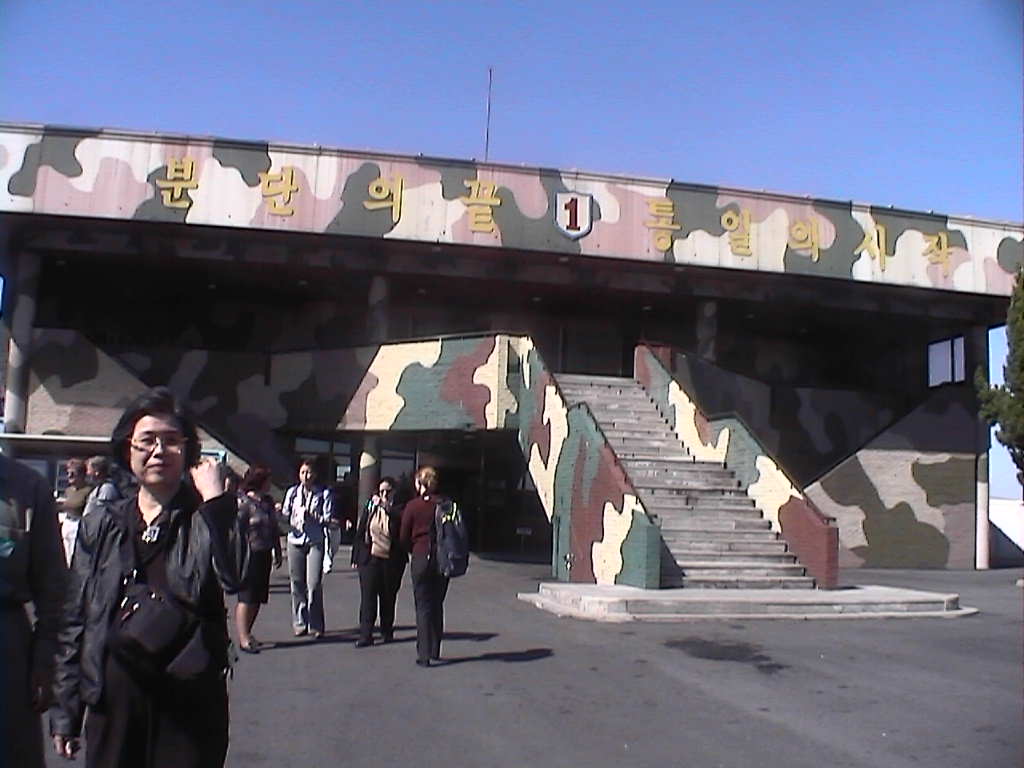
We drove past ploughed fields into some hills which were roped off with bright yellow and red signs proclaiming "Landmines" on either side of the road. At the top we came to the Dora Observatory Platform, which is where you get the chance to peer over at North Korea. But today it was very misty and it could have been anywhere. The building had been painted in naff "if we use a few dark colours, perhaps they won't notice the building on the hill" type of military camouflage. A Korean soldier with an immaculate American accent pointed out the two borders, the Military Demarcation Lines, and the North Korean propaganda village called Kijongdong with its unfeasibly tall flagpole "the tallest flagpole in the world" (I thought that was in Kuala Lumpur, Malaysia). We could see the a giant North Korean flag at the top of it. Across the valley was the South Korean propaganda village with a more modest flagpole. The soldier also pointed out the new railroad that is being built through the DMZ and scheduled to open before the end of the decade. Supposedly on a good day, you can see as far as Kejung, North Korea's second largest city, but today it was just a view of low lying undulating hills, woodlands and greenery.
Photo of Dora Observatory Platform Building
Photo of Typical View from Observation Platform
Photo of Model of DMZ layout
The funniest thing about standing on the terrace was that you could pay to look through those crappy telescopes, but you could only take photos from behind a thick yellow line that said "Photo Here". Since it was about 10m back from the walled terrace, all you'd photograph were the telescopes. I assume they have not heard of satellite technology. The Americans must have filmed every square inch of the DMZ from space. It wasn't exactly a security threat here. I took a photo of the yellow line instead. Well, I was only following orders. We had about 15 minutes here.
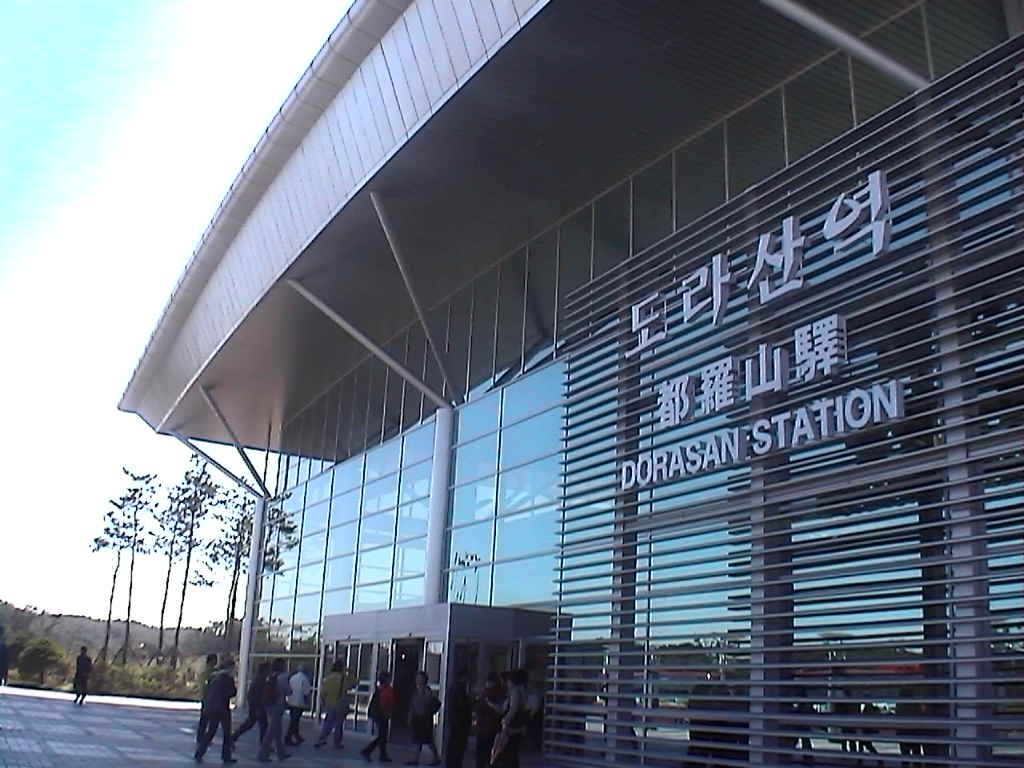
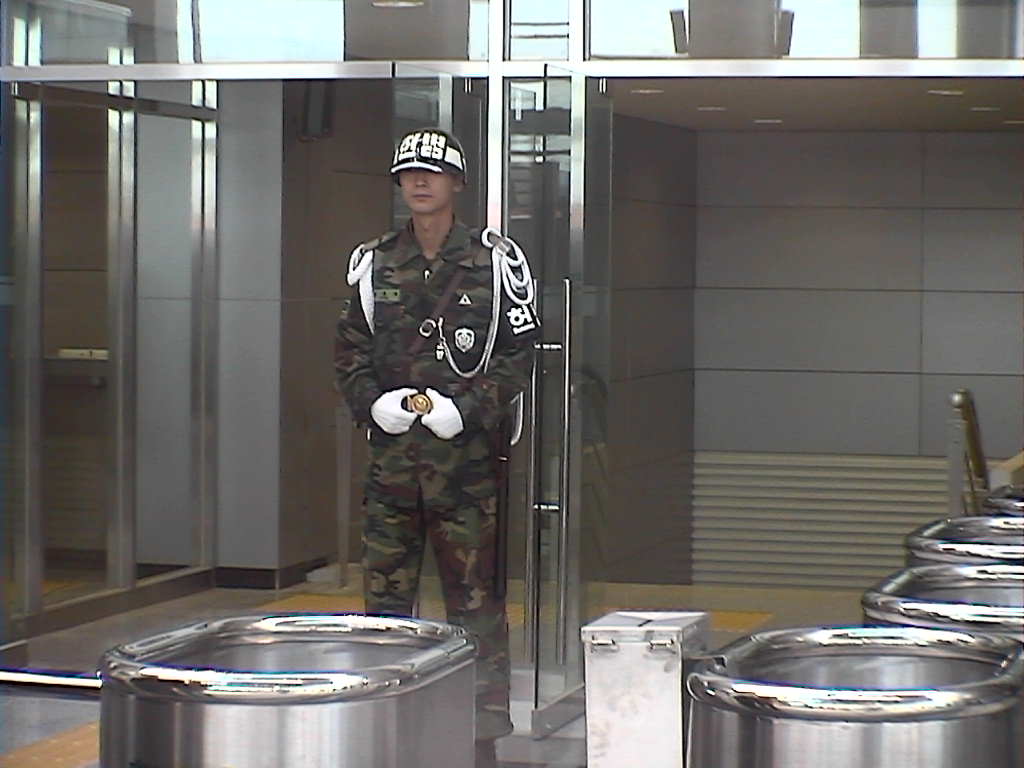
We were then taken to Dorasan Station, which is the last South Korean train terminal and stands right on the edge of the Military Demarcation Zone of the DMZ. I guess it is used by the soldiers and local farmers. A sign read "Seoul 56km / Pyeongyang 205km" (the North Korean capital). The new railroad being constructed across to the north starts here and George W Bush himself visited it in Feb 2002 for the opening ceremony for the start of the project. He had signed a ceremonial beam with "I hope this reunites Korean families". But his handwriting was so bad, that it looked like "What country am I in? Are there Communists around here? I'll be back" (I'm not kidding). Soldiers stood outside the station and made sure that we didn't point our cameras towards the north.
Photo of Dorasan Station
Photo of Soldier Who Told Me To Put My Camera Away
After this 10 minute stop, we had a quick drive through Reunification Village. Here a small community of farmers have been allowed to work the fields in the area. For living in such a godforsaken place, their families are exempt from military service and they live tax-free. We were allowed a 5 minute (whoopee!) stop, while the Koran tourists rushed into the shops looking to buy local produce but just found ice creams.
And that was the tour. We returned back over the bridge, where a soldier checked with our guide that everyone was still on board (who would want to stay here?) and we returned to Imjim Gaki, got rid of the Korean tourists and returned to Seoul. I suppose you have to be able to say that you did the infamous DMZ, but I wouldn't put it at the top of your sights. You can also do a more expensive trip to the village of Panmunjeom which actually sits across the border and where the endless peace negotiations continue ad nuseum.
What did occur to me during the trip is that Korea has never invaded another country. They have been invaded by the Chinese, Mongols and Japanese on many occasions. The only reason that Korea is divided is because the US and Russia made a deal during the Second World War to divide it. So even the current situation and tragic circumstances are not their fault. Personally, I expect North Korea to crumble within 5 years. As in Germany, reunification is inevitable. I am still sorely tempted to visit North Korea from Beijing, but it is an expensive £1000 guided week tour. And after just 6 hours on a guided tour, I was ready to kill someone. You can't beat independent travel.
First up was the Olympic Park. The grounds contained numerous world class sporting facilities and the remains of an ancient fortress. There was a massive and impressive Olympic gateway; a parallel supported T shaped structure with lively colourful painted designs under the curving flaps of the T shape. A wide concrete plaza (full of rollerbladers) was lined with 200 stone pillars with comical faces carved on top. Flags of every competing nation still flew in a semi circle around the plaza.
Photo of Olympic Gateway at Olympic Park
Another Photo of Olympic Gateway at Olympic Park with Funny Face Pillars
Photo of The Flags and Plaza
Within the enormous park grounds, dominated by a lake and surrounding grassy hills of the old fortress were 200 sculptures dotted around that offered a "serene if somewhat bizarre sight" (LP) with the sport stadiums as a backdrop. Or rather they used to... At least a third of the area containing the sculptures had been ploughed up by the landscapers from hell. I'd like to say that there was some kind of plan to their destruction, but it looked as if they'd all got pissed one night, jumped on some bulldozers and driven around wherever they fancied. The entire area was roped off so I never got a close up of the sculptures that poked out of amongst the giant piles of dirt.
But past that, there were plenty to choose from; international varieties, both small and impressively large. A German sculpture had two Volkswagen cars at the top of a pole; one upside down and the resting on top (both at a slant). It looked like they had been interrupted during car sex. There was also a lot of crap too ("hey, I've just been given a large Olympic grant. What have I got lying around that looks complete shite?"). But that's modern sculpture. You pays your money and you see what you get. I love this off the wall stuff.
That said, the grounds were very impressive. Down by the lake, a dozen brides and bridegrooms were getting their official wedding photos taken which was obviously a separate procedure to the actual wedding day. They were taking advantage of the wonderful sunshine, weeping willows and cherry blossoms dropping off the trees. The brides looked spectacular with long creamy wedding gowns. A gaggle of helpers would set the dress just so. The bridegrooms in smart black tuxedos or gold/black pinstripe waistcoats and freshly cut hair, would smirk next to the bride. Not surprisingly, the grounds were full of schoolkids on fieldtrips. The adventurous ones would yell "what's you name?", "where are you from?" and "why are you such a fat bastard?". If I replied, they would reply with their name and age. Then they learnt the expression "Like I give a shit, kid". Only kidding. I'd never knock an 8 year old for practising their English. I'd just slap them around a bit. After the 40th kid it does get tiring.
Photo of Wedding Photo Location
Olympic Park Official Homepage
A long walk down a wide boulevard took me past Lotte World (like an indoor theme park with every US franchise you could name; KFC, Pizza Hut, TGIFs etc). There were more sculptures in the middle of the boulevard. One was a group of runners' legs cut off at the shorts, except that they weren't wearing any shorts! What I thought was muscle was something else. Use your imaginations. It was certainly different.
3km from Olympic Park on the same boulevard, lay the Seoul Sports Complex containing an array of sports arenas including the official Olympic Stadium that doubles as a soccer stadium. It was closed, but I could peak through the glass doors to see some of the arena. The sports stadiums and indoor arenas have obviously aged since 1988, but both complexes had remarkable facilities that England would kill for. You'd have to knock down the entire town of Wembley and rebuild it with a dozen stadiums in landscaped parks. Before 1988, much of this area was just pear orchards. No wonder we will never host another Olympics. We just don't have the space.
South Korea seems to have real vitality that seems to have dissipated somewhat in Japan. Or maybe it was just Seoul and the experience of living in the fifth largest city in the world. I loved walking past the food markets and sampling various delights. I'd rate Seoul as a better stop over than Singapore, Kuala Lumpur and even Hong Kong. The people have real energy and are still optimistic towards the future. It was a nice crossover between standardised, sterilised and homogenised Japan and chaotic China. Labelled it as the Land Not Quite Right but is getting there, in its own time.
Overall, I'm glad I chose to spend a year in Japan rather than Korea. Japan is such a strange country, whereas South Korea was another side of westernised Asia. Its not until you leave Japan that you realise what a strange place it is. I couldn't have hoped to meet two more generous hosts, Mr Jeong and Mr Kim, anywhere. They made my stay in South Korea much more special and showed me a side of Korean life that I would never have seen on my own. On my final night, I met up them and Aussie Danielle for a last session of hot food and too much Soju. No one seems to visit Korea, but as with the Philippines, Myanmar, Tibet and Laos, I will be encouraging other travellers to give it a go. It is definitely the unknown treasure of Asia.
Travel - £152 (inc Ferry to China)
Accommodation - £223
Food - £153
Other - £140 (inc Chinese Visa)
Total - £138
Grand Total - £654