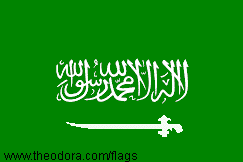
 Saudi Arabia
Saudi Arabia
Saudi ArabiaSeptember 2025
I never thought that I would get to visit the Kingdom of Saudi Arabia. Back in the day, you could only visit on business or be invited by a Saudi businessman. So, when it decided to open up to tourists recently and offer tourist visas, it was high on our list of countries to visit. My initial research to do a road trip was floundered by the fact that Saudi car rentals only allow you to drive 200 free kilometres a day so unless we were flying from city to city, it was logically unrealistic. Instead, I found an 8 day tour via Tour Radar called the ‘The Complete – Escorted Tour in 3 or 4* Hotels’ which started in Riyadh and finished in Jeddah taking in both the modern and historical highlights of the country. Getting the Saudi Arabian visa was easy except when it came to providing an exact head/shoulder photo of a certain size which took a lot of manipulating. They also wanted a hotel address which I couldn’t get from the tour company until two weeks until we left. We headed for London Heathrow on Thursday October 25 with suitcases full of long trousers, long sleeved shirts and for Wendy ‘baggy clothing’. I received a Whats App message from a Mr Hossam to say that a driver would meet us at Riyadh airport which was good news.
Friday September 26
After a final pint of Guinness in Terminal 2 before a week of alcoholic de-tox, we caught a flight with Lufthansa to Frankfurt leaving at 09:30. Arriving at midday local time, we only had an hour to make the 13:00 connection, but the special assistance that Wendy needed took so long that we were not dropped at Terminal A until 12:50 and discovered we needed to be in Terminal B. Frankfurt airport is huge and a representative said we had missed our flight. We were directed to the ‘Rebooking office’ and our hearts sunk at the possibly of having to wait a day for a flight to Riyadh. We were pleasantly surprised when we were booked onto a Saudi Arabian Airlines flight at 16:30 which meant we would still get to Riyadh for the start of the tour the following day. We were given 15 Euro ‘meal vouchers’ which allowed me to have a cheeky German beer. I was able to contact M
r Hossam to reschedule airport pick up around midnight (instead of the original 8pm). Saudi Arabian airlines seemed to believe in the traditional service that airlines used to offer. Before take-off, we were given Arabic coffee (with cardamom) and a date which is the traditional Arabic offer of hospitality along with water, hot flannels and a lovely package that included everything you needed for the flight – socks, toothbrush, earplugs, eye cover etc). We even had an Islamic prayer before we took off. Our seat screens announced. “Ladies and Gentlemen. The text you are about to hear is a supplication which Prophet Mohammed Peace Be Upon Him Used to pray upon travelling.”
Which was nice. During the near six hour flight, prayer reminders popped up during the movies (which had sex scenes edited out) and which were subtitled in Arabic. Arriving around midnight (local time) we were met by airport assistance and whisked off to Immigration. Here we had our fingerprints and photos taken and handed over our paper Saudi visas. Fortunately, our luggage had arrived, having been transferred from Lufthansa to Saudi Arabian Airlines at Frankfurt. The driver, called Iman, a Bangladeshi, had our names ‘Robert and Wendy’ on a board and brought his BMW Series 5 car up to the terminal. It was a smooth ride into Riyadh with all of the buildings lit up at night. There was even bottled water in the car for us.
When he pulled up at a hotel around 1am, we thought our day was over. But when we went to check in, we discovered that it was the wrong hotel. Iman had gone, so the hotel receptionist offered to call Mr Hossam to explain the mistake. Twenty minutes later, Iman was back and followed Sat Nav on his phone to another hotel which was also wrong. I made sure he didn’t leave until I found this out. We finally reached our hotel, the Grand Plaza Dhabad around 2am. The lobby had three paintings above reception. The middle one was of Salman bin Abdulaziz Al Saud, the King of Saudi Arabia. Wikipedia said it was “a position he has held since 2015. He was also Prime Minister of Saudi Arabia from 2015 to 2022. He is the 25th son of King Abdulaziz, the founder of Saudi Arabia. He assumed the throne on 23 January 2015. Prior to his accession, he was Crown Prince of Saudi Arabia from 18 June 2012 to 23 January 2015. Salman is the third oldest living head of state, the oldest living monarch, and Saudi Arabia's first head of state born after the unification of Saudi Arabia. He has a reported personal wealth of at least $18 billion, which makes him the third wealthiest royal in the world.”
It had been an exhausting day but we had arrived. Our room looked like our suitcases had exploded and we had to start the tour first thing tomorrow, but we were here for two nights.
Saturday September 27
We dragged ourselves down to the buffet breakfast with a good selection (no bacon or pork sausages allowed in Saudi) where omelettes were cooked, and there was a vast slab of proper honeycomb. One item was labelled ‘Lamp Liver’ which I assume was lamb. At 8.30 pm, our guide Nabil arrived with the bus where other tourists had already been picked up. Nabil was a Moroccan from Casablanca but based in Dubai. He turned out to be an excellent guide who couldn’t do enough for us, keeping the tour on schedule and organising all the local guides and logistics. There were thirteen in the group (including us), two Americans, two French, two German, two Austrian. To be honest, apart from the French and an American woman, the rest kept themselves to themselves and didn’t socialise with us or even try to communicate. It felt like we were all ‘independent’ travellers’ who resented having to do a group tour. But we were fine with their unfriendliness. We were here to experience the country.
I had a couple of travel guides. One was a simplistic ‘Travel Guide 2025’ by Rosemary Eugen but I thought that her ‘overview’ was a good summary. “Saudi Arabia is a land of sweeping deserts, dramatic mountains, glittering coastlines and deep-rooted traditions. Though long recognised for its religious importance and oil wealth, today’s Saudi Arabia is stepping confidently into the global spotlight as a cultural, historical and adventure travel destination. This is a nation redefining itself on its own terms – welcoming the world while holding tight to what makes its unique.”
It is positioned at the heart of the Arabian Peninsula,and shares borders with Jordan, Iraq, Kuwait, Bahrain, Qatar, the UAE, Oman and Yemen. It is about a third of the size of Australia, four times as big as France and nine times larger than the UK. It has a population of around 36 million and of these, a third are expatriate workers and their dependents. There are at least 2 million Bangladeshis,1.5m Philippines, and 1m Egyptians. For centuries, it was known primarily as the birthplace of Islam and possessing Islam’s two holiest cities of Mecca and Medinah.
Historically, Saudi Arabia was under Ottoman (Turkish) rule for centuries until 1918. There were a couple of attempts at independence (First Saudi state 1744-1818 and second Saudi State 1824-91) but it was Abdul Aziz bin Abdul Rahman bin Faisal bin Turki bin Abdullah bin Mohammed Al-Saud (crazy name, crazy guy – he shortened it to Ibn Saud) who succeeded his father as leader of the Saud dynasty in 1901 and by 1932 was the ‘King of Saudi Arabia’ having united the country through a force of arms. He then married a daughter from each of the defeated tribes and senior religious families. He had around 20 wives (but never more than four at a time) and 100 children and the creation of a family network that dominates the state. He died in 1953. There are now estimated to be 15000 members of the ‘Royal Family’ of which 2000 senior members hold most of wealth and power. Oil production started in the 1943. One thing I didn’t realise was that slavery was not abolished until 1962 (whatever ‘slavery’ was by then). Women’s rights have improved since 2018 and by 2020, they were 33% of the Saudi workforce.
Saudi Arabia holds 15% of the world’s proven oil reserves and produces 13.4 m barrels of oil a day, the largest exporter of crude oil in the world. Yet, it is also the sixth largest consumer of oil, and the air-conditioning uses 70% of the nation’s electricity. It is left on all the time, regardless whether people are home or not. I was surprised that petrol prices were as high at 40p a litre. The price did not differ wherever we were in the country. The official currency is the Saudi Riyal (SAR) currently 1 = 20p. Credit cards were excepted everywhere. One joyful realisation was that they had the same plugs/voltage as the UK.
Our guide today was Yiyad, a thirty something bearded male, who came across as a modern progressive person. He would answer any question honesty even on religion and politics which surprised me given the reputation of people not supposedly allowed to air views publicly on such issues. He told us that back in 2010, people did not pay tax. All utilities, education and health were free. But the current King had an agenda of change and building infrastructure (Saudi Vision 2030) and trying to diversify from the monopoly of oil and now everyone was paying taxes. The King’s showpiece is a new city/province called Neom being built in the northwest running 460km down the Red Sea coastline supposedly developed with ‘green’ practices and designed to maintain a sustainable environment. $500 billion is being used to finance it.
Today we would be exploring Riyadh. As the capital and largest city, the ‘Travel Guide 2025’ said that “Riyadh is a dynamic blend of tradition and modernity. Towering skyscrapers rise beside centuries old forts, and bustling souks co-exist with high end shopping malls. It’s the financial, and cultural heart of the country.” Its other importance is it is where the King resides. The temperature today would be a roasting 42’C.
Before we started, Yiyad produced cardamom coffee and dates. He pointed out that the coffee was served from the right, using the right hand. You should not refuse the first cup because you would be insulting the hospitality of your host, but after that, you could wave your hand over your cup if you did not want anymore. It was an acquired taste and fortunately was in very small cups. We would be offered this everywhere throughout our stay. Every hotel lobby had a coffee pot on the go.
Our first destination was the King Abdul Aziz Historical Center, a district at the heart of al Murabba that encompassed the Saudi National Museum, National Museum Park, Murabba Square and the Murabba Palace. We walked through the park to the nearby Murabba Palace. Built between 1936 and 1945 and restored in 1999, the old King Abdul Aziz lived there until his death in 1953. The palace introduced modern features such as electricity, plumbed bathrooms, early modern air conditioning and the first lift in Saudi Arabia. The palace is constructed in the traditional Najd style using mud bricks, straw, wood and palm tree fronds. The doors, windows and ceiling were made of wood. The lovely exterior was sand colour with white pillars and window frames over two levels around an open courtyard. We could not gain access to the Palace, but we did see the Rolls Royce gifted by Winston Churchill.
At the National Museum (free admission), we were met by a jovial Mr Ali, a historian, who would guide us around this ‘state of the art museum which offers a journey through Saud Arabia’s natural, cultural and religious history” (Travel Guide 2025). There were eight halls starting with the Hall of Man and the Universe taking us back to Palaeolithic times, followed by the Hall of the Arab Kingdoms and Hall of the Pre-Islamic Era (400BC exhibits). On the first floor was the Hall of the Prophet’s Mission (the rise of Islam), the Hall of Islam and the Arabian Peninsula and onto the Hall of the First Saudi State, and Hall of the Second Saudi State.. The Unification of the Kingdom Hall took us through the first part of the Twentieth Century. The final hall was the Hall of the Haji and Two Holy Mosques where we learnt about Mecca and Medina. The museum was well laid out and spacious with reconstructions. We were so captivated that when Mr Ali offered to do an extra 30 minutes, we said ‘Lead the way’. It was a useful introduction to the kingdom and some of the historical areas that we would explore later in the week.
The local souq/market was shutting up for the 1pm prayers so Yiyad took us to a couple of places to explain the burning of wood in the four pronged incense burner. He also took us through the traditional clothing that he was wearing. He wore a skull cap under his red and white checkered ‘shemagh’’ held in place with a black cord called an ‘agal’. The red and white is associated with the Bedouin culture and has become a symbol of Saudi identity over generations. His main ‘dress’ was a white ‘Thobe’, a long loose fitting robe which dropped down to his feet. When he lifted his Thobe, he revealed he was wearing a pair of white leggings (something I never imagined them doing) under which he said he wore boxer shorts. During formal occasions, a traditional cloak called a ‘Bisht’ is worn which may be decorated with gold or silver embroidery. I had a go at dressing up with the main components and got a photo taken. Women traditionally wear a black abaya sometimes with a burqa.
We were taken to a local restaurant where Nabil ordered our lunch. This turned out to be a large piece of roasted chicken on a massive bed of saffron rice, some cheese samosas and something we never identified. The locals ate the meal with their hands (including the rice). Bottles or water and Diet Pepsi washed it down. We also stopped in at a money changer. I cashed40 English Pounds for 198 Saudi Rials to have some ‘walking around money’.
After lunch we visited Masmak Fort near the National Museum. The Brandt Guide to Saudi Arabia called it “an architectural and historical gem.” Built in 1865, the ‘Battle of Riyadh’ took place in 1902 and where Ibn Saud (saves me typing out his full name again) was victorious and it was the turning point in the unification of the Kingdom of Saudi Arabia as further military campaigns were planned and run from the fortress. When we entered via a large wooden gate we noticed a smaller door within the gate, designed to let only one person enter and thus maintain the security of the fort with its 18 metre tall watchtowers. There were various rooms and exhibitions inside, but it was the fort itself that was the highlight with its traditional Najdi design.
The historical sights over, it was time to see modern Riyadh and we headed down the King Fahd Road to the financial district. On the way, we passed the Kingdom Centre Tower which is Riyadh’s most recognisable landmark. At 302 metres high, the Sky Bridge on the 99th floor “offers breath-taking views of the capital” (Travel Guide 2025). Wendy nicknamed it the ‘Potato Peeler’ because of its shape. Another fabulous ‘skyscraper’ was the Al Faisaliah Tower. This building with 30 floors, towering at a height of around 267 m is shaped as an elongated pyramid with 655 glass panels covering the entire building and a huge glass globe near the top, measuring 24 m in diameter. Currently, the Al Faisaliah Tower Saudi Arabia is the fourth tallest skyscraper in the country. There were plenty of other memorising tall buildings on the King Fahd Road.
The Saudipedia website said that the “King Abdullah Financial District, or (KAFD), is the largest multi-use financial district in the Middle East, boasting a strategic location in the heart of Riyadh City. The district is an integrated destination that combines residential, business, and entertainment facilities. Furthermore, it stands as an architectural marvel with more than thirty buildings, including sixty-four towers that have reshaped the urban skyline of the capital, Riyadh”. It represents the primary destination for finance and business in the region. Started in 2006, the glass skyscrapers had spectacular designs. I remember visiting New York City for the first time in January 1979, and being stunned by the skyscrapers and myriad designs. I felt the same way here as I stared up at the towers above me. It felt like a city of the future and has won various awards. Even the colossal mosque had a futuristic design in triangular patterns. We were really impressed.
The new metro station which had recently opened was also ‘space age’. I found a description by the Zaha Hadid Architects who designed it. “The station’s six rail platforms over four levels connect with bus and park and ride services, creating an important multi-modal transport hub for the city. The design prioritises connectivity, with a three dimensional lattice defined by a sequence of opposing sinewaves, optimising internal circulation and avoiding congestion. The station’s façade, clad in ultra-high performance concrete panels, reduces solar gain and references traditional regional architecture.” Whatever. I just know that I had never seen a metro station like it anywhere in the world. The exterior was like three bands of white interlocking honeycombs.
Returning back down the King Fahd Rd, we hit heavy traffic late in the afternoon. Considering that this was the second day of their weekend, I was surprised at the gridlocked roads. Near the hotel, Nabil let us out to visit a supermarket where I was able to stock us with milk (for our English tea and coffee!) and cold drinks. Back in the hotel room, we turned on the TV for the first time. Channel 1 was live footage of the pilgrims at Mecca performing the hajj walking in circles around what looked like a black box. I thought that it looked like hundreds of thousands of ants gradually disappearing down a plughole. After yesterday and today’s frantic touring we had an early night.
Sunday 28 September
We had to have an early breakfast and our luggage ready for pick up at 7.45am. We joined the morning rush hour and headed out of town to the Riyadh Railway Station. One thing I noticed was that there were long stretches of divided roads. In the UK, we would have built a roundabout to allow you to turn in the opposite direction. In Saudi Arabia, they had U turns where cars would be bottlenecked and queued up in the left lane, trying to turn left onto the opposite road but having to time it against the fast-moving traffic they were joining. We participated in quite a few of these over the following days. It didn’t help with the Saudi habit of ignoring the queue and trying to cut in front of our bus or other cars. Like most Middle Eastern countries, they drove with their horns.
When we arrived, somewhere in the western outskirts (Sinaiyh Qadeem district) of Riyadh, the railway station looked like an airport terminal with a massive glass façade and a ‘Departures’ sign. Its unique design and architecture had been the result of an Italian architect back in 1981 inspired by the design of mosques along the Mediterranean Sea. It looked like it had been designed yesterday. The station’s design included a vast main lobby with two wings that enclosed the railway platforms. The roof was constructed from prefabricated, pre-stressed beams and the exterior was clad in local limestone. The building incorporated triangular openings for windows, arcades and parapets which contributed to its distinctive appearance. It was another fabulous building. We lined up at check in desks with our luggage. Nabil had given us our paper tickets. We had to show them and our passports, and our luggage disappeared like it would at an airport. The platform was covered in a curved steel girders in a space age design that looked superb. Every station we stopped at had the same type of platform architecture.
On board the train, operated by the Saudi Railways Company (SAR), there was spacious leg room and fold down tables (like on a flight). Before we departed at 10am, there was another prayer from Allah for the journey. Our carriage was full. Some women wore the black burkas and fiddled with their mobile phones. As soon as we left, the desert scenery immediately appeared. Many passengers kept their window shutters down to keep the sun out. The air conditioning was lovely for the five hour journey covering 420 miles and it was a very smooth ride. As I peered out of the window during the trip, I saw more electric pylons than people. At the first stop of Al Majmaah, some of the passengers got off and half a dozen cleaners got on to clean the empty seat areas and toilets. Talk about service. Around two hours into the journey, herds of camels started to appear in the desert. We had another stop at Al Quissim before we finally pulled into Ha’il around 3pm. We collected our luggage from a belt as you would at an airport.
Historically, Ha’il (meaning ‘place between two things’) has been known as the ‘Land of the Two Mountains’ referring to the Aja and Salma Mountains which are prominent natural features of the region’s Shammar mountain range which rises up to 1200 metres above sea level. The landscape was rich with mountains, valleys, deserts, plains and volcanic hills. There are hot and dry summers, and cold and harsh winters sometimes with snow, the only place to get it in Saudi Arabia. Ha’il is located on the southern edge of the Nafud Desert. Most of the 600,000 population still live conservative, traditional lives. It is also traditionally the home of Saudi Arabia’s poets and writers.
We were met by a Bangladeshi driver and bus which would be our transport for the rest of the week. Our first sight was Al Qishlah Castle. This relatively modern landmark was built as a military fortress in 1943, was later used as a prison and became a heritage building in 1995. Measuring 143 by141 metres with 8.5 metre high walls, the large castle was two stories high and constructed in the traditional Najd style of mud, stone and wood. There were eight watch towers (attracting flocks of pigeons) and 143 rooms facing onto a courtyard. It was a nice place to photograph but a bit uninspiring. Outside the walls next to a ‘disabled’ parking space was a sign of a person in a wheelchair and underneath ‘Parking for people with determination’.
The 17th century A’arif Fort was built on a hill in the centre of Ha’il. The (restored) mud and clay exterior had walls filled with round and rectangular windows and traditional triangular designs on top. It was only 40 by 11metres in size. From the top we could view the whole of Ha’il surrounding it. Again, a quick visit was enough.
The final stop was a bit of a surprise. We pulled up outside a residence where we were welcomed by the owner Mamdoyh, who offered us seats in the courtyard which was dominated by a palm tree with orange and lemon trees around it. Coffee and dates were offered. The residence had been the family for 120 years and was a series of rooms full of Saudi antiques and previously used household stuff such as a reel to reel tape deck from the 1970s. There were rows of attractive Dallah coffee pots but the majority of ‘stuff’ was what we would have called ‘tat’. But Mamdoyh was friendly and interested to learn about us. Sweet tea was later offered. It was nice to visit a real Saudi household even if it was more of ‘living museum’.
We had been impressed with our Riyadh hotel but when we entered the Holiday Villa Hotel in Ha’il, we were stunned by its vast atrium. The pictures of the King and the other two were above the reception as before. We were given a spacious room on the 7th floor and could look down to the lobby below. The café advertised itself as a ‘Chess Club’ and had two boards set up on the tables but no takers. The restaurant on the 6th floor offered us excellent buffet choices such as chicken, beef, salads and pastries. I noticed a man going up to try a lot of different dishes. I asked if he was trying to eat everything. “I have to” he smiled, ‘I’m in charge of the restaurant.” There was a useful 24-hour supermarket next door. The façade of the hotel changed to various colours in the darkness. It was our nicest hotel during the week but unfortunately, we only had one night so hardly unpacked.
Monday 29 September
We had another early start but had time for the breakfast buffet. I did miss bacon and pork sausages. The only thing available were chicken sausages which lacked any flavour. One label that I found funny was the ‘‘Foul with condiments’. Around 8am, we were back on the road for a 72 mile journey accompanied by rocky outcrops which gave out to flat desert scenery. The sealed road was smooth and there was little traffic. We passed through Qina which didn’t feature in my guidebooks. There were the first ‘Camel warning’ traffic signs which we would see throughout the week. We eventually reached Jubbah which had a series of interesting roundabouts. One had a huge Dallah coffee pot with running water and a massive incense burner. Another celebrated the fact the Paris to Dakar rally was held in Saudi Arabia in 2025 and had passed through here.
Jubbah (population 20,000) is an oasis in the southern end of the Nafud Desert in a valley with a water supply and surrounded by large sandstone outcrops. Jubbah apparently means ‘well’’. It was located on the site of an ancient lake and is now lush with palm trees. The nearby mountains are supposedly named after the humps of camels. It was on the caravan trail from pre-Islamic times and has been inhabited since the Stone Age. At the small Visitors Centre, we were the only visitors and watched a couple of videos about the site before we were led by our guide, a smiling man called Mamdoyd who wore the traditional white robe and red and white checkered shemagh. He led us outside into the mountains in very bright sunshine to view the petroglyphs.
Jubbah is one of two main locations of the 2015 UNESCO World Heritage Sites of ‘Rock Art in the Ha’il region’. These petroglyphs are recognised as some of the most important in the world. The Brandt guidebook said “Depictions on the rocks of people and animals brilliantly illustrate the everyday life of this area as far back as 10,000 years ago. They indicate a time when the area was fertile and able to sustain cattle, deer, gazelles, horses, ibex, lions, oryx and ostriches” like the African savannah today. The depictions of camels were probably added centuries later as the climate turned drier. Historians think that the humid period lasted from the 10th to 6th centuries BC and that desertification took place after that.
Because Wendy couldn’t climb the steps, she had decided to stay at the Visitors centre where she chatted to two of the women in their burqas who worked there. One was called Fatima. She learnt what it was like to be a woman in Saudi Arabia, that their job opportunities were much better, about raising their children and other ‘woman stuff’. When we returned, she told me that she had had a ‘special experience’ of sharing knowledge with the women. When she went to take their photos, she almost said ‘Smile’ before realising that she could only see their eyes and not their faces. We then drove a short 3 km to the second site called Jebel Sinman and climbed more stairs where we saw a clear depiction of a chariot being pulled by two horses and hunting scenes. It had been a lovely visit, and we felt privileged to have had the petroglyphs to ourselves.
The reason for our early start today was that we had an additional 345 mile journey to reach Al Ula. My photos remind me that the long journey was through more spectacular desert scenery, traffic signs of ‘Camels Crossing Area’ and ‘Attention: Sandstorm Area’ (one was misspelt ‘Sandstrom’). One thing I noticed was that the brown and white cars of the ‘road traffic police’ were always parked on the outskirts of villages and towns. The ‘National’ police cars were larger and faster black and white cars. At one point, four National police cars flew past us in a convoy with their lights flashing red. We came across them twenty minutes later parked in the middle of nowhere having a chat amongst themselves. Sometimes we would see a sign with ‘Checkpoint Ahead’. This was usually before we entered a major town or city and where police inspected trucks or cars, but our bus was never stopped. At one point, two large camels crossed the road in front of us. During the trip, we passed through the famous desert of Nefud Al Kabir which means ‘great extent of sand dunes’ (no surprise there) which is 290 km by 225 km wide.
We stopped a couple of times for drinks, snacks and fuel but it was a long haul of around eight hours. As the sun started to drop, yellow sandstone hills started to appear that turned red under the setting sun. This turned into a brilliant yellow sunset that set off the silhouettes of the mountain outcrops which grew taller as we approached Al Ula. It was an 11 km mystery tour through the dark streets of Al Ula until we reached the modest hotel of Al Wateen Hotel at 7.45pm. It was rather isolated, but our room was spacious even if the shower leaked over the bathroom floor. We were offered a lukewarm buffet of various dishes. But we did discover the delicious dessert called ‘Omanli’ which was puff pastry in cream with nuts and covered in chopped pistachios. Our TV was in Arabic and I couldn’t work out the settings, but we were too tired to care.
Tuesday 30 September
The breakfast was minimal but at least they had the Omanli pudding on offer which was a novel way to start the day. We had two nights here, so we didn’t have to check out. Al Ula’s highlight is the Nabataean UNESCO World Heritage Site of Mada’in Saleh. The Brandt guide said “Many visitors will feel that they have discovered something very special, at least until tourism becomes more mainstream” and raved about the “mind blowing rock formations.” On both counts, they were correct. Al-Ula is an ancient oasis that has been inhabited for the last 7000 years. During the 1st millennium BC, the city of Dedan developed thanks to its strategic location on the frankincense trade road to become one of the oldest Arabian kingdoms. During the first century BC, the Nabatean people came from Petra, settled at Al-Hijr where they built monumental tombs similar to the ones they dug in Petra. A number of them include inscriptions and dates.
The stairs at the top of many tombs represent the transportation of the soul to heaven. The facades are hewn from sandstone rock and there are some other flattened rock faces, that were perhaps carved in preparation for future tombs that were never built. Many of the tombs were elaborately decorated with Nabataean inscriptions and symbols of life and the afterlife including eagles, griffins, sphinxes and Medusa like faces surrounded by snakes meant to warn off potential intruders. Some of the inscriptions contained warnings of fines and divide punishment to reinforce the message. The area was first mentioned by an English traveller Charles Doughty in the 1880s in his book about exploring the Arabian desert, but it was French archaeologists who started to excavate the site in the early Twentieth Century.
From the entrance of the Hegra Archaeological Site also called Mada’in Saleh (declared an UNESCO World Heritage site in 2008), we were bused out to the first site of Jebel Ithlib. A ‘golf cart’ was provided to let Wendy explore as well which driven by a friendly guide called Mohammed who had studied in Sunderland for a year. The Jebel Ithlib area was highlighted by a well preserved meeting place (‘diwan’) set in a dramatic setting at the entrance of a very narrow passage between two sets of rock cliffs. The diwan was built into the rock and contained stone benches on three sides. It was used for religious meetings, banqueting and entertainment. We walked through the gap to see writing and petroglyphs carved into the upper cliffs.
The next stop was the immense Jebel al Banat which Mohammed called ‘Girls’ Mountain’. It was a cluster of 29 tombs that were owned by or created for women. There were elaborate decorations above the doors of the tombs containing depictions of snakes, birds of pray and other pre-Islamic symbols. I had left the group with another guide to double back and take some photos around the corner of the vast rock. I started to photo every tomb and disappear inside for a photo. I had done this to at least a dozen tombs, when I caught up with the group who were told they could only enter Tomb 24. Oops. The insides usually had three or four large carved rectangles but some had coffin sized holes in the sides of the tombs. Historically and visually, this is site was spectacular.
The third site was Jebel Al Ahmar where 80 tombs were scattered on a plain in several clusters and then we moved onto the Tomb of the Lion of Kuza. This large monolith was a towering 22 metres tall. It is also known as ‘Qasr al Farad’ (lonely castle) because it stands in isolation from other clusters of tombs. From the top down, it contained steps, ledges, four columns and a small rectangular opening. It looked monumental. Nearby we spotted ‘Face Rock’, a sandstone rock whose formation looked like a person’s face in profile including the neck, lips, nose and eyelids.
One feature that all the sandstone rocks had were the innumerable holes in them, some in lines and of different sizes. Apparently, these were created by tiny quartz crystals which were originally embedded in the sandstone and the wind/rain caused the crystals to slowly be revolved for millions(?) of years until the holes had been created. We hadn’t seen such things before but they added to the atmosphere of the area as did the toffee coloured rocks which sometimes looked like huge blobs of ice cream. The whole area felt very special, and again, we felt privileged to have explored it with just a few people. I think that this was a major highlight during our visit to Saudi Arabia.
We were bused back to our own bus where we drove into Al’ Ula to explore the ‘Old Town’. This was inhabited from the 12th Century until the 1980s. The lower level was where the original settlement of Al’ Ula remained mostly in ruin. On our tour, we saw the Masjid al Izam (Mosque of Bones) named when the Prophet Mohammed indicated the direction of Mecca with bones during his visit. The Mousa bin Nusair Fort was built as defence for the settlement during the 6th Century BC. The 190 steps up to 45 metres gave a good view over the Old Town and the ruins of the original settlement. On the way through the narrow passageways, Nabil pointed out King Charles’ signature in Arabic which he had been taught to do on a mud wall on a 2024 visit. During our explorations everything was shut, and it was like walking through a deserted town. I am not sure why.
At this point we said goodbye to seven of our group who had a shorter tour than us. It was no great loss since they hadn’t talked to us and it gave us more room on the bus. Nabil took us to the local fruit and vegetables market where we had a lunch of grapes and pistachio nuts. Our final sight was ‘Elephant Rock’. The 52 metre high rock looked remarkedly like an elephant in all directions. It made for a great photo and was a unique rock formation.
After the early start and long day yesterday, it was nice to get back to the hotel before 4pm. We got the TV sorted so we could watch BBC News in English. I was astonished to discover that the TV had 247 channels for all surrounding countries and even Palestine. I walked for 15 minutes to the nearest supermarket to stock up on cold drinks and snacks. You could get Diet Pepsi but the Saudi version (Kinza) was much cheaper. That evening, our (piping hot) dinner came pre-packed. There were chicken and beef dishes and salad. And of course, more Omanli pudding.
Wednesday October 1
This morning at breakfast, I learnt the Arabic for ‘Bless you’ when I sneezed. “Allah yarhama” means ‘May Allah have mercy on you’. Our bags were packed ready to check out. We were taken to the Dadan Tombs area and walked up to Jebel Ikmah. The rocky pathway fractured one of Wendy’s front wheels of her wheelchair, leaving it mortally wounded. We were however able to later borrow wheelchairs from our hotels in Medinah and Jeddah. Jebel Ikmah, known as the ‘Outdoor Library’ was, my Brandt guide said “an astounding site” and that “Visitors will be awed by the proliferation of inscriptions in Aramaic, Dadantic, Thamudic, Minaic and Nabataean languages, leaving a lasting testimony to the importance of these diverse historical kingdoms that go back to at least the first millennium BC. The site also gives a template for understanding the development of the Arabic language.” It was the setting itself that was unforgettable, with much of this carved work being on clusters of towering rock formations. We also saw a rich display of rock art depicting people and animals in scenes of everyday life. Our guide today at this site was Omar, a cheery youth who pointed out the languages and explained their meanings.
At the Visitors Centre, we did an ‘activity’. We were given small slabs of red sandstone, an Arabic/English alphabet, and a hammer and narrow chisel. The idea was that we chiselled our names in Arabic which of course reads right to left. After marking the letters in pencil, we toiled away until Wendy spotted an expert rock carver called Selim and asked if he would do hers. When we saw the excellent result, I admitted defeat and had mine done as well.
At another area, we walked up to view a series of tombs 50 metres above us on a cliff face. The two ‘Lion Tombs’ (with a lions carved on either side of the opening) were indicative of the high status of the occupants (maybe royalty?). At Dadan North, we walked down to an excavation site of the ruins of a stone carved temple (worshipping Dhu Ghaybah, the most important god of the Liyhanites, my guidebook said. Who knew?) and the surrounding foundations of former residences. The backdrop was towering yellow sandstone mountains with acres of green palm trees at their base.
We had set off early today to take in these extra historical sights because we had to drive to Medina around 207 miles away. There was more desert scenery with rocky outcrops, warnings of camels and sandstorms and regular radar speed traps that looked like big grey boxes by the side of the road. The trip also had regular examples of terrible driving by Saudi drivers. I have three examples. 1. Just because there is a double white line which means no overtaking should not stop you from overtaking 2. Even our bus driver decided to overtake a truck on dual white lines on a sharp bend. I could see another truck coming towards us and as we pulled out to overtake, I was thinking ‘we’re not going to make this’. It was only the oncoming truck piling on his breaks and pulling halfway off the road that let our bus get past. 3. This one was the best. The bus was overtaken on both sides at same time on a two lane road! A driver had gone to overtake the bus but another driver behind him obviously thought he was overtaking too slowly so he decided to overtake on the right on the sand at the same time. It was a bit disconcerting to hear the roar of engines as they went past and the bus actually shook. I forgot to mention that the Saudis drive on the right but that doesn’t stop them driving on either lane.
We took a toilet break in the middle of nowhere and saw an large tall green isolated plant with a flower. This was an Askara known as the ‘Flower of the Desert’. Just outside the city of Madinah, we passed through another checkpoint. We had been in the Medinah Province since Al’Ula. The province is home to around 2.1 million people with significant agriculture and industry as well as being a global pilgrimage destination.
Madinah, the capital, is the second most important site in the Islamic world and is the main destination on the Islamic pilgrimage trail after Mecca. It is the location of the Masjid al Nabawi Mosque (Prophet’s Mosque) complex which includes the tomb of the Prophet Mohammed. The population in the ‘Enlightened City’ or ‘City of Lights’ has increased from one million in 2010 to two million in 2025. One of the reasons is that Islamic tradition says that if you die in Medinah, Allah will forgive all your sins which has attracted the coffin dodgers. As we made our way to our hotel in the centre, we could see lines of pilgrims making their way to the Mosque. The comfortable Mysk Touch Al Balad Rawafed Hotel where we checked into, was less than 200 metres from the Prophet’s Mosque and we were right in the centre of the action. We set off to witness this unique place. The mosque (or Al Haram area) is officially off-limits to non-Muslims so we could only watch the pilgrims entering, exiting, praying and chatting from the ‘Green line’ where the gates were. We could also peer through the large metal perimeter fence. It had a serene ambiance, expansive marble courtyards and the iconic green Dome marking the Prophet’s resting place.
Originally constructed in 662 AD, it was the second mosque built during the life of the Prophet Mohammed, after the Quba Mosque. It is also the world’s second largest mosque after the al Haram Mosque in Mecca. Originally covering an area of 30m by 35m, the mosque has been expanded over the centuries and in 1992 had been increased to 160,000 square metres able to hold 500,000 pilgrims but even now another expansion is underway. There are now 42 gates to the interior of the mosque (women can enter four of them). The exterior is mostly a sand colour. There are a total of 27 domes and 10 minarets (four from Ottoman tines, the rest from the Twentieth century). Decoration featured black and white stones, marble and elaborate Islamic geometric designs.’ Wudu’ stations for ritual washing in preparation for prayer were in several locations. Large umbrella shaped awnings were suspended over much of the area providing shade. These awnings looked fantastic. They cost one million dollars each and could also collect water if it rained. Other statistics: there are 10,000 toilets, 5000 cars can park underneath. 2000 workers on are 24/7 shifts to keep it clean and provide security. Medinah has 5000 mosques. There were 84 hotels around the Mosque providing 82,000 rooms.
When we returned after dark for another look, the umbrella awnings had been lowered and their stems had bright lights to illuminate the mosque. All the minarets were lit by spotlights. It looked glorious. It was one of the most interesting and enchanting places I have ever visited anywhere in the world. There was a steady flow of pilgrims throughout the evening. On our TV in the hotel, Channel 2 provided 24 footage of the mosque. Around the hotel were lots of ‘pilgrimage souvenir’ shops (the first ones we had seen in the country) and we were able to find fridge magnets at last for 60 pence each. I was so impressed, I bought three.
Thursday October 2
After a lovely breakfast with an array of choices and surrounded by pilgrims also staying at our hotel, we were met in the lobby by our Medinah tour guide called Fassal Alkelabi. As with all the other guides he was dressed in traditional costume, and was very knowledgeable and friendly. We started by visiting the Prophet’s Mosque (which I have already covered) and gave us much of the information I wrote about.
With our luggage in the bus, we headed for the old Al Hejaz Railway station. In the late 19th Century, it used to take pilgrims up to forty days on a ‘caravan journey’ to cover the 820 miles from Damascus in Syria to Medinah. Started in 1900 and completed by 1908, the Ottoman empire had built the Hejaz railway between the two cities and reduced the journey time to five days. The railway line only lasted ten years until 1918 when it was blown up by Bedouin soldiers as a security risk. The attractive brick station was closed but we could see the bautiful Ottoman architectural touches. Nearby, we popped into the mosque which had been built to allow pilgrims to pray at the start or end of their journey at Madinah.
Quba Mosque holds the distinction of being the first mosque in Islamic History. It is believed that the Prophet Mohammed laid the first stone upon arrival in Madinah from Mecca. It was completely rebuilt in 1986 and featured 4 majestic minarets and 56 domes, all of which were pristine white to reflect the sunlight. There was enough room for 20,000 pilgrims. It was currently 5000 square metres in area but in 2022, it was announced that the surrounding area would be expanded to 55,000 square metres to allow 66,000 pilgrims to come in contact with the mosque. Tour groups of pilgrims made their way into it. One group were dressed in illuminous green clothing. Our guide said that there were 8 million palm trees that had been planted nearby. We also popped into Al Sirah Experience where we watched an animation on the ‘The Journey to Quba Experience’. The blurb on the website said “An immersive journey back to 7th century Medinah when Al-Ansar (who he?) embraced Prophet Mohammed with unwavering faith. Experience the sights, sounds and emotions of this pivotal moment in Islamic history from the Al-Ansar’s heartfelt welcome to the anticipation of building Islam’s first mosque, Quba.”
We drove past the Masjid al Qiblatain known as the ‘Two Direction’ mosque. Originally built in 623AD, this mosque is where Muslims believe the Prophet was commanded to change the direction of prayer from Jerusalem to Mecca and to reposition the ‘mihrab’ or directional niche accordingly. It was one of the rare few mosques that contained two mihrabs, one facing Jerusalem and the other, Mecca. It was rebuilt in the 1980s and only the mihrab facing Mecca was retained.
Beneath the Jebel Uhud - Mount Uhud (Mountain of Heaven) 1077 metres tall, is the site of a pivotal battle in Islamic history – the Battle of Uhud in 625 AD, where the Prophet Mohammed snatched defeat from victory over his opponents when his archers left their post on a hill, thinking the battle was over and the opponents were allowed to kick some Islam ass. Pilgrims visit to pay respects to the graves where 70 ‘companions’ who died in the battle are buried and also take in views from the rocky outcrop called ‘Archers Hill’ where the archers supposedly stood. We clambered up the modest hill full of people to look over the rather barren cemetery surrounded by a fence and at the large Sayed Al Shuhada Mosque. When I went to look at the mosque, I came across a large group of Indonesian women who were making a pilgrimage. They were all dressed identically in black and blue.
Our tour of Madinah was over, and it was time to head for our final destination, Jeddah which lay 255 miles south. With breaks, it would take around five hours. Leaving the Medinah checkpoint, we joined a motorway (Highway 15) where the speed limit was 140kph (usually it was 120 kph). I think that around 85 miles per hour was judged to be the minimum allowed. We seemed to roar through the desert and at one point passed through a sandstorm. There were the innumerable speed cameras and camel warnings. For most of the trip, Jeddah was joined with ‘Macca’ on the mileage signs because Mecca is only 45 miles from Jeddah. I didn’t take many photos apart from at a fuel stop where we met some Bangladeshi workers in a takeaway café.
Passing through the crowded checkpoint into Jeddah, we approached the city from the north. To our right was pointed out the Burj Jeddah or’ Jeddah Tower’ which will become the tallest building in the world reaching one kilometre tall and beating the Burj Dubai (828 metres). Eventually, we pulled into our final hotel called the Blue Diamond Hotel in the southern part, just off the Jeddah Corniche, a road that shadows the coastline for much of Jeddah. It was just a five minute walk to see the Red Sea and a man-made beach. At the restaurant, they just had a set meal in English with a few choices. Salads for starters, fish or burgers with chips and cheesecake for dessert. But the portions were huge and tasty.
Friday October 3
Today, Wendy decided to rest up so the remaining five of us plus Nabil were joined by our Jeddah guide called Mr Mohammed Ashmawi. He looked older than me, but when I asked him his age, he said “25 plus experience”. He was quite opinionated and when he was talking about something being built in a couple of years, I said that it wouldn’t happen like that in the UK. He turned and whispered that it was because the UK was full of Indians that everything took so long to build. He was also adamant that London was a very dangerous city and that everyone got their mobile phone stolen. Whereas in Jeddah, if you left your phone, it would still be there when you got back.
Jeddah, my Brandt guide said “has a well deserved reputation as the Kingdom’s most progressive city and is often where any social changes in the country first take place”. It is the second largest city in Saudi Arabia with almost five million people. It was a trading city for centuries and has the second largest port in the Middle East after Dubai. Jeddah is known as the ‘Bride of the Red Sea’ although after touring the city for a day, I felt that it was more ‘Always the Bridesmaid, never the Bride.’ It has been attempting to compete with Riyadh with a number of ‘tallest and largest’ structures and much of the city was still being rebuilt. It will be a great place to visit in five years.
The Corniche extends for 30km in Jeddah along the coast with city parks, sandy and rocky beaches, food kiosks, picnic areas and sections where you could rent bicycles. We went up and down this to pick off the sights. Jeddah has a lot of roundabouts and many had interesting sculptures. My Bradt guidebook had a bit of information about them, “In the 1970s, Saudi and international artists were asked by the then Mayor to create sculptures, bronzes and other works of art that could be displayed in the centre of Jeddah’s many roundabouts. The result was more than 20 individual exhibits which were installed on the roundabouts mostly on the Corniche. Works include the Bicycle, boat, Camel, Car Crash, Cosmos, Fist, Four Lanterns, Globe, Magic Carpet, Seagull and Sword.” I think we passed most of these during our explorations.
The Al Rahmah or ‘Floating Mosque’ was located next to the Jeddah Yacht Club. A ‘jobs worth’ security guard said that I couldn’t take photos (even of the Yacht club) but when he wasn’t looking I still did. This beautiful structure was built in 1985 on a platform over the Red Sea. In addition to the main dome, its design included 53 additional domes as well as 23 umbrella shaped structures proving shade. I thought the ‘Floating’ description was a bit optimistic since it was at least 4 metres above the sea which was out at low tide. Next to the mosque was a wall behind which the Formula One event had taken place in April. They had photos of the racing drivers. Not a follower of the sport, I only recognised the British driver Lewis Hamilton’ At a couple of places during our tour, I spotted vast empty sandy areas off the Corniche. When I asked our guide what they were going to build there, he said that it was parking for the Formula One Race and Park and Ride buses took the spectators to the track.
There was a lot of building going on in Jeddah. The local Government had tried to stop developers buying land and then sitting on it, by charging them 100% tax a year later if nothing had started to be built. This would be a good idea to adopt in the UK. A new metro system was being built to encourage public transport to reduce the traffic jams. They are also supposedly building the largest Opera House in the world.
While the 1pm prayers were on the horizon, we pulled into the vast Red Sea Mall. Every shop was closed along with most of the food outlets. It felt like everyone had been eaten by zombies and apart from a couple of security guards, there was virtually no one there. I laughed at a couple of things. Firstly, the Marks and Spencer store that seems popular in Muslim countries. I’m sure they think it is very English without realising that Michael Marks was a Polish Jew. The second one was a restaurant called ‘Fridays’. This was obviously a ‘Thank God It’s Friday’ franchise but they obviously could not have ‘God’ in the title. We did an interesting tour of the Central Fish market. It was very large with dozens of stalls and an amazing collection of fish, some huge, for sale. There were swordfish, lobsters, groupers and other strange and wonderful species. All of the friendly stall holders that I chatted to, were from Yemen and were happy to be photographed holding up their large fish.
The historical district of Al Balad is the original walled city in the south of Jeddah and has been designated a UNESCO World Heritage Site owing to its unique culture and architecture dating back to the 7th century AD. The 500 year old multi-story houses (up to 30 metres tall) had the traditional and distinctive Hijazi architecture and were decorated with wonderful latticed wooden windows. These boxed windows with bright green, blue or brown colours were designed to enhance airflow in a pre-air conditioning world. Our guide took us for a magical mystery tour around the narrow lanes, pointing out buildings and telling stories. Apparently, the kitchen was always on the top floor so that if a fire occurred, most of the building would be saved. We tried sugar cane juice at one stall and also watched a baker removing huge flat bread from a red-hot kiln and bought and ate it fresh. Some say that UNESCO rescued this area before it was pulled down. It felt a bit strange to be designated a World Heritage site when there was a multimillion dollar project to restore 56 of the buildings. I always thought places that had survived relatively intact were the ones chosen rather than have something rebuilt. The old town is now mostly populated by expatriates from Asia and Africa.
After our final dinner at the hotel, I took Wendy up to the roof where we could view the King Fahd Fountain which had been built offshore in the Red Sea. It is supposedly the world’s tallest fountain, reaching over 200m high. Water from the Red Sea is propelled into the air from what looks like a very large gold incense burner. The wind was blowing so the actual fountain had a magnificent water spray coming off the main jet.
Saturday October 4
We were picked up at 10am by a driver who took us to the King Abdul Aziz International Airport (KAIA) in North Jeddah. The vast Haramain High Speed Railway airport station had been built adjoining the airport and operated between Mecca and Medinah via Jeddah. The trains can reach speeds of 180mph. The temperature outside was 36’c (but more like 45’c with the humidity). We had a porter help us with the bags and getting the broken wheelchair wrapped to be checked on as normal luggage.
Egypt Airlines flew us at 13:00 to Cairo Airport arriving 15:10 (local time) and where the two and a hour layover was more than enough time to catch the 17:50 connecting flight to London Heathrow arriving at 21:05. I found it amusing before we landed on both flights that there was an announcement “We hope you have a safe landing”. We were home in Wales by 2am. The first thing I did was to open a beer.
Our trip to Saudi Arabia had been a lot better than we expected and we really enjoyed experiencing the country. We found everyone very friendly and helpful, the hotels very good, our overall guide Nabil and the local guides excellent and we felt privileged to have seen the UNESCO historical sights and the pilgrimage city of Medinah. Best of all, it felt like we had discovered Saudi Arabia before the rest of the world and word gets around and mainstream tourism takes off. Friends were critical of the visit due to the ‘human rights’ issues but every country has its problems and if I took their attitude I wouldn’t have seen half the world that I have.
