Romania
Romania
RomaniaAugust 2005
When we reached the Romanian border, there was an empty EU channel and we passed all the crappy Moldavian cars backed up and went straight to the front of our line. Ha bloody ha. A friendly Romanian official went through our paperwork quickly and efficiency. No visa was required for any EU citizen. We had our passports stamped, were told to “Have a nice day” and to drive up the road to get our ‘vignette.’ When you drive your car around Romania, you have to pay a special road tax by the week. The man in the kiosk looked like he had the most boring job in the world. He had to fill in endless forms, type in the car details into an ancient PC (with those skills, he could get a job on the Moldovan side) and eventually he gave me a little sticker for the car. It took 15 minutes to do the paperwork and it cost 2 Euros. Welcome to Romania.
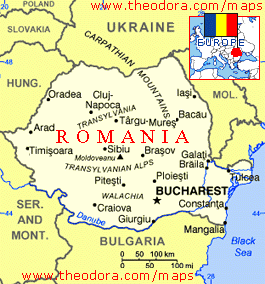
Romania in a nutshell: Romania gained independence from the old Turkish Ottoman Empire in 1878. It supported the Allied Powers against Germany in the First World War and came out well, but backed Germany in the Second World War and was overrun by the Soviet Union. A Communist “people’s republic” was established and Nicol Ceausescu took over as a de facto dictator in 1965, setting up a police state which became increasingly oppressive and draconian throughout the 1980s. He was overthrown and executed in 1989. Gradually the other Communists lost power and now a democratic system of sorts is improving while Romania is clawing itself forward, slowly and surely trying to lose the remnants of the Ceausescu era.
It’s the 11th largest country in Europe, about the size of Oregon. Bordered by Bulgaria, Hungary, Molova,Serbia & Montenegro, and Ukraine. Access to the Black Sea. 22 million people. Romanian language. Eastern orthodox religion. Natural resources: petroleum (reserves declining), timber, natural gas, coal, iron ore, salt. Agricultural (wheat, corn, barley, sugar beet, sunflower seeds, potatoes) and manufacturing industries. Average income $7,700. 29% below the poverty level. Currency is the Leu (plural Lei – read like lay). Hot summers (average 23’C) and cold winters (average -3’C).
DIY Romanian: yes – da, no – nu, good – bun, bad – rau, please – va rog, thank you – mulitimesc, do you speak English? (probably not) – vorbiti englezeste?, where is the nearest Tescos? – unde Tescos?, do you have a teenage daughter to sell? – never found that one in Romanian, are any of your extended family in the Mafia? – even worse…
I had originally planned to visit Romania (and Moldova) in 2001 with a friend and we even had flights booked to Bucharest, before I was offered a job teaching in Japan and had to sacrifice the flight. Back then, Romania had a bad reputation for corrupt policemen who would stop tourists for anything in a bid to extract money and anyone with a car was a prime target. Consequently, I was expecting a bad time with the police, but we saw very few throughout our stay and noone stopped us. This was because thousands of policemen have been fired as part of Romania’s attempt to de-corrupt itself to be allowed to enter the European Community provisionally in 2007.
Famed for it’s majestic castles, medieval towns and painted churches, Romania was now chasing the dreams of the rest of the west. So we found a mixed culture; the old Eastern Bloc of horse drawn carts jostling for space against fast cars whose drivers were talking money on mobile phones. According to the CIA, the population has double the number of mobile phones (7m) than land line phones (4.3m) and these figures were from 2003.
We headed to Iasi to find an ATM. According to my internet exchange rates, an English Pound was worth nearly 52,000 Romanian Lei. However, Romania was in the process of changing its currency by removing three zeros so that a Pound was worth 52 Lei. Our problem was that we didn‘t know if it had occurred. When I pulled out 5 million Lei from the ATM, I assumed they hadn’t, otherwise I had just emptied my account, my overdraft facility and then some rather than the £96 worth of cash we needed to get going.
On the outskirts of Iasi, we discovered a massive hypermarket called Metro. They seemed to be the up and coming adventure for the Romanian consumerist. When we went in to restock, we discovered three things; that it was actually a cash and carry place so we couldn’t shop there, that the place was full to the gills with shoppers all welding large trolleys and buying a dozen of everything, and that after they had been through the tills and paid their money, they had their receipts and goods double checked by security guards to make sure they hadn’t stolen anything. We made for the hills instead. Along the way, we came across a large of number of people marching slowly down the road with a people holding huge bouquets of flowers and crosses over their shoulders. It was a Romanian funeral. Somewhere in the middle was the Orthodox Minister dressed in his black gown. There were probably a hundred people. The coffin was carried on a cart pulled by a horse.
The north east of Romania (Moldovia not to be confused with that other place) had beautiful alpine scenery, pine tree forests and the Eastern Carpathian Mountains as a backdrop. It was stunning. The Painted Monasteries of Southern Bucovina in the NW of Moldovia are “rightly acclaimed as masterpieces of art and architecture, steeped in history and perfectly in harmony with their surroundings” (Rough Guide…a decent guidebook at last!). Founded in the 15th and 16th Centuries, when the area was still under potential infidel invasion, someone has the bright idea of covering the churches’ outer walls with paintings of biblical events for the benefit of the illiterate faithful. “These frescos, billboards from the late medieval world, are essentially Byzantine but infused with the vitality of the local folk art and mythology” (RG). Whatever. They are some of the best sights that Romania has to offer. We checked out the two ‘best’ examples;
From the rather ugly town of Suceava, we followed a narrow road to Voronet Monastery which has been nicknamed the “Oriental Sistine Chapel” and even had a colour named after it (Voronet Blue). The ‘Last Judgement’ fresco here is seen as the best of all the monasteries. Painted around 1547-50 “Fish tailed bulls, unicorns and other zodical symbols forma frieze below the eaves, beneath which Christ sits in majesty and where the deceased are judged and prayers for their souls counted. On either side are Turks in limbo, destined for perdition. Beneath them, devils and angels push sinners into the flames while two angels sound the last trump on alpine horns” (RG) Graves are open and animals come bearing the limbs they have devoured. I like to think that this is the plight of Moldovan officials. I could go on and on (you already have Bob). Suffice to say have a look at the photos. Not bad for 600 years of sun, rain, wind and snow. (I must have had something on my camera lens because the top left hand corner of these photos are smudged…but you’ll get the general idea).
To reach Sucevita monastery, we had to climb over the mountains for 50km along a twisty rising road. It was like being in Switzerland, looking down on green pastures, lots of tall haystacks, through pine forests and er, passing hitchhiking nuns. Not a sight I’d seen before. Our backseat was rather full so we couldn’t stop to help them. Just the journey there was worth the effort.
Sucevita monastery was much more spacious. Surrounded by huge whitewashed walls and watch towers and steep grey roofs, the church was bigger and had an air of grandeur. It was the last to be built in the area in 1584. Its frescoes (painted 1596), equally stunning to Voronet’s were brilliant reds and blues and emerald green. The ‘Ladder of Virtue’ was the most famous where flights of angels assist the righteous to paradise, while sinners fall through the rungs into the arms of a grinning demon. Inside, the church walls were also covered in frescoes but are blackened by centuries of candle smoke. UNESCO has declared them both World Heritage Sites and they were unique. Unmissable if you like church stuff.
Backtracking along the Swiss type road, we rejoined the ‘main’ road heading west and saw our first police car. My dad looked at the map and guidebook and chose Vatra Dornei for the night which had a hostel. “It’s bound to be quiet” he added. When we arrived, we discovered a town heaving with tourists and we had no idea why. Apparently it is a spa town but to look at it, you wonder why anyone would bother to come. But they did in droves. Our hostel (Hotel Baza de Instruire Informatica – try saying that to a passer by with Unde “where is” in front of it) was no longer a hostel. My Rough Guide only four years old said there was only one hotel in town. There were now at least a dozen and they were all full, so were the home stays. We still couldn’t see any reason why you’d come here for a weekend except to drink heavily and forget you were stuck in Vatra Dornei.
We had no option but to leave town. On the outskirts, I spotted ‘Camera’ (room) and pulled up. An old woman with cataracts was asleep on a wooden bench outside. When she awoke, she looked frightened (must have been my shorts!) and went inside. Guess we aren’t staying here. We were just about to leave when the owner came from the back. He showed me the accommodation. It was a proper Romanian pension: a first floor flat with a kitchen, a bathroom (full of small pornographic sticker pictures on the wall), and a small bedroom and balcony with table and chairs. The rooms were filled with old traditional Romanian wooden furniture. There was a stuffed owl above my father’s bed and huge stuffed fish heads above mine. Who were these people? Why would you stuff fish heads? It was only £12 and just what we needed. Their teenage son spoke good English. He was on holiday from college and had just quit his summer job saying “They promised me 800,000 lei for a week’s work and only paid me 500,000.” Romanian corruption was still alive and kicking. We parked in the drive and they locked the gate. There was no escape. Then it started to rain in a big way.
The large house had the old grey tiled triangular roof peaks like an old Victorian mansion. It was next to a line of dull grey cheap terraced housing, right next to the railway line that split the houses from the road. We spent the night drinking heavily, trying to forget that we were stuck in Vatra Dornei with a stuffed owl and fish heads around us inside and the fact that it was pissing down outside and when the trains passed, everything shook (remember Elroy Blues in the ‘Blues Brothers’ movie saying “The trains pass so often you won’t even notice them”). The family never bothered us. Neither did the Belgium relatives who were staying in the other bedroom and who came back after we had passed out. They were still asleep when we left. I wonder what stuffed items they had in their room. The place is called ‘Pensiunea Ciprian’ on No 1 on Str. Piscului. They even had their own promotional leaflet and you can see the owl in one of the pictures. Its strange however, that they don’t mention there is a railway line right outside the front gate. One of those places you never forget.
The next morning, the rain was still coming down in sheets. The roads were awash with water. It didn’t stop until 1pm! What a great day to go driving. Despite the lovely rural scenery, it was a miserable experience tackling the narrow twisty roads and trucks throwing up spray. The weather didn’t stop the horses and carts from being out on the road which also slowed things down. My dad did a three hour stretch and felt exhausted. We came past Bistrita on the main road, then cut south across country to Reghin (unfortunately missing out the town called Turda) and then Tirgumures. South of here lay Sighisoara, our next port of call.
“A forbidding silhouette of battlements and needle spires looms over Sighisoara…and it seems fitting that this was the birthplace of Vlad the Impaler – the man known as Dracula” (RG). We had entered the vast region of Transylvania, probably as famous as Romania itself. Sighisoara had also been declared a UNESCO World Heritage Site, principally for its intact medieval centre.
The old town or citadel dominated the newer quarters from a rocky massif whose slopes supported a jumble of ancient, leaning houses, their windows overlooking the steps leading up to the main gateway. Above rose the mighty 14th Century Clock Tower. Sighisoara was initially a free town controlled by craft guilds, each of which had to finance the construction of a bastion and defend it during wartime (The hexagonal Shoemakers Tower is the most impressive remaining of the nine left). The town grew rich on trade profits and the old residences were all rebuilt after an earthquake and fire in 1676. There were also the impressively covered wooden Scholars’ Stairs (175 of them) that rise steeply to the Church On the Hill (still being restored). Built in 1642, I hadn’t seen anything like these anywhere else in Europe. The cobbled backstreets revealed beautiful medieval buildings with timber frames and painted plaster inbetween. There was a nice touch on one corner of an inn. A painted deer had a real pair of horns stuck out from the wall at the edge that looked as if they belonged to the painting.
But everyone had come to see Dracula’s birthplace. It was an impressive yellow painted three story structure, with a cafe on the ground floor. Born in 1481, Vlad was born here who later earned the title as ‘the Impaler’. Abroad, he is better known as Dracula (Son of the Devil or Dragon). Vlad had a privileged childhood since his dad was a Knight of the Order of the Dragon after fighting the Turks. Dad then got to take charge of the region of Wallachia and later, for whatever reason, decided to become an early dysfunctional family by sending Vlad and his brother to Turkey as hostages to the Turkish Sultan in an attempt to gain favouritism. This was no picnic and the young lads lived in daily fear of getting buggered or strangled. Needlesstosay, Vlad came home, eventually took over and spent the rest of his life trying to extract revenge on the Turks. Apparently, he made sure whenever he ate his main meal that some Turk was wriggling in front of him impaled on a stake. Ozzy Osbourne eat your heart out.
So we took our photos and listened to American tourists wittering on while I tried not to point out the obvious that “Dracula was not born here. He is a fictional character for f**k’s sake.” But did they listen? Did George Bush, when he was told a hurricane was going to hit New Orleans? No, they went on their merry ignorant way. But we liked Sighisoara. It had history and it had character (unlike say, Warsaw’s old town) and it was the best old medieval centre we saw in Romania. Well worth a visit.
The rain had let off during our visit there but by the time we reached Sibiu southwest of Sighisoara, it was back. Supposedly, this was another classic example of a medieval city, but when we arrived, we found that it had been declared the “European Cultural City of 2007” and was having a rapid makeover probably UNESCO financed. This involved digging up all three major squares at the same time and fencing them off. It was a construction nightmare and ultimately a major disappointment for us. The old town did have some wonderful buildings (painted in sky blue, red, apricot or pea green) which surrounded the squares, but it was another case of sterilising history. The mentality seemed to be that medieval market places must have had nice paving, fountains and probably a McDonalds and a Starbucks café.
In the rain, the muddy squares (Piata Mare, Piata Mica and Piata Huet) looked miserable, as did we. We drove all this way to see this? At Paita Huet, we popped into the massive Evangelical Cathedral to find the crypt, where the tomb of Mihnea the Bad, Dracula’s son was housed. A nice name, but its difficult to top your dad, so I suppose ‘bad’ is a good attempt except that rather than being compared to a Michael Jackson album title, he could have looked up his Roget’s Thesaurus and picked from “appalling, atrocious, awful, defective, dreadful, terrible, unpleasant, unwelcome etc. What about ‘Menacing’ to go with Mihnea? ” The cathedral also housed Romania’s largest church organ and someone was practising on it when we were there. Cathedrals always sound better with the background of an organ even if a few bum notes are thrown in. The other two squares were impressive, even in the rain, but surrounded by construction, I felt robbed. At the Piata Mica, we stood on the 1859 Liar’s Bridge. Apparently if someone tells a lie, the bridge will collapse. So I said that Moldovan officials were nice people and the bridge never fell. Another disappointment. When I see this city paraded before the world in 2007 as the ‘European Cultural Capital’, I will remember how bad it looked when I was there. Like a shithole. Still, they pick similar cities. In the UK, Liverpool got chosen. I rest my case.
We cut our stay short and decided not to stay. We headed for Brasov and knew we wouldn’t reach it before dark so anywhere on route would do. The roads were straight and flat and we were surrounded on either side by harvested wheat fields and wild flowers growing by the roadside. Well at least, I thought they were wild flowers but my dad informed me that he had them in his garden. As dust fell, we reached the moderately sized town of Faguras and decided to check out the hotels. The first was full but they said ‘Diana’ and we tried to find it by asking locals. When we asked one large tattooed guy, he asked in German “Are you German?” No, we’re English, I replied in English. “That’s ok then” he said and gave us directions.
Pension Diana, on a side square, was a new establishment. Clean, utilitarian and £26 for the cramped room. I almost missed last night’s spacious abode and stuffed fish heads, which at least had character. But we had a fridge outside the room to cool our depleting supplies of Polish beer, and we had cable TV (with 57 channels of shit), so we were able to watch the World Athletic Championships for the first time. If you are wondering what we were eating, we had stocked up in Poland with all the main food groups (beer, sausage, peanuts, chocolate etc), so we could just buy bread, tomatoes and fruit as and when. European cuisine has been so standardised that even if we had gone out to eat in restaurants, it would have been the same as we could have got at home. It was easier and cheaper to drink good beer, snack out while reading or watching TV and wait until we hit a supermarket to diversify the diet.
Faguras “54km west of Brasov, has a reputation as an ugly town, dominated by chemical works and scarred by Ceausescu’s attempts at town planning, but it has its attractive aspects” (Rough Guide)…yeah, a TV showing the World Athletic Championships.
Near the hotel lay the old, sturdy fortress which looked worth a visit, but when we awoke the next morning, it was pissing down, sorry, persistently raining. It was tempting to lay in bed reading, snacking and pass the day exploring the town for bars and drown our sorrows, but somehow (despite the beer intake the evening before), we dragged ourselves out and took off. Why let a force 9 gale stop you from touring?
We made for Bran Castle – probably the most popular tourist site in Romania, but not today. The village of Bran was washed out by incessant rain and streams running down the sides of road. The tourist market stalls had all their tat under plastic sheets and were sheltering under canvas. There were no tourists apart from me – probably because the castle was closed on a Monday (i.e. today).
Situated 28km southwest of Brasnov, the town commands the entrance to a pass and a castle was built here around 1370. Vlad the Impaler probably attacked it in 1460 from which it gets its “Dracula’s castle” label. Perched on a rocky bluff, and protected from site by trees, it rises in tiers of towers and ramparts from the woods with a mountain backdrop (invisible today due to low lying cloud/fog/rain). I suppose it looked atmospheric especially on a day like this with the mist swirling around.
Every town needs a tourist gimmick and Bran is luckier than most in Romania, using Dracula to entice the punters. Everything had a ‘Dracula’ label including “Camping Dracula”. I had visions of a gay Dracula mincing around saying “oooh hark at her.” I don’t remember Dracula being part of the Village People. We didn’t bother to stay and find somewhere to have breakfast where the menu creations using Dracula images would have probably been a bit long in the tooth. Groan.
On the way back to Brasnov, we drove up through the fir tree forests to the ruins of the 14th century Rasnov castle that overlooked the town of the same name. It was still pouring with rain so there were no views but there would have been in the sun. It had a spectacular location but I just skirted the outside walls where rivers of water poured out of rain pipes. Such a bloody miserable day.
Brasov. Originally took off as a medieval Saxon trade town and played a big part in the kick out the Communists revolution in 1987 and 1989. We were here to see Old Brasov and in the pouring rain parked just outside the old town. Brasov has a bad reputation for ‘street kids’ but today’s weather was so awful, they were probably sheltering somewhere and noone bothered us. Piata Statului at the heart of the Baroque townscape was “quintessentially Germanic” (Rough Guide) whatever that means. It looked pretty good in the rain. The fact that it was not being reconstructed like Sibiu’s main square, was a major improvement.
Not many people know this: Local legend has it that when the Pied Piper enticed the children from Hamelin in Germany, they vanished underground and emerged in Transylvania, near the site of Brasov’s main square – Piata Sfatului (Council Square). It is lined with sturdy merchants’ houses, “their red roof tiles tilted rakishly, presenting their shop fronts to the 15th Century Council House” (Rough Guide).
Apparently, the town’s most famous landmark is the ‘Black Church’, whose towers stab upwards like daggers. The church took a century to complete (finished 1477) and is called the Black Church due to its soot blackened walls, the result of a great fire in 1689. Well, excuse me, but it didn’t look very soot blackened to me. Maybe the continual rain washed it off. They wanted another entrance fee so we never saw the white-washed walled inside. I could also live without the Turkish carpets as well. What can I say? It was wet and miserable. In those conditions, a medieval town centre looks like any other place in the rain. They had nice fountains in the square but we didn’t need more water. We spent more time in the Tescos hypermarket on the outskirts eating hot pizza and restocking with food and beer. So shoot us.
Sinaia (apparently the “Pearl of the Carpathians”) was the next stop to take in the mountain scenery and royal castle. In the rain, the scenery was non existent and this being a Monday, the castle was closed. Nevertheless we could still walk around the grounds of Peles Castle, which set in a large park, landscaped in English fashion, outwardly resembles a Bavarian Schloss. I thought a Schloss was one of those ice cones with fruit flavouring, but there you are. What do I know? It was built around 1883 and contains 106 rooms, all richly decorated, and we couldn’t even see one. Still the walk was nice and it had stopped raining. Just up the road was the smaller Pelisor Palace (Little Peles). This was closed as well. Doh!
122km south lay the capital of Bucharest. Late in the afternoon, we decided to try and find a hostel north of the city and I had found one on the Internet at Otopeni, near an airport. There were a couple of problems. Firstly, the entire main highway was being dug up from one end of the town to the other and you couldn’t cross the road until you ha driven all the way to either end. Secondly, the hostel no longer existed. We found the road and asked a few locals. One even walked around with me. It was another lesson learnt not to trust the Internet on hostel accommodation.
When we hit the outskirts, the sun had returned. Yippee. With a population of over two million it “may be the largest city between Berlin and Athens, but its by no means the most beautiful. At first sight, the city is a chaotic jumble of traffic-choked streets, ugly concrete apartment blocks and grandiose but unfinished Communist developments” (Rough Guide). Yes the streets were traffic clocked, yes there were lots of ugly concrete apartment blocks, but it didn’t look ant worse than Warsaw and one area down by the People’s Palace was really nice.
Entering the city along wide boulevards, we came across an Arc De Triumf which was a bit of a surprise. A slighter smaller version than the one in Paris, it was originally built of wood in 1878 and then rebuilt with stone in 1935.
Late in the day, we attempted to find the Villa Helga hostel. After finding the road which went on for miles, and eventually asking a very happy fat local man who actually jogged with me to the hostel, we found it fully booked. Doh!
So we decided to leave Bucharest and see if we could find any accommodation on the outskirts. We headed west through all the rush hour chaotic jumble of traffic-choked streets, ugly concrete apartment blocks and grandiose but unfinished Communist developments and then found ourselves in the countryside. We had not seen one hotel or even a sign saying ‘camera’ (Room). Nothing. By now it was getting on for 8pm. Then we saw a sign saying ‘Casa Comana’, except that it didn’t say whether it was straight on or down a side road. After a couple of miles going straight on, we decided it must be down the side road and retraced our route. It was apparently 16km away. That is, 16 km of narrow, potholed surfaces just like the old Bulgarian roads I had experienced years before. It was very rural; virtually no traffic, dogs lying in the dirt or laying flattened as road kill (a new road kill sight – 2 dead dogs lying together!), haystacks, cows and locals peddling their bikes. The signs stopped at T-junctions. I guessed this way and that.
16km came and went. Maybe the place didn’t exist. We found the Comana Monastery, assuming the hotel was next door. It wasn’t. A monk waved us on up a side road in a tiny village and finally discovered our elusive accommodation. There was an additional problem. Noone answered the door. So we were stuck in the middle of nowhere (about halfway between Bucharest and Bulgaria), it was almost dark and the only place we had found in two hours of driving was shut. We asked the man who lived across the road. He couldn’t speak English but he asked another neighbour who thought she knew where the caretaker was. She ran around knocking on doors and finally tracked her down. The caretaker who also couldn’t speak English called her daughter who could speak some basic English. It wasn’t so much a hotel as a large house with bedrooms, lounge, and kitchen. The kind of place where you come to stay a week.
We were given a lovely clean en suite room with a satellite TV. We were so relieved to actually find somewhere (especially since it was only £10 a night each) and this place was very different to anywhere we had stayed on the trip. So it was another evening of gorging on sausage, peanuts, chocolate etc washed down by copious amounts of beer in front of the World Athletic Championships on TV. We didn’t have the heart to get the little old caretaker to knock up a meal for us.
Awoken by dogs barking, geese cackling and goats bleating, we returned to Bucharest Central along the same potholed lanes, while women herded geese to the river, eventually reaching the suburbs and the morning rush hour trawl through the chaotic jumble of traffic-choked streets, ugly concrete apartment blocks and grandiose but unfinished Communist developments. I was getting very good at cutting up Romanian drivers who obviously hadn’t experienced the Ukraine style of driving.
Bucharest held one attraction for me; not a museum, not a historical place but a building; the colossal Palace of Parliament, claimed to be the second largest building in the world – after the Pentagon – measuring 270m by 240m and 86m high. “It epitomizes the megalomania that overtook Ceausescu in the 1980s; here he intended to house ministries, Communist Party offices and the apartments of high functionaries.
The first obstacle was the Ticket Office woman. We arrived at 9.50am and entered her office to be told (well told in Romanian) that the office was closed and to come back at 10am. So we came back at 10am along with various other independent tourists to be told that coach parties had booked in advance and that they had priority. So we watched various couriers buy tickets for their groups and eventually the groups got in via a protracted security procedure. So we all come back in and say can we go in now. No, we have to wait for the right group to appear and ask to join that group.
A Spanish group appeared. Some of the individual tourists could speak Spanish and agreed to take us on. But trying to get through security, they said the group was too big so 4 were let onto the group and the rest of us waited for the next group. From the time of arriving, it took us over an hour to get on a tour. Talk about Communist bureaucracy. It was well worth the wait.
The sheer size of the building can only be grasped by comparison with toy like cars scuttling past below. It has 12 storeys, four underground levels (including a nuclear bunker), a 100m long lobby and 1100 rooms. On our hour long tour we only saw a dozen of the best function rooms, but everyone was different and immaculately furnished. To take photos, you were supposed to buy a ‘pass’ which cost as much as the entry fee (£8). We were also escorted by several people; a guide and additional security. I took photos regardless as did everyone else. The interiors were lavishly decorated with marble and gold leaf and there are 4,500 chandeliers (11,000 were planned), the largest of which weighs 1.5 tonnes. The decoration was never finished because Ceausescu and his wife were anally retentive over their tastes. We saw one marvellous marble staircase which had been rebuilt three times (because Ceausescu was a short arse and felt embarrassed descending steps too tall for his little legs).
The pretty female guide, who spoke excellent English was quite open in answering questions. I asked what the Romanian people thought about it (considering how much it cost while many people lived below the poverty line). She told me that many Romanians were resentful about the building. For starters, noone had been paid for their work. Nuns, for example, had been forced into producing tapestries/carpets for the buildings. Regardless of the politics, it is one of the most impressive buildings you will ever see. I hadn’t seen anything so grandiose since the new Australian Parliament Building in Canberra, Australia.
That done, we took in the boulevard of fountains that face the Palace of Parliament and then drove in circles trying to find the Romanian Athenaeum, the major old concert hall in Bucharest. I had to park outside the Royal Palace and leap out for a photo while soldiers told me move the car. That done, it was time to leave both Bucharest and Romania.
It took about 30 minutes to reach the border south of the capital at Giurgiu. It was an easy crossing because the border was virtually empty and there was an EU channel. We had to pay an additional departure tax and a ‘discreet tax’ totalling about £6. A scam tax to pay to use Friendship Bridge. We crossed the bridge to find the trucks backed up on the single lane. I walked on and discovered it was the trucks causing the hold up. So we drove past them all and waited to get processed by the Bulgarian officials. We were pretty much straight through. Goodbye Romania, hello Bulgaria.
It had taken a few years to visit Romania, but it had been well worth it. I had seen the major sights I wanted to see, but was surprised how fast it was westernising. The weather was crap but unavoidable. My conclusion was that a country that had a bad reputation for giving tourists grief, had turned itself around to encourage tourism. It will take a while to catch up to Hungarian, Czech and Polish standards so visit it soon, before it becomes just another sanitised EU country.
Travel - £ 65.54
Accommodation - £54.91
Food - £7.25
Other - £23.84
Total - £151.54