 Panama
Panama
PanamaJanuary 2014
Panama Photos
Click here to enlarge the photos
Our Air France flight left Birmingham Airport at 0625 on Friday January 24th. We left a cold and wet UK for Paris and caught a long connecting flight to Bogota, Columbia. Arriving there late afternoon (local time), there was a text to say that my 80 year old mum had crashed her car. Blinded by low afternoon sunlight, she had hit a kerb and rolled the car three times. She was now in hospital but uninjured. There wasn’t much I could do. We caught a final connecting Copa Airlines flight to Panama City and arrived around 8pm (local time).
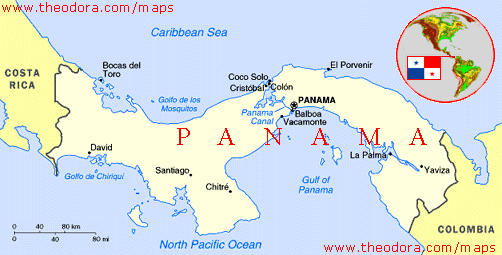
There was no visa for Panama when we touched down at Tocumen International Airport. I knew we would be tired after 19 hours of travel with an evening arrival and the airport 27km out of the centre. During my research, I found a hotel that would pick us up from the airport for free as long as we stayed two nights. It was nice to see someone holding up a sign with our names. Another couple were also being picked up. We boarded a minibus and hurtled down the road into the centre. The temperature was 27’C at 9pm. There were lots of high rise towers and shopping malls. It looked very Americanised and quite prosperous. The Hotel Marparaiso – Marparaiso Hotel gave us a decent ensuite room for $45 a night. I had arrived in country 127.
The Rough Guide said “A narrow, snake-shaped stretch of land that divides oceans and continents, Panama has long been one of the world’s greatest crossroads – far before the construction of its famous canal….it’s historical ties to the US have led to an exaggerated perception of the country as a de-facto American colony…the comparatively high level of economic development and the use of the American Dollar make it one of the more expensive countries in the region”. Footprint said “Panama is a place of great dynamism and change, fast emerging as one of Latin America’s most powerful nations.” At its most slender point less than 80km of land separates the Atlantic and Pacific Oceans. It has a population of around 3.5 million, 85% of which are Roman Catholic.
The following morning, we had one of the slowest complimentary breakfasts in history at the hotel, seemingly invisible to the staff. Even after ordering it, nothing appeared. It was as if they thought we weren’t taking it seriously. The roll and coffee was hardly worth the 20 minutes wait. We looked at the walls to see if paint was drying. While Panama has plenty of islands and forests, we only had one day to take in a couple of sights.
Panama City (pop 450,000) is a curious blend of old Spain and US-style mall developments. The Lonely Persons Guide said it was “undoubtedly the most cosmopolitan capital in Central America.” As a thriving centre for international banking and trade, it sports a skyline of shimmering glass and steel towers. Residents apparently joke that it is the ‘Miami of the South’ except that more English is spoken.
We walked ten blocks to an intersection near the Legislative Building. The guidebooks said we could get a bus to the Panama Canal from here. A local woman came up and warned us that it was a rough area. None of the buses meant anything. I spotted a policeman who spoke no English (no one did in this part of town) who intimated that we needed to go to the Albrook Mall where the major bus terminal was located.
To use a public bus in Panama City, you are supposed to have a metro card with credits on it. But we couldn’t see where you got one. The bus driver ignored my Dollar Bill and waved us through the turnstile. Which was nice. The rides were only 25 cents. We would be leaving for Costa Rica from the Albrook Mall tomorrow and took the opportunity to check on international buses. It was booked for the next two days. We would have to get to the border using a combination of buses.
At least we could buy a metro card. To get to the Panama Canal, we had to catch a ‘chicken bus’ which are old US school buses. These are heavily customised with vivid spray paintings on the outside and unique dashboard additions. The Amador Causeway marked the entrance to the canal and the Canal Zone.
Stretching eighty kilometres from Panama City in the south to Colon in the north, the Panama Canal “is a work of mesmerising brilliance. ” (Rough Guide) which cuts through the Continental Divide. One of the largest and most ambitious endeavours ever undertaken, the waterway allows massive vessels which otherwise would have to travel all the way south around Cape Horn to traverse the isthmus in less than one day. The original French attempt in the late nineteenth century was abandoned after the deaths of 22,000 workers from disease. The American attempt was completed in 1914 and until 1977, the strip of land that extended either side of the canal was de facto US territory known as the Canal Zone.
Around 14,000 vessels pass through the canal each year and around the world, ships are built with the dimension of the Panama’s Canal locks in mind which are 305m long and 33.5m wide. Ships pay according to their weight. The canal has three sets of double locks with a huge artificial lake in between. The Canal is currently being expanded with newer larger locks allowing much more container traffic.
We were dropped outside the entrance to the engineering masterpiece of the Miraflores Locks. The first locks here are the biggest in the whole canal system opening in just two minutes and guiding ships through by electric locomotives called mules. It only cost $5 to visit the observation deck, packed with tourist groups and we were fortunate to see the last ship of the morning pass through around 10.30am. Nothing else comes through until 2.30pm. It all took place in seemingly slow motion but the ship was eventually pulled free of the locks. It felt good to see a world famous sight so early in our trip.
Back at the entrance, we caught a chicken bus back to Albrook Mall and then a local bus back to the intersection. It took a while to get our bearings but we finally found a road leading to the Casco Viejo (‘Old Compound’) which occupied a narrow peninsula. It was declared an UNESCO World Heritage Site in 1997. Footprint said “Created in 1673 after the sacking of the original town, Casco Viejo is a treasure trove of architectural delights, some restored, some in a desperate state of repair but most demanding a gentle meander through the shady streets.” Which is what we did. It was 36’c and a roasting afternoon. Old colonial buildings either side of cobbled streets were painted in soft pastel colours, some ornately decorated with beautiful wrought iron railings.
It was an unusual combination of beautifully restored public buildings, churches, plazas, monuments and museums alongside inner-city decay which after decades of neglect, is now gradually being gentrified. The Plaza Cathedral (or Plaza de la Independence) sat at the heart of the old city with the classical façade of the cathedral (1796) dominating one side. The walled tip of the peninsula had the picturesque Plaza de Francia with its bright red poinciana trees and obelisk topped by a cockerel. Steps led up to the Paseo de las Bovedas promenade along the top of the defensive walls surrounding the peninsula on three sides. It was ablaze with bougainvilla.
To celebrate Trevor buying a Panama hat and to deal with the heat, we sat and sipped ice cold Balboa beers before heading to the local fish market. Here we found stalls selling Sopa de pescado (fish chowder) and ‘Ceviche’ (raw corvina or shellfish seasoned with tiny red and yellow peppers, thin slices of onion and marinated in lime juice). We opted for the latter which was served with crackers. It tasted lovely and we stopped at another stall to taste their recipe. Ironically, the word ‘Panama’ means ‘abundance of fish’. It was certainly popular late on a Saturday afternoon. After a long trudge back to the hotel, we checked out the local neighbourhood for a possible evening meal later, returned to the hotel room and both promptly fell sleep until midnight. So much for the nightlife.
We were up at 5am the next morning (Sunday Feb 26th), packed and off to catch a local bus back to the Albrook Mall. We thought that if we waited for the hotel breakfast, we would never get there. Buses to David left every hour and we were on the 7am. Enjoying the comfortable seats, we passed through the interior of mostly steep, rugged mountains and dissected upland plains through lots of forests, over rolling hills with some views of the coast. At 10.30am the bus had a breakfast stop at a large roadside cafeteria. Unsure of what the food was, I pointed at something. It was fish and rice.
The city of David (pop 125,000) appeared around 2.30pm. It is the second largest city in Panama and a major agricultural centre. We arrived at one end of the bus terminal and someone led us to the other where minibuses were heading for the Costa Rican border at Paso Canaoa. Around 4.30pm we walked out of Panama and were stamped into Costa Rica. We were already five hours behind the UK. Now we lost another hour. It was 3.20pm on a sleepy Sunday afternoon.
Our trip to Panama had been short and sweet. I get the impression from the guidebooks that there is a lot more to do in Panama if you like nature, forests and beaches. I was happy with my first impressions of the country. Using US Dollars as the currency made it nice and easy. The people seemed warm and receptive to tourists although it seemed mostly Americans making the visit when we were there. I think I’ll be back one day.