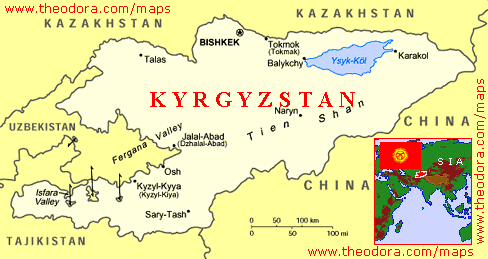
Kyrgyzstan
Kyrgyzstan
KyrgyzstanAugust 2011
Photos of Kyrgyzstan
Click here to view larger pictures
Monday August 29th (cont) Entering ‘No Man’s Land’ between the borders, it took over half an hour to cross it. It was desolate scenery with a twisting bumpy road that had been washed out in places and we were forced to drive through water and over large boulders. Monty would definitely not been able to tackle this area. To put the isolation into perspective, our driver was waved down by two of the army. Their battery was flat and their jeep was marooned off the road on some undulating grassland. We bumped over the grasslands and the driver hooked up his battery to theirs and jump started them. We climbed up and down more passes until finally spotting the Kyrgyzstan border post which looked a lot more civilised.
Our driver took our passports to a hut and climbed the stairs. He was gone for some time, during which a British motorcyclist arrived and was processed. The father in our vehicle was ordered to the hut for whatever reason and we waited an age. The driver and man returned and we drove to another hut where the passports were taken in again. There were no forms to fill in but someone did pop out to check our faces but not our backpacks. There were three dogs within the fenced compound and when they saw our driver returning to the vehicle, they gave chase. He ran and climbed in just in time as they snapped at his feet. When the British motorcyclist set off, they gave chase along the road until giving up. It was very comical to watch.
There was a generally good sealed road (with some potholes) to the first main town of Sary Tash. As we entered it, some coffin-dodger was crawling along slowly in his car in the middle of the road completely oblivious to any other traffic. Our driver overtook him, only to be pulled in at a police check just up the road and given a fine for reckless driving. Our driver, by the way, wore dark sunglasses, smoked endlessly, had a mounted mobile phone and his choice of music was Britney Spears on repeat. Consequently, he slowed down on Kyrgzstan roads afraid of more police fines.
As we climbed a pass, the sealed road gave out to a new road being built over the mountains. Under heavy recent rainfall (and it was still raining when we crossed it), the track had turned to mud. Our driver was flagged down by some old men with a stranded white van in the middle of the mud. They were asking for a tow out of the mud. He connected up a rope and attempted to reverse to pull them up and the wheels were spinning and no progress was made. Despite the yells, he gave up and we left them in the mud and rain. I was starting to think we were a mobile rescue unit, but as with our driver to Khorog, I guess people help out where they can. One day it could be you.
The scenery turned more impressive again with strangely coloured mountains that had buckled waves of reds, oranges and yellows. It was a shame that dusk was falling. We stopped for petrol but the driver only put in a certain amount. Then there was a food stop, though Trev and I waited outside because we had no local currency. Then he stopped for more petrol. He gave the impression that he didn’t want to put in anymore than necessary.
Darkness fell. We passed and narrowly avoided five sets of donkey suicide squads walking in the middle of the road and only spotted at the last second. Then we only just avoided a cow followed by locals and cyclists. Noone had lights or bright clothing. It didn’t help that our driver continued to wear his dark sunglasses, which is not the best thing to do when driving in the dark. He started to slow down unable to see anything ahead. In the end, the fat father took over the driving and our speed and quality of driving improved. He knew the road and was able to anticipate the hazards. We made good time, until the driver demanded to take the wheel again and we returned to his substandard and slow driving. He must have been exhausted because he had been driving up around since 9am and the roads were not exactly motorways. We had no idea when we would arrive or where.
Around 10pm, we arrived on the outskirts of Osh. Expecting to be taken into the centre, we were surprised when we turned off up a lane to a homestead. Someone came to meet us. He explained that the driver was not allowed to enter Osh and that we could stay here the night and enter Osh tomorrow. The driver had earlier hinted that we could stay with him but we hadn’t understood him. Obviously run by the ‘fixers’ the price was high and there was no shower. The family entered but we gave it a pass. Despite the late hour, we were only 5km from the centre and took a gamble that we would find somewhere. I had a few addresses.
The gamble paid off, when reaching the bottom of the lane and starting up the road, a plush 4-wheel drive came out of another lane and saw my thumb stuck out trying to get aride. ‘Osh?’ we asked and climbed in. A young man was driving with his mate sat in the other front seat. Their English was minimal but they were students. He was obviously just cruising around in daddy’s car. Hurtling into town, we passed a couple of hotels. I had suggested the Ata Batay Guesthouse, but the address I had was wrong. He then proceeded to spend the next 40 minutes trying to hunt the guesthouse down which was on the outskirts. He would jump out and ask someone and then someone else. When he thought he had found it, he would knock on the gates and wake the owners up and then ask them if they knew it. I wasn’t sure if he was just enjoying the experience or felt obliged to find the place come what may. After 30 minutes we had already pleaded that he just drop us in the centre and we would find somewhere, but the lad was on a mission and he finally found the place. It was locked up and very secure, but he woke up the owners and a girl who spoke some English, stood on a balcony behind a wire fence and yelled down questions, a bit surprised to have two westerners turning up unannounced outside at 11.15 pm. We were let in and given a comfortable room. We congratulated ourselves on getting to Osh and finding somewhere by having our first shower in 2 days and eating powered chicken soup.
Tuesday August 30th Kyrgyzstan was our last new country. The CIA website said that it was a Central Asian country of incredible natural beauty and proud nomadic traditions. It is landlocked; entirely mountainous, dominated by the Tien Shan range. 94% of the country is 1,000 m above sea level with an average elevation of 2,750 m with many tall peaks.
Most of Kyrgyzstan was formally annexed to Russia in 1876. The Kyrgyz staged a major revolt against the Tsarist Empire in 1916 in which almost one-sixth of the Kyrgyz population was killed. Kyrgyzstan became a Soviet republic in 1936 and achieved independence in 1991 when the USSR dissolved. Nationwide demonstrations in the spring of 2005 resulted in the ouster of a President who had run the country since 1990.
Subsequent presidential elections in July 2005 were won overwhelmingly by former prime minister Kurmanbek Bakiev who then manipulated the parliament to accrue new powers for himself. In July 2009, after months of harassment against his opponents and media critics, Bakiev won re-election in a presidential campaign that the international community deemed flawed and he was booted out in April 2010 to be replaced by President Otunbaeva who will serve as president until the end of 2011. Presidential elections are scheduled to be held in October 2011. Continuing concerns include: endemic corruption, poor interethnic relations, and terrorism.
The nice Guesthouse helped, but we had already decided to spend our remaining spare day in Osh. With a population of 300,000, it is Kyrgyzstan’s second biggest city and “the administrative centre of the huge populous province that engulfs the Fergana Valley on the Kyrgyzstan side…Osh suffers a kind of demographic schizophrenia with Uzbeks making up 40% of its population who are more drawn to. Uzbekistan and the rest of the Fergana Valley, but isolated from it by one of the world’s more absurd international borders” (Lonely Person’s Guide). It is a very old city and must have been a major hub on the Silk Road from its earliest days, and smashed by the Mongols in the 13th century. One of the reasons for us to stay was the Jayma Bazaar, one of Central Asia’s best markets.
After a nice breakfast talking to a couple of Swiss electronic engineers over here on a project (one of which headed for the toilet quickly with stomach problems. Join the club). There was a long walk into town from the guesthouse, probably a couple of miles, but we had all day. A van was pulled up full of freshly baked loaves in the back while some were being delivered to restaurants. The town was waking up. Like Tajikistan, there were lots of 20th Anniversary of Independence posters and the monuments were adorned in colourful flags.
We walked into a bank to get some local currency. The security guard sat us down and chatted to us in English, taking the opportunity to practice his language skills. He asked someone to fetch us coffee. It never arrived and he apologised.
The Jayma Bazaar was immense, sprawled over a couple of major streets and then behind them on alleyways of stalls. It was teeming with everything you might need. My photos give a brief snapshot of biscuits/sweets, an array of fruit and vegetables, dried fruit and nuts, all parts of every animal including severed goat heads and cow feet, DVDs, clothing etc. We were more interested in the traditional clothing/souvenir section and eventually found it. It was so cheap, I wanted to buy everything but was aware of the fact that it all had to be carried in my backpack. In the end, I settled on a black gown, silly felt hats and colourful cushion covers. The whole market was a full of bustling activity and it was nice to just explore it with no-one dragging you in to a stall to try and sell you something. I hate shopping but this was a relaxing experience.
Outside the market we lunch (a rare occurrence for us) at a busy restaurant which was some kind of tasty Chinese stir fry beef/chicken/mushroom dish – by copying a local diner. We found an internet café for a quick check/update and also checked up on where our minibuses would leave for Bishkek tomorrow.
We discovered a park where there was a ‘fair’ to celebrate the 20th Anniversary. I discovered later that it was also the end of Eid. Families were getting their photos taken in front of phoney scenery, pot plants and flags. There were old men playing chess with their tall hats. An old Yak-40 aeroplane had been parked permanently as a monument which is not something you see in every town. It looked a little battered.
Solomon’s Throne was a jagged, barren rock that seemed to dominate Osh. Apparently it is a Muslim place of pilgrimage. To be honest we were more interested in stumbling across a small supermarket nearby that sold lots of beer including ‘Old Bobby’. Loaded up with a variety of beer and snacks, it was a long walk home. We seemed to have 400 channels of shit on our TV but with enough beer, it didn’t matter. We had enjoyed our day off in Osh immensely.
Wednesday August 31st I had previously asked our hosts about booking a taxi down to the ‘shared taxi area’. We got up at 5am, packed and our taxi arrived at 6am. When we got to the taxi area where we had checked prices with yesterday, they wanted more and it was a 9am departure. Leaving them screaming at me, I walked up the road to find another shared taxi (obviously rival companies) which was cheaper with an 8am estimated time of departure. We climbed aboard and waited for other passengers. It didn’t happen. We waited in a side area while watching locals push horrendously over-weighed trolleys of goods into the market area. Some were very old people and it was humbling to see them have such a hard life. While we waited I found some battered food specimens for breakfast.
Our driver eventually took us to pick someone up on the outskirts. On the way back along the main road, he was severely cut up by a driver and took chase. They drove crazily in amongst the traffic and both eventually pulled up at the place where we had been sitting. The other driver was his mate who was an Asian lookalike of the old comedian Frank Carson. We wondered what the rest of the journey would be like.
The Lonely Person guide said “from the standpoint of landscape, the Bishkek-Osh road is a sequence of superlatives, taking the traveller over two 3000m-plus passes, through the yawning Suusamyr Valley, around the immense Toktogul reservoir, down the deep Naryn River gorge and into the broad Fergana Valley.” We would do these sights in reverse.
By 9.30am, we finally had a full minibus. All the passengers were women except for a young man with a bandage around the bottom half of his face. He obviously had had a bad accident and scraped a lot of skin off his face. We nicknamed him ‘Jaw-Boy”. Outside Osh, the driver put his foot down and hammered it along a flat road dodging men on horses and walking who were herding hundreds of sheep down the centre of the road. It was lovely rural scenery, typical of the Fergana Valley with horses, herds of cattle, goats and locals on carts being pulled by donkeys and house roofs stacked with hay. We passed through small towns and the occasional police radar trap and then through Ozgon 55km north of Osh. Each town would have an imposing town sign on its outskirts.
The strange international border with Uzbekistan cut across the major route north, so to avoid having to cross immigration posts, everyone went via Jalal-Abad. This had been a concern for us before reaching Osh. We were not sure if we could get around Uzbekistan because we didn’t have another visa entry. Around 11.30am, just before Jalal-Abad, we had an early lunch. We all sat at outside tables. There was no menu and the driver asked us what we wanted. With no menu, we didn’t know. So he got up, walked to another table, picked up someone’s food and bought it over to show us, which was novel. It looked good so we ended up with a kebab, some beef and boiled potatoes. Our driver’s meal consisted of a huge slab of pork on top of a pile of noodles. To get to the rather ‘smelly’ toilets at the back, I had to walk past the dark open kitchens. Let’s just say that they were busy and working in trying conditions. Outside the restaurant, someone had started a wooden BBQ to cook kebabs and the smoke was drifting everywhere, including into the restaurant.
Jalal-Abad with a population of around 74,000 is Kyrgyzstan’s third largest city, but you wouldn’t know it. We passed by a busy market area with a decorative mosque and kept going. Ironically, in 2008, it was at the Uzbek border attempting to reach Jalal-Abad, that we had been turned away because our visa had expired and deportation procedures started the next day at Andijan. Now 3 years later, we had finally got to the other side.
After we had skirted the border, the excellent sealed road (one of the best on our entire trip) reached the coal mining town of Tash Komur which was strung out for miles along the west side of the Nayrn River below a dam. We followed miles and miles of scenic sky blue lakes/reservoirs. The gorge of the lower Nayrn River was an impressive passage, with sheer walls and towering pillars of red sandstone and our little road clinging to the side. You will see a never-ending series of scenic photos on this webpage. Sat in the front seat, I shot so many photos today that I burnt out one camera battery and resorted to my back up camera. The trouble is that I still don’t think they capture the absolute beauty of this entire region. The water was still enough to allow reflections of the landscape on it.
Before Kara-Kol, there was a hold up. We were parked behind a truck, but could see a crushed burnt out car further up on the other side of a road. There had been a very bad car accident involving two vehicles. The delay was while the dead bodies were being pulled from the cars and lifted onto a flatbed truck. As we eventually left the scene, we saw a bloody corpse being laid on the truck and screaming/crying from someone. Rubber necking at the state of the two cars, I don’t think anyone would have survived that crash.
Kara-Kol (22,000) was based by an impressive 1976 Soviet dam which took 14 years of construction. It is 210m high, 150m wide at the top and holding back around a 199 billion cubic metre lake. It is part of the Nizhnenarynskiy Kaskad, a series of five dams down the lower gorge of the Naryn River. We stopped for a break here, maybe for our driver to reflect the speed he had been driving all day but he was one of the best we had. The next town of Toktogul (70,000) also sat next to a reservoir.
We climbed up to the 3184m summit of the Ala-Bel pass over the Suusamyr –Tau mountains to a plateaux which had a very straight road across the Suusamyr Basin. This was classic Kyrgyz yurt country settled by nomads with their white gers and old blue painted railroad carriages on wheels, thousands of horses and sheep grazing and lots of roadside stands offering honey, sunflower oil, fresh cheese balls (kymys) and other daily products. The scenery was stunning with the plateaux surrounded by steep sided snow capped mountains under a vivid blue sky and fluffy white clouds. This was certainly one of the most impressive scenic areas of our entire trip.
From the Suusamyr Basin, we climbed up a second twisting road with a panoramic view of snow capped mountains reflected in a lake. It took us up to the highest point of the journey, the 3586m Tor-Ashuu Pass where the craggy Kyrgyz Alatau range and Talas Alatau meet. The road burrowed through a series of Soviet built dipping tunnels and descended through a crumbling canyon. The driver went flat out down this road, stopping only for a toll booth and a police checkpoint.
The last 100km was through the flat and agricultural Chuy valley. We turned right at Kara Balta, crossing a river and headed for the capital, Bishkek. The traffic thickened which was strange after having almost empty roads for most of the day. Police radar traps increased in frequency. Population meant police. It was still light at 7.30pm as we approached the outskirts where herds of cows were crossing the main road.
One of our female passengers spoke a little English and asked us where we were staying. I had
pencilled in the Radisson Guesthouse. Our driver had been convinced by other passengers to get dropped in town rather than at a transport hub and the woman said that she was getting out near our guesthouse. We ended up getting dropped only 4 blocks away. It was dark by now, but we found the small road and the guesthouse which was behind a tall locked gate. The owner’s son was outside and let us in.
We were lucky because there was one room left. The Guesthouse had good reports for its spotless, efficient setup, but our room/cabin had no power to the TV and the beds were, let’s just say ‘springy and squeaky’. Still, it was cheap, clean and it was only for one night. A sign in the room said ‘No alcohol allowed.’ In their dreams. We went walkabout and on the way home, we found a shop and bought a variety of bottled beers that were smuggled in and consumed. We had reached Bishkek and were nearing the end of our road trip.
Thursday September 1st Ignoring the pile of empty beer bottles, we stepped out for breakfast in the Guesthouse where we met a friendly French couple who were cycling around. They had tried to cross a border which was closed, lost 4 days in the process and had returned to Bishkek. Now they were having to plan another route and asked us about our journey yesterday. While we thoroughly recommended the journey on the plateaux which would be perfect for cycling, they were concerned about getting their bikes up to the pass and through the tunnel. At the other end, they would have to get back to Bishkek. With two bikes, they would probably have to rent a taxi by themselves. Leaving them to it, we had a morning to explore Bishkek before heading for Almaty in Kazakhstan.
Bishkek has around a 900,000 population and I’ll admit that the Lonely Person’s Guide was pretty accurate when it wrote ”Bishkek feels green – but its not because of the trees. Green because it is young, wet-behind the ears, racing to grow up and unsure of what it wants to become.”… “A cosmopolitan capital? It needs a heap more money for that. A dignified Silk Road legacy? Bishkek needs a tad more history.”
We took a stroll around the major sights. It was a very colourful city for a couple of reasons. In late summer, all the public gardens were full of flowers. I’m not sure if it was timed for the 20th Anniversary of Independence celebrations or whether they are always here. The first place we passed was the Philharmonic Concert Hall. The strange concrete building design with large statues outside, was complimented by the lines of flowers. Secondly, the 20th Anniversary celebrations were an excuse to cover some of the buildings in huge drapes and the colours of the national flag all over the place.
On the main strip, Chuy Prospektisi, we passed the Parliament Building (the ‘White House’), a typically important Communist structure with the official seal sat behind a fancy fence. The President is also based here. There was a small protest going on and some placards had been tied to the fence. A policeman was faithfully walking along and copying every message down into a notebook. He could have used the camera on his mobile phone. He forbade us to photos of these signs but further along, I did anyway with one of him recording them.
As we approached Ala-Too Square, there was a facade that had massive ‘20th Anniversary’ posters. Ala-Too Square is a sea of concrete that was originally Lenin Square until 1991. His statue has been replaced by the historical hero Erkindik (Freedom). There is also a massive Kyrgyz flag on a tall metal mast, guarded over (under?) by two soldiers who stand to attention in their kiosks, wearing their comically oversized hats. The flag is lowered every day at dusk. Behind the Flag and Statue was the State Historical Museum which we would return to later. The endless colourful flowerbeds and rows of red and blue flags, eroded the feeling of stark concrete around the square that was split by the main road. The actual anniversary was 31st August (yesterday), but there were still special backdrops/flower memorials where families could have their photos taken.
At one square with a statue surrounded by flower beds, we were approached by a teenage girl and her instructor. She was a ‘Jehovah Witness’ and was being trained to spread the word. We must have looked like easy targets. We politely listened, nodded, made our excuses and fled while the trainer took her back to the seat for a de-brief. She probably said ‘They look like drunks. They are probably irredeemable.” I had been dying to say “I’m Jehovah. How are we doing?” Nearby was the Victory Square with an immense yurt shaped World War Two monument, erected on the 40th anniversary of the end of the war, complete with an eternal flame. It was certainly unique.
Entering a department store, we found a ‘souvenir’ section on the 5th floor. Apart from the Osh market, these were the only souvenirs we saw on the entire trip. There were even postcards, so we got some, and tracked down the central post office nearby – another strange concreted design with a giant clock tower. In the huge lobby, you did not buy stamps at a counter, but went to a kiosk where a woman distributed them. We quickly wrote them and posted them, there and then.
The ambiance of Bishkek was very relaxed. It was well laid out in blocks with wide roads and a fair amount of traffic. No one bothered us, we saw no beggars and a street café culture was slowly evolving. The one thing to say about this city was that the women were absolutely stunning. They seemed to be halfway between western and Asian, so they were tall and slim with western hairstyles and clothes. If I was a younger man, I would have stayed here!
Our final stop was the State Historical Museum. The front of this large box shaped building was completely covered in a huge anniversary drape with a massive photo of a line of children running towards you. Which was nice. Inside, the building was quite unique with a wide marble staircase at the ground floor, splitting into sections on the second and third floors. The whole interior seemed to be marble with some exhibits having loads of space and others crammed into small areas. The best thing was the ceiling murals on the 2nd and 3rd floors which were painted as a shrine to Lenin and the Revolution. Former US President Ronald Reagan was immortalised wearing a skull, sitting astride a missile and grinning wildly. Nazi Germany is depicted as a rampaging bear while (Mother) Russia is a beautiful woman clutching a white dove. The murals were brilliant and one of the best things in Bishkek. I took a lot of photos of these, so check them out on this web page.
There was also a pretty extreme exhibition of violent protests that had taken place last year in 2010, where some protestors against the President had been killed. The exhibition did not fuck around. There were photos of the person alive and another of them dead. Sometimes their clothes were displayed complete with bloodstains. It was one of the most powerful exhibits I had seen with no holes barred and ironically it had taken place less than a kilometre from the museum. It was almost as if the museum was saying to the Parliament Building just down the road “Don’t mess around with us. We’re watching”.
Kyrgyzstan Roadkill: Human car crash, dog
Photos of Kazahzstan Part 2/Almaty
Click here to view larger pictures
Travel - £44.87
Accommodation - £85.75(3 nights)
Food - £26.46
Other - £0.63 (excludes all the souvenirs, postcards/stamps
Total - £157.71
Travel - £0.42p
Accommodation - £27.24(1 night)
Food - £25.76
Other - £0
Total - £53.42