 Guatemala
Guatemala
GuatemalaFebruary 2014
Guatemala Photos
Click here to enlarge the photos
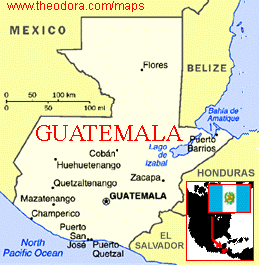
Guatemala was our final country on this trip. We had originally thought of heading to Belize first, but from Copan, it was a pretty convoluted route involving buses and ferries and with our few remaining days, there was no guarantee that we would get back to Guatemala to see anything. Having visited Belize before, I convinced Trev that Guatemala had a lot more to offer us.
Around five hours after leaving Copan Ruinas, we approached the large nondescript capital city of Guatemala city. We were dropped by the side of a motorway at a taxi rank and someone organised a taxi to take us to the Linea Dorada bus terminal where we booked an overnight bus to Flores. I felt that the Mayan ruins of Tikal should not be missed but they were about ten hours north east of Guatemala City. To get there and back in our limited time, we’d need two overnight journeys.
Surrounded on three sides by jagged hills and volcanic cones, Guatemala City itself had nothing to offer us. The largest city in Central America (3 million population) was according to the Rough Guide “a shapeless and swelling metropolitan mass” while the Lonely Persons Guide said it was “big, dirty, dangerous and utterly forgettable.” I had been through it twice back in 1995 and I had to agree with the guidebooks.
We had a really comfortable overnight bus with reclining seats, leg room and air conditioning for the nine hour journey. A small hot dog and bottled water was offered as a snack. We got off the bus rather dozily at 6am on Friday February 7th. We were on the island of Flores and it was only just daylight. Flores had a reputation for ‘Coyotes.’ These were touts who organised shuttle bus tickets to Tikal and buses to Guatemala City. Feeling a bit disorientated, we sorted out a return journey to Tikel as well as a return night trip to Guatemala City and onto Antigua for our final night.
The CIA website says of Guatemala which is a little larger than England “ The Maya civilization flourished in Guatemala and surrounding regions during the first millennium A.D. After almost three centuries as a Spanish colony, Guatemala won its independence in 1821. During the second half of the 20th century, it experienced a variety of military and civilian governments, as well as a 36-year guerilla war. In 1996, the government signed a peace agreement formally ending the internal conflict, which had left more than 200,000 people dead and had created, by some estimates, about 1 million refugees.
Guatemala is a predominantly poor country that struggles in several areas of health and development, including infant, child, and maternal mortality, malnutrition, literacy, and contraceptive awareness and use. The country's large indigenous population is disproportionately affected. Guatemala is the most populous country in Central America and has the highest fertility rate in Latin America. It also has the highest population growth rate in Latin America, which is likely to continue because of its large reproductive-age population and high birth rate. Almost half of Guatemala's population is under age 19, making it the youngest population in Latin America. The ethic mix is around 60% Mestizo (mixed Amerindian-Spanish - in local Spanish called Ladino) and European. Spanish is the official language for 60% and Amerindian languages make up the other 40%. Guatemalans have a history of emigrating legally and illegally to Mexico, the United States, and Canada because of a lack of economic opportunity, political instability, and natural disasters.
More than half the 15 million population of this Constitutional Democratic Republic live below the poverty line. Average income is around $5,500. Agricultural products include: Agriculture: sugar cane, corn, bananas, coffee, beans, cardamom; cattle, sheep, pigs, and chickens. Industries include Industry: sugar, textiles and clothing, furniture, chemicals, petroleum, metals, rubber and tourists.” (Info taken from CIA website)
Our shuttle bus arrived with a smiling middle aged driver. We had to hang around while the tout rounded up other passengers. Then we drove around the small town to pick them up, use an ATM, and pick up a few supplies.
Eventually we set off for the 550sq metre Parque Nacional Tikal which was about an hour away. After paying an admission charge we dropped at the car park. From here it was a short walk up a lane to the Jungle Lodge. There are only a couple of hotels in the park and this was supposedly the best one. It was made up of self-contained bungalows though we got the cheapest option sharing the communal bathrooms. The place seemed half empty at this time of the year and we usually had the bathroom to ourselves. It was already hot and humid as we set off past the security guards to explore this world famous sight.
The Footprint Guidebook said “With its Maya skyscrapers pushing up through the jungle canopy, Tikal will have you transfixed.” The Maya settled here in 700BC and the site was gradually developed. By 250AD the ‘early Classic’ period, Tikal had become an important, heavily populated religious, cultural and commercial city. By middle of the ‘Classic period’ mid 6th Century, Tikal sprawled over (estimates vary) from 16 to 30 sq km, more than 4000 structures and contained maybe up to 100,000 people. Tikal’s greatness waned around 900. It had rulers such as King Great Jaguar Paw, Lord Water and Lord Chocolate. It disappeared beneath the jungle to be rediscovered in 1848.
The most striking feature of Tikal is its six giant temples. These are steep-sided pyramids that rise up to heights of 64m from the forest floor. They were built to commemorate the powerful rulers and the towering pyramids poke above the jungle’s green canopy to catch the sun. It is different from Copan because it is deep in the jungle. Its many plazas have been cleared of trees and vines and its temples uncovered and partially restored. The Rough Guide concluded that “The sheer scale of the place is astounding and its jungle location spellbinding.”
I was amazed by the place when I first visited it in 1995 and it did not disappoint me this time. My report just summarises the major sites that we saw. The photos tell more more than any description could. The Great Plaza stood at the heart of the ancient city. Surrounded by four massive structures, this was the focus of ceremonial and religious activity at Tikal for around a thousand years. At one end was Temple 1 (Temple of the Grand Jaguar) standing at 44m high. The staircase to the top was now closed (after two tourists fell to their death). I had climbed it on my earlier visit. Temple II (Temple of the Masks) at a height of 38m stood opposite. I had climbed the main staircase to this as well. But now a new wooden structure had been built behind the temple to allow you to ascend it. The view from here around the Great Plaza was stunning. The other two sides of the Plaza were the North Acropolis which by 800AD had 12 temples on top of a vast platform and the Central Acropolis which was a maze of courtyards, small rooms and temples. The Mayans were always rebuilding on top of older structures and these two acropolises were a result of centuries of restructuring.
Temple III was 60m high and still covered in jungle vegetation. You couldn’t climb this but Temple IV at 64m was the tallest of all the Tikal structures, built in 741AD, and there was a wooden staircase up to it’s summit from where we had stupendous views over an ocean of rain forest and the roofs of the great temples piercing the canopy. Temple V, built 800AD was 58m high but again off limits.
El Mundo Perdido or ‘The Lost World’ was a complex of 38 structures surrounding a Great Pyramid (32m). This very distinct section of the site had its own atmosphere and architecture. It was originally built as an observatory. It was here that we spotted Howler monkeys. These are really loud monkeys who call out to the opposite sex with a gruff loud pitched bark that echoes around the forest. We had heard them in various places but they often remained elusive. We also saw quieter spider monkeys.
We spent five hours on the first day exploring the complex. It was relatively quiet with occasional small tour parties but away from the Great Plaza, we often didn’t see anyone. There are so many places to explore, the delight of Tikal is just wandering along the paths and seeing what you stumble across. Just walking around the jungle and listening to the wildlife is a lovely experience. Unmissable.
Back at the hotel, we walked out to the small restaurants to check out potential eating places (our hotel restaurant was beyond our means). We had a beer and the inflated price suggested that we wait until we left Tikal to buy any more! The hotel had a small swimming pool which I partook trying to ignore the loud American conversations. In the evening we went to an outside restaurant for Mexican chicken. We could hear the generator humming in the background to provide electricity. With nothing to do in the evening, we were asleep by 9pm grateful for a bed after the bus ride last night.
On my first visit to Tikal I had got up early to watch the sunrise from a pyramid (this was when there was no security). This morning, I got up at 6am and went for a stealth mission into the park. I was convinced that we could get into the park free through the jungle at the back of our hotel complex. But my first attempt took me the wrong way to the car park. A second attempt through thick forest led me to an wooden shack used by Park staff. No one was there and a track from there led me to other tracks that linked into the main one. I was in. There was no one about and when I reached the Great Plaza, it was empty and covered in early morning mist. In the silence, I could hear howler monkeys grunting away. Occasional small mammals would run out in front of me.
I returned back to Trev in the room. We packed most of our stuff and then followed my secret route and entered the park. There were a couple of tour groups. Once inside the park, everyone assumed that you had shown your tickets at the security check and no-one bothered you. We concentrated on the Northern Circuit of structures which we hadn’t done yesterday as well as revisiting all the major sights. We saw a toucan, frog and spider monkeys. Climbing Temple IV again, we waited for the few tourists to leave and then sat up there with the temple to ourselves for 10 minutes and the best view in the park over the jungle with the temple tops poking through. It was a fine way to remember Tikal.
We had to sneak back into the hotel through the jungle and my secret route. After a shower, we checked out and walked to the car park to find a shuttle bus back to Flores. Our Coyote ticket was valid. Back in Flores around 2pm, we found a sleepy town dying from the heat. With a population of just 30,600 Flores is spectacularly located on an island in the Lago de Peten Itza. A 500 metre causeway links Flores to the lakeshore town of Santa Elena. It had an easy pace and old world atmosphere. Many people were sat by the lake just trying to stay cool. Boats offered to take us for a tour of the lake but we were happy to just sit and look. We wandered the narrow streets and ended up having a chicken burrito and some ice cold beer. It looked like a nice place to stay but we had to get back to Guatemala City.
We had originally booked an 8pm bus, but rather than wait five hours, we decided to walk across the causeway and into Santa Elena to the bus terminal. It was about a mile away. We were able to change our bus to 6pm and sat in a dingy waiting room, drinking beer while the rain poured down outside in a thunderstorm which had resulted from all that heat we had felt in Flores. I don’t have much recollection of the 10 hour bus journey. The bus wasn’t so comfortable, we stopped to pick passengers up and there was a meal stop somewhere.
On Sun February 9th at 4am we arrived at the Fuerte del Northe Bus Terminal 1 in Guatemala City. The guide books all said that this was a bad area and that you should only travel at night in a taxi. Since it was still dark, we had no choice but to hole up. A lone TV was playing some crappy American TV sitcom. A coffee stall set up outside. There were taxi drivers but we had a shuttle bus ticket to Antigua though we were not sure where from.
As the sun rose, a bus pulled into the terminal around 5.30am. A shuttle bus also rolled up nearly full. When I showed the driver our tickets, he told us to get in and we eventually headed for our final destination of Antigua about an hour outside the capital. I had also been to Antigua in 1995 and I thought the town was a lovely place to stay. Since we had a plane flight back to Panama City from Guatemala City tomorrow afternoon, it seemed the perfect place to stay on our final night.
As we walked towards the market area, a hotel tout approached us and gave us a leaflet for a hotel. We had another in mind, but it was still locked up for the night. While we debated what to do, we saw a bakery across the road and had a coffee and pasty for breakfast. Then we saw the tout again and he led us to the hotel and left. It was only 2 blocks south of the Central market but there were no rooms available yet. So we left our bags and went exploring.
Antigua is Guatemala’s tourism show piece. With a population of around 58,000 the Lonely Person’s Guide said it was “a place of rare beauty and major historical significance and vibrant culture, it is the country’s one must-visit destination.” It served as the Spanish colonial capital from 1543 until 1776 three years after it was destroyed by a 1773 earthquake. The capital then moved up the road to Guatemala City. Antigua boasts an astonishing catalogue of colonial relics in a magnificent setting. It overflows with colonial architecture and fine churches on streets that are linked by squat houses, painted in ochre shades and topped with terracotta tiles. The town is surrounded by three volcanoes: Agua (3766m), Fuego (3763m) and Acatenango (3976m). It has long been designated an UNESCO World Heritage Site. Some structures are fully renovated while others have been left with colourful sprays of bougainvillea sprouting from the crumbling ruins.
The joy of Antigua is just walking along the cobbled streets and discovering what is around the next corner. Some of the more famous sights are around Parque Central with it’s trees and Fuente de Las Sirenas fountain and which is a gathering place for locals and tourists. It is surrounded by attractive low lying buildings including the Palacio de los Capitanes General, one of oldest (1558) buildings in Antigua and the Palacio del Ayuntamiento, or Town Hall (1743) whose walls are more than a metre thick and which has a double level arcaded façade. This now houses two museums. The whitewashed Catedral de Santiago (started 1542 finished 1670, destroyed by earthquake in 1773, rebuilt 1820) also stood on one side of Parque Central. It is quite spartan inside because it lost all its treasures in the earthquake. Some of the fallen masonry from the earthquake lies behind the present structure.
Another public area, Parque Union is flanked on both ends by a church. San Pedro (1680) and Santa Clara with an ornate façade. There was a washhouse in front of Santa Clara where women gathered to scrub, rinse and gossip. The Iglesia Y Convento de Nuestra senora de la Merced is Antigua’s most striking colonial church (1548-1717). Outside one church we saw a fat priest in a brown robe blessing vehicles with holy water. I’d never seen a 4 wheel pick up truck get baptised before. We also checked out the Mercado (market) including the Artisans Market nearby. Now that we were flying home, we could start buying souvenirs. I bought a couple of hammocks and some hanging clay bells. Trev bought a machete.
A popular trip from Antigua is to climb the Volcan Pacaya (2552m). This volcano has erupted twenty times since 1565 but from the mid 1960s it has been continuously active. The cone is now split in two since the most recent eruption in 2010. With an afternoon to spare, we decided to join a trip which picked us up from our hotel around 2pm. We were a bit shocked to hear the driver tell us that no open cans of beer or food were allowed in the minibus as we stood there with an open can of beer in our hand and we had to down it in one.
It was almost an hour’s drive to a small hamlet where we paid an admission charge and fended off offers of walking sticks from small children and horse back rides up the volcano. About twenty of us set off with a guide. Not that you needed one to follow a dusty path up the volcano but that’s how the economy survives.
The group set off at a decent pace and Trev found the going tough. It was a long slog up a dusty trail through some sparse forest. Every ten minutes or so, the guide would stop the group and let everyone catch up, though those at the back got no rest. Someone followed with a horse looking for a drop out. They got one eventually. Trev was struggling to catch his breath at one point and debating whether to go on. He had lost his sense of humour. Always a bad sign. We slowed down and kept going regardless of how far ahead everyone was.
After an hour or so, we reached an area covered in black basaltic rock. Shallow tunnels had formed, creating natural open air saunas though we only saw small fissures or steam holes with the steam vaporizing. It was cold up there with the cloud whispering around in the wind. The guide cooked some marshmallows and let the group take photos at various points. I suppose we spent an hour up there. But Trev and me were the only ones to have bought beer with us! We congratulated ourselves on getting to the top (well not the exact summit but as close as we were allowed). It was a good sight to end our trip on, though it wasn't as spectacular as the live Nicaraguan volcano we had seen.
Returning down the dusty trail, back to the tree line, the light was fading but we reached the shuttle bus before dark. Everyone seemed to have gone apart from us. Back in Antigua, we were dropped off at the hotel, showered and ventured out for our final meal. We looked for a steak out that someone had recommended. It was upmarket with waiters in tuxedos. There was no glass in the windows and we looked out at the street through open holes. But it was a pleasant evening and not exactly cold. We feasted on huge expensive steaks, French fries & guacamole. Washed down by beer. The £48 meal was as much a celebration that we had succeeded in cracking Central America and had achieved all our goals. Back at the hotel room, we had supermarket wine to drink and both passed out on top of our beds.
The final day, Monday February 10th meant we had to pack properly for the flights home. We went for a last wander around the streets and bought our last souvenirs from the market place. We had arranged for an 11.20am shuttle bus to take us to the airport outside Guatemala City which took less than an hour. I had pre-booked flights to Panama City back in the UK with Copa Airlines. When we had checked in, we realised that we had been upgraded to Club Class. Result! This didn't happen often. But we only had an hour to get beer and snacks down our throats and read newspapers in the VIP lounge before the flight was called. What surprised us was that I was wearing a T-shirt and shorts so I was hardly dressed for the part.
We took off at 2.05pm. On board we were given drinks, nuts and a shrimp lunch. It was an excellent experience and we landed at Panama City airport at 5pm. We then had to hang around drinking beer, catching up with diaries and reading until our Air France flight left at 10pm. I had a film fest on the overnight flight watching 'Captain Miller', 'The Fifth Estate' 'Rush' and gave up on 'Gravity'. We arrived in Paris 1300 local time on Tuesday February 11th, and waited an hour for our 1425 Flybe flight to Birmingham. The trip was over.
I'd really recommend a trip like this. Each country is different and you can have a range of experiences. Most backpackers we met were just visiting a couple of countries but we liked the momentum of travelling though a variety of places. Obviously it was just a recce trip and I'd love to spend more time in each country. But until I have the time, the trip will have to suffice in giving me an idea of what Central America is like. My account concentrated on the countries I hadn't been to. So Honduras and Guatemala don't have much depth to them. Personally, I think Nicaragua is the up and coming country to visit. Costa Rica is definitely the safest and most well established (based on the number of female tourists) and Guatemala has also been popular for ages. El Salvador hasn't really got started.